

15 Cooperative Effects in Plasmonics
553
(a)
(b)
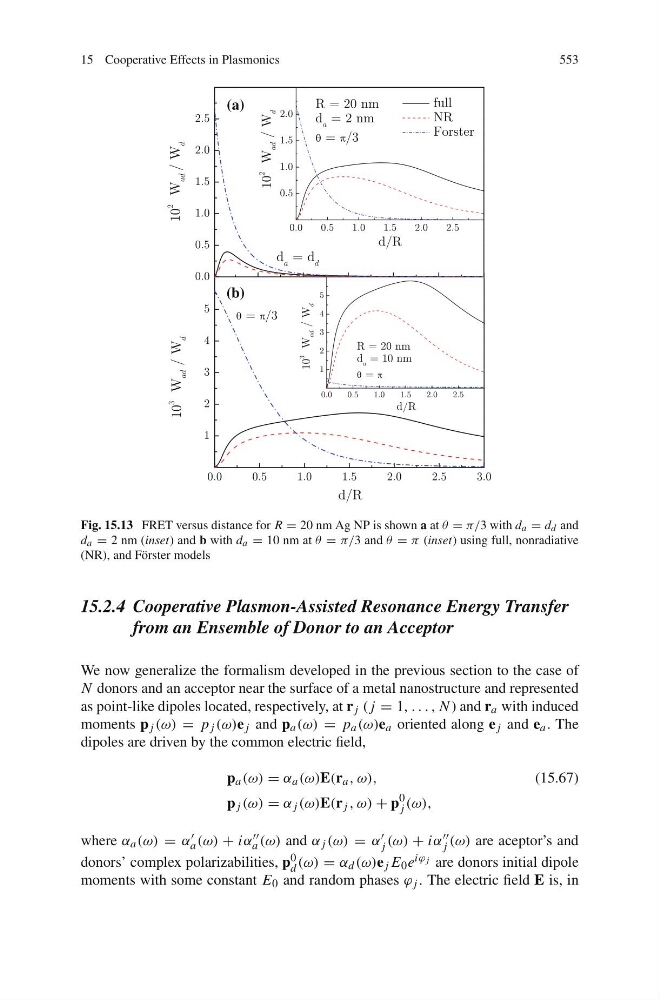
Fig. 15.13 FRET versus distance for R = 20 nm Ag NP is shown a at θ = π/3 with d a = d d and
d a = 2 nm (inset) and b with d a = 10 nm at θ = π/3 and θ = π (inset) using full, nonradiative
(NR), and Förster models
15.2.4 Cooperative Plasmon-Assisted Resonance Energy Transfer
from an Ensemble of Donor to an Acceptor
We now generalize the formalism developed in the previous section to the case of
N donors and an acceptor near the surface of a metal nanostructure and represented
as point-like dipoles located, respectively, at r j ( j = 1, . . . , N ) and r a with induced
moments p j (ω) = p j (ω)e j and p a (ω) = p a (ω)e a oriented along e j and e a . The
dipoles are driven by the common electric field,
p a (ω) = α a (ω)E(r a , ω),
(15.67)
p j (ω) = α j (ω)E(r j , ω) + p
0
j (ω),
where α a (ω) = α √
a (ω) + iα √√
a (ω) and α j (ω) = α √
j (ω) + iα √√
j (ω) are aceptor’s and
donors’ complex polarizabilities, p 0
d (ω) = α d (ω)e j E 0 e iϕ j are donors initial dipole
moments with some constant E 0 and random phases ϕ j . The electric field E is, in
553
(a)
(b)
Fig. 15.13 FRET versus distance for R = 20 nm Ag NP is shown a at θ = π/3 with d a = d d and
d a = 2 nm (inset) and b with d a = 10 nm at θ = π/3 and θ = π (inset) using full, nonradiative
(NR), and Förster models
15.2.4 Cooperative Plasmon-Assisted Resonance Energy Transfer
from an Ensemble of Donor to an Acceptor
We now generalize the formalism developed in the previous section to the case of
N donors and an acceptor near the surface of a metal nanostructure and represented
as point-like dipoles located, respectively, at r j ( j = 1, . . . , N ) and r a with induced
moments p j (ω) = p j (ω)e j and p a (ω) = p a (ω)e a oriented along e j and e a . The
dipoles are driven by the common electric field,
p a (ω) = α a (ω)E(r a , ω),
(15.67)
p j (ω) = α j (ω)E(r j , ω) + p
0
j (ω),
where α a (ω) = α √
a (ω) + iα √√
a (ω) and α j (ω) = α √
j (ω) + iα √√
j (ω) are aceptor’s and
donors’ complex polarizabilities, p 0
d (ω) = α d (ω)e j E 0 e iϕ j are donors initial dipole
moments with some constant E 0 and random phases ϕ j . The electric field E is, in