

552
V. N. Pustovit and T. V. Shahbazyan
(a)
(b)
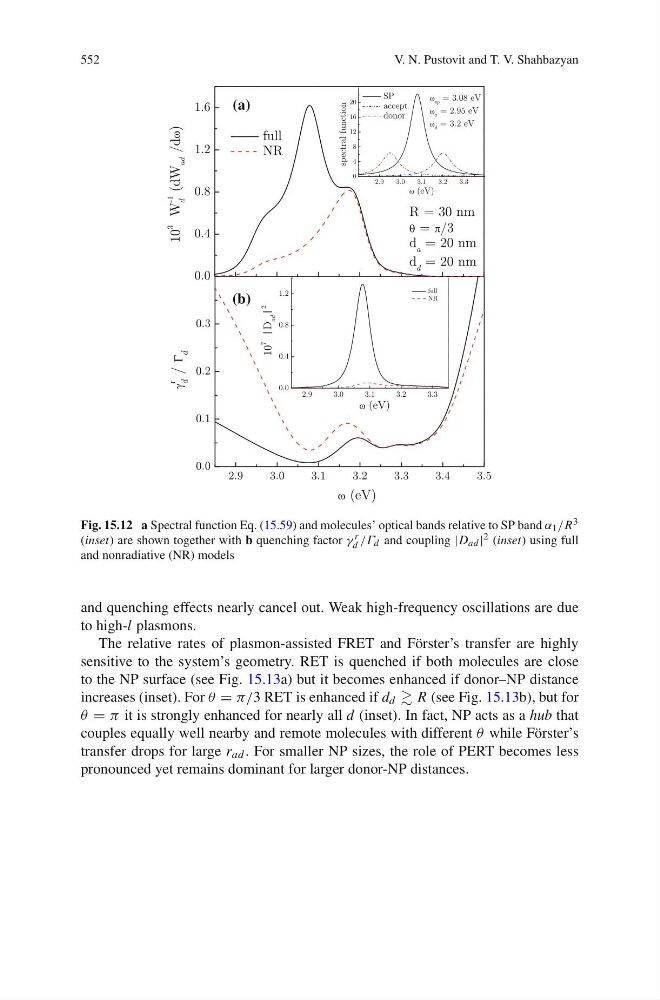
Fig. 15.12 a Spectral function Eq. (15.59) and molecules’ optical bands relative to SP band α 1 /R 3
(inset) are shown together with b quenching factor γ r
d /Γ d and coupling |D ad | 2 (inset) using full
and nonradiative (NR) models
and quenching effects nearly cancel out. Weak high-frequency oscillations are due
to high-l plasmons.
The relative rates of plasmon-assisted FRET and Förster’s transfer are highly
sensitive to the system’s geometry. RET is quenched if both molecules are close
to the NP surface (see Fig. 15.13a) but it becomes enhanced if donor–NP distance
increases (inset). For θ = π/3 RET is enhanced if d d R (see Fig. 15.13b), but for
θ = π it is strongly enhanced for nearly all d (inset). In fact, NP acts as a hub that
couples equally well nearby and remote molecules with different θ while Förster’s
transfer drops for large r ad . For smaller NP sizes, the role of PERT becomes less
pronounced yet remains dominant for larger donor-NP distances.
V. N. Pustovit and T. V. Shahbazyan
(a)
(b)
Fig. 15.12 a Spectral function Eq. (15.59) and molecules’ optical bands relative to SP band α 1 /R 3
(inset) are shown together with b quenching factor γ r
d /Γ d and coupling |D ad | 2 (inset) using full
and nonradiative (NR) models
and quenching effects nearly cancel out. Weak high-frequency oscillations are due
to high-l plasmons.
The relative rates of plasmon-assisted FRET and Förster’s transfer are highly
sensitive to the system’s geometry. RET is quenched if both molecules are close
to the NP surface (see Fig. 15.13a) but it becomes enhanced if donor–NP distance
increases (inset). For θ = π/3 RET is enhanced if d d R (see Fig. 15.13b), but for
θ = π it is strongly enhanced for nearly all d (inset). In fact, NP acts as a hub that
couples equally well nearby and remote molecules with different θ while Förster’s
transfer drops for large r ad . For smaller NP sizes, the role of PERT becomes less
pronounced yet remains dominant for larger donor-NP distances.