

528
V. N. Pustovit and T. V. Shahbazyan
NP [12, 13]. Namely, in a wide range of dipole–NP distances, three eigenvalues
corresponding to superradiant states are found to be well separated from the rest and
scaled with N according to ∪N Γ /3. Since the radiative decay rate of superradiant
states also scales as ∪N Γ r /3, their quantum efficiencies essentially coincide with
Q of single dipole–NP system. Therefore, in the cooperative regime, the ensemble
quantum efficiency, Q ens , is thrice that of the single dipole–NP system,
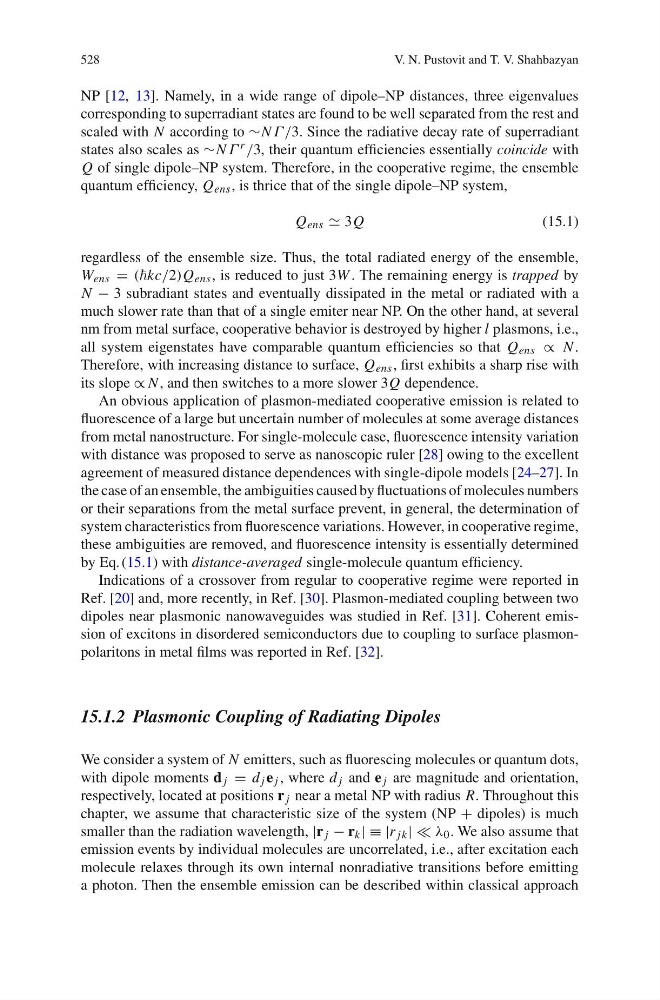
Q ens 3Q
(15.1)
regardless of the ensemble size. Thus, the total radiated energy of the ensemble,
W ens = (kc/2)Q ens , is reduced to just 3W . The remaining energy is trapped by
N − 3 subradiant states and eventually dissipated in the metal or radiated with a
much slower rate than that of a single emiter near NP. On the other hand, at several
nm from metal surface, cooperative behavior is destroyed by higher l plasmons, i.e.,
all system eigenstates have comparable quantum efficiencies so that Q ens ∼ N .
Therefore, with increasing distance to surface, Q ens , first exhibits a sharp rise with
its slope ∼ N , and then switches to a more slower 3Q dependence.
An obvious application of plasmon-mediated cooperative emission is related to
fluorescence of a large but uncertain number of molecules at some average distances
from metal nanostructure. For single-molecule case, fluorescence intensity variation
with distance was proposed to serve as nanoscopic ruler [28] owing to the excellent
agreement of measured distance dependences with single-dipole models [24–27]. In
the case of an ensemble, the ambiguities caused by fluctuations of molecules numbers
or their separations from the metal surface prevent, in general, the determination of
system characteristics from fluorescence variations. However, in cooperative regime,
these ambiguities are removed, and fluorescence intensity is essentially determined
by Eq. (15.1) with distance-averaged single-molecule quantum efficiency.
Indications of a crossover from regular to cooperative regime were reported in
Ref. [20] and, more recently, in Ref. [30]. Plasmon-mediated coupling between two
dipoles near plasmonic nanowaveguides was studied in Ref. [31]. Coherent emission of excitons in disordered semiconductors due to coupling to surface plasmonpolaritons in metal films was reported in Ref. [32].
15.1.2 Plasmonic Coupling of Radiating Dipoles
We consider a system of N emitters, such as fluorescing molecules or quantum dots,
with dipole moments d j = d j e j , where d j and e j are magnitude and orientation,
respectively, located at positions r j near a metal NP with radius R. Throughout this
chapter, we assume that characteristic size of the system (NP + dipoles) is much
smaller than the radiation wavelength, |r j − r k | ≡ |r jk | ∝ λ 0 . We also assume that
emission events by individual molecules are uncorrelated, i.e., after excitation each
molecule relaxes through its own internal nonradiative transitions before emitting
a photon. Then the ensemble emission can be described within classical approach
V. N. Pustovit and T. V. Shahbazyan
NP [12, 13]. Namely, in a wide range of dipole–NP distances, three eigenvalues
corresponding to superradiant states are found to be well separated from the rest and
scaled with N according to ∪N Γ /3. Since the radiative decay rate of superradiant
states also scales as ∪N Γ r /3, their quantum efficiencies essentially coincide with
Q of single dipole–NP system. Therefore, in the cooperative regime, the ensemble
quantum efficiency, Q ens , is thrice that of the single dipole–NP system,
Q ens 3Q
(15.1)
regardless of the ensemble size. Thus, the total radiated energy of the ensemble,
W ens = (kc/2)Q ens , is reduced to just 3W . The remaining energy is trapped by
N − 3 subradiant states and eventually dissipated in the metal or radiated with a
much slower rate than that of a single emiter near NP. On the other hand, at several
nm from metal surface, cooperative behavior is destroyed by higher l plasmons, i.e.,
all system eigenstates have comparable quantum efficiencies so that Q ens ∼ N .
Therefore, with increasing distance to surface, Q ens , first exhibits a sharp rise with
its slope ∼ N , and then switches to a more slower 3Q dependence.
An obvious application of plasmon-mediated cooperative emission is related to
fluorescence of a large but uncertain number of molecules at some average distances
from metal nanostructure. For single-molecule case, fluorescence intensity variation
with distance was proposed to serve as nanoscopic ruler [28] owing to the excellent
agreement of measured distance dependences with single-dipole models [24–27]. In
the case of an ensemble, the ambiguities caused by fluctuations of molecules numbers
or their separations from the metal surface prevent, in general, the determination of
system characteristics from fluorescence variations. However, in cooperative regime,
these ambiguities are removed, and fluorescence intensity is essentially determined
by Eq. (15.1) with distance-averaged single-molecule quantum efficiency.
Indications of a crossover from regular to cooperative regime were reported in
Ref. [20] and, more recently, in Ref. [30]. Plasmon-mediated coupling between two
dipoles near plasmonic nanowaveguides was studied in Ref. [31]. Coherent emission of excitons in disordered semiconductors due to coupling to surface plasmonpolaritons in metal films was reported in Ref. [32].
15.1.2 Plasmonic Coupling of Radiating Dipoles
We consider a system of N emitters, such as fluorescing molecules or quantum dots,
with dipole moments d j = d j e j , where d j and e j are magnitude and orientation,
respectively, located at positions r j near a metal NP with radius R. Throughout this
chapter, we assume that characteristic size of the system (NP + dipoles) is much
smaller than the radiation wavelength, |r j − r k | ≡ |r jk | ∝ λ 0 . We also assume that
emission events by individual molecules are uncorrelated, i.e., after excitation each
molecule relaxes through its own internal nonradiative transitions before emitting
a photon. Then the ensemble emission can be described within classical approach