

508
F. Gentile et al.
14.2.3 Vanishingly Small Friction Coefficients of SHSs
and Evaporation Dynamics
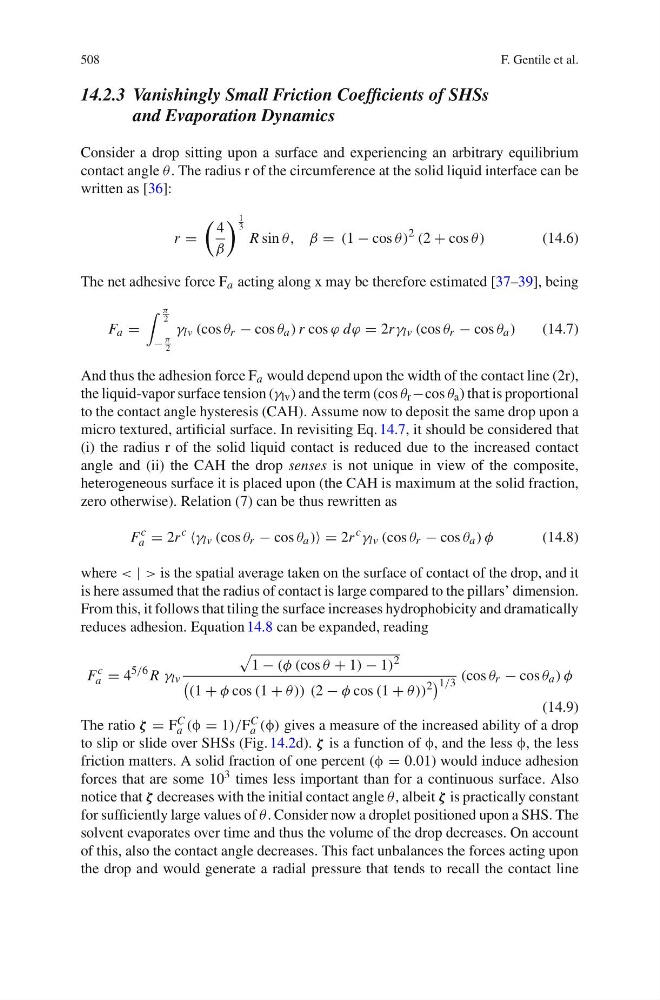
Consider a drop sitting upon a surface and experiencing an arbitrary equilibrium
contact angle ε . The radius r of the circumference at the solid liquid interface can be
written as [36]:
r =
4
∂
1
3
R sin ε, ∂ = (1 − cos ε )
2
(2 + cos ε )
(14.6)
The net adhesive force F a acting along x may be therefore estimated [37–39], being
F a =
α
2
−
α
2
Δ lv (cos ε r − cos ε a ) r cos ω dω = 2r Δ lv (cos ε r − cos ε a )
(14.7)
And thus the adhesion force F a would depend upon the width of the contact line (2r),
the liquid-vapor surface tension (Δ lv ) and the term (cos ε r −cos ε a ) that is proportional
to the contact angle hysteresis (CAH). Assume now to deposit the same drop upon a
micro textured, artificial surface. In revisiting Eq. 14.7, it should be considered that
(i) the radius r of the solid liquid contact is reduced due to the increased contact
angle and (ii) the CAH the drop senses is not unique in view of the composite,
heterogeneous surface it is placed upon (the CAH is maximum at the solid fraction,
zero otherwise). Relation (7) can be thus rewritten as
F
c
a = 2r
c
Δ lv (cos ε r − cos ε a ) = 2r
c
Δ lv (cos ε r − cos ε a ) λ
(14.8)
where < | > is the spatial average taken on the surface of contact of the drop, and it
is here assumed that the radius of contact is large compared to the pillars’ dimension.
From this, it follows that tiling the surface increases hydrophobicity and dramatically
reduces adhesion. Equation 14.8 can be expanded, reading
F
c
a = 4
5/6 R Δ lv
1 − (λ (cos ε + 1) − 1)
2
(1 + λ cos (1 + ε )) (2 − λ cos (1 + ε))
2
1/3 (cos ε r − cos ε a ) λ
(14.9)
The ratio ζ = F C
a (φ = 1)/F C
a (φ) gives a measure of the increased ability of a drop
to slip or slide over SHSs (Fig. 14.2d). ζ is a function of φ, and the less φ, the less
friction matters. A solid fraction of one percent (φ = 0.01) would induce adhesion
forces that are some 10 3 times less important than for a continuous surface. Also
notice that ζ decreases with the initial contact angle ε , albeit ζ is practically constant
for sufficiently large values of ε . Consider now a droplet positioned upon a SHS. The
solvent evaporates over time and thus the volume of the drop decreases. On account
of this, also the contact angle decreases. This fact unbalances the forces acting upon
the drop and would generate a radial pressure that tends to recall the contact line
F. Gentile et al.
14.2.3 Vanishingly Small Friction Coefficients of SHSs
and Evaporation Dynamics
Consider a drop sitting upon a surface and experiencing an arbitrary equilibrium
contact angle ε . The radius r of the circumference at the solid liquid interface can be
written as [36]:
r =
4
∂
1
3
R sin ε, ∂ = (1 − cos ε )
2
(2 + cos ε )
(14.6)
The net adhesive force F a acting along x may be therefore estimated [37–39], being
F a =
α
2
−
α
2
Δ lv (cos ε r − cos ε a ) r cos ω dω = 2r Δ lv (cos ε r − cos ε a )
(14.7)
And thus the adhesion force F a would depend upon the width of the contact line (2r),
the liquid-vapor surface tension (Δ lv ) and the term (cos ε r −cos ε a ) that is proportional
to the contact angle hysteresis (CAH). Assume now to deposit the same drop upon a
micro textured, artificial surface. In revisiting Eq. 14.7, it should be considered that
(i) the radius r of the solid liquid contact is reduced due to the increased contact
angle and (ii) the CAH the drop senses is not unique in view of the composite,
heterogeneous surface it is placed upon (the CAH is maximum at the solid fraction,
zero otherwise). Relation (7) can be thus rewritten as
F
c
a = 2r
c
Δ lv (cos ε r − cos ε a ) = 2r
c
Δ lv (cos ε r − cos ε a ) λ
(14.8)
where < | > is the spatial average taken on the surface of contact of the drop, and it
is here assumed that the radius of contact is large compared to the pillars’ dimension.
From this, it follows that tiling the surface increases hydrophobicity and dramatically
reduces adhesion. Equation 14.8 can be expanded, reading
F
c
a = 4
5/6 R Δ lv
1 − (λ (cos ε + 1) − 1)
2
(1 + λ cos (1 + ε )) (2 − λ cos (1 + ε))
2
1/3 (cos ε r − cos ε a ) λ
(14.9)
The ratio ζ = F C
a (φ = 1)/F C
a (φ) gives a measure of the increased ability of a drop
to slip or slide over SHSs (Fig. 14.2d). ζ is a function of φ, and the less φ, the less
friction matters. A solid fraction of one percent (φ = 0.01) would induce adhesion
forces that are some 10 3 times less important than for a continuous surface. Also
notice that ζ decreases with the initial contact angle ε , albeit ζ is practically constant
for sufficiently large values of ε . Consider now a droplet positioned upon a SHS. The
solvent evaporates over time and thus the volume of the drop decreases. On account
of this, also the contact angle decreases. This fact unbalances the forces acting upon
the drop and would generate a radial pressure that tends to recall the contact line