

13 Spinoptics in Plasmonics
489
deflection is regarded as the OSHE-LA and it arises due to the rotation of the local
unit cell’s anisotropy rather than the chain path curvature.The described mechanism
paves the way for one to consider other path symmetries. According to Noether’s
theorem, for every symmetry in dynamical system there is a corresponding dynamical
conservation law [73].
When the structure symmetry, or more explicitly the chain path ϕ (x, y), is circular,
the corresponding conservation rule is for the angular momentum (AM). The AM of
an optical beam can have two components: an intrinsic component that is associated
with the handedness of the optical spin, and an extrinsic (orbital) component that is
associated with its spatial structure. In an optical paraxial beam with a spiral phase
distribution (γ = −lπ, where π is the azimuthal angle in polar coordinates, and the
integer number l is the topological charge), the total AM per photon, in units of
(normalized AM), was shown to be j = λ + l [33]. Let’s consider circular chains
with a path parameter ϕ = r o π (r o is the chain radius) of annular apertures and
rotating nanorods with a rotation rate ∂ = m/r o , so the local anisotropy orientation
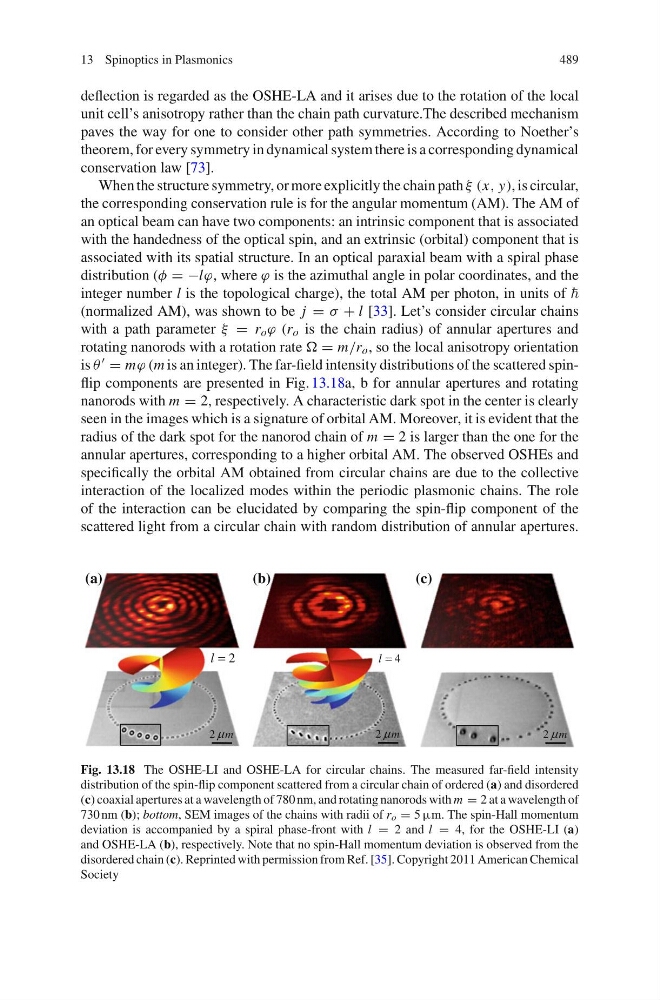
is τ = mπ (m is an integer). The far-field intensity distributions of the scattered spinflip components are presented in Fig. 13.18a, b for annular apertures and rotating
nanorods with m = 2, respectively. A characteristic dark spot in the center is clearly
seen in the images which is a signature of orbital AM. Moreover, it is evident that the
radius of the dark spot for the nanorod chain of m = 2 is larger than the one for the
annular apertures, corresponding to a higher orbital AM. The observed OSHEs and
specifically the orbital AM obtained from circular chains are due to the collective
interaction of the localized modes within the periodic plasmonic chains. The role
of the interaction can be elucidated by comparing the spin-flip component of the
scattered light from a circular chain with random distribution of annular apertures.
2
=
l
m
μ
2
4
=
l
m
μ
2
m
μ
2
(a)
(b)
(c)
Fig. 13.18 The OSHE-LI and OSHE-LA for circular chains. The measured far-field intensity
distribution of the spin-flip component scattered from a circular chain of ordered (a) and disordered
(c) coaxial apertures at a wavelength of 780 nm, and rotating nanorods with m = 2 at a wavelength of
730 nm (b); bottom, SEM images of the chains with radii of r o = 5 µm. The spin-Hall momentum
deviation is accompanied by a spiral phase-front with l = 2 and l = 4, for the OSHE-LI (a)
and OSHE-LA (b), respectively. Note that no spin-Hall momentum deviation is observed from the
disordered chain (c). Reprinted with permission from Ref. [35]. Copyright 2011 American Chemical
Society
489
deflection is regarded as the OSHE-LA and it arises due to the rotation of the local
unit cell’s anisotropy rather than the chain path curvature.The described mechanism
paves the way for one to consider other path symmetries. According to Noether’s
theorem, for every symmetry in dynamical system there is a corresponding dynamical
conservation law [73].
When the structure symmetry, or more explicitly the chain path ϕ (x, y), is circular,
the corresponding conservation rule is for the angular momentum (AM). The AM of
an optical beam can have two components: an intrinsic component that is associated
with the handedness of the optical spin, and an extrinsic (orbital) component that is
associated with its spatial structure. In an optical paraxial beam with a spiral phase
distribution (γ = −lπ, where π is the azimuthal angle in polar coordinates, and the
integer number l is the topological charge), the total AM per photon, in units of
(normalized AM), was shown to be j = λ + l [33]. Let’s consider circular chains
with a path parameter ϕ = r o π (r o is the chain radius) of annular apertures and
rotating nanorods with a rotation rate ∂ = m/r o , so the local anisotropy orientation
is τ = mπ (m is an integer). The far-field intensity distributions of the scattered spinflip components are presented in Fig. 13.18a, b for annular apertures and rotating
nanorods with m = 2, respectively. A characteristic dark spot in the center is clearly
seen in the images which is a signature of orbital AM. Moreover, it is evident that the
radius of the dark spot for the nanorod chain of m = 2 is larger than the one for the
annular apertures, corresponding to a higher orbital AM. The observed OSHEs and
specifically the orbital AM obtained from circular chains are due to the collective
interaction of the localized modes within the periodic plasmonic chains. The role
of the interaction can be elucidated by comparing the spin-flip component of the
scattered light from a circular chain with random distribution of annular apertures.
2
=
l
m
μ
2
4
=
l
m
μ
2
m
μ
2
(a)
(b)
(c)
Fig. 13.18 The OSHE-LI and OSHE-LA for circular chains. The measured far-field intensity
distribution of the spin-flip component scattered from a circular chain of ordered (a) and disordered
(c) coaxial apertures at a wavelength of 780 nm, and rotating nanorods with m = 2 at a wavelength of
730 nm (b); bottom, SEM images of the chains with radii of r o = 5 µm. The spin-Hall momentum
deviation is accompanied by a spiral phase-front with l = 2 and l = 4, for the OSHE-LI (a)
and OSHE-LA (b), respectively. Note that no spin-Hall momentum deviation is observed from the
disordered chain (c). Reprinted with permission from Ref. [35]. Copyright 2011 American Chemical
Society