

12 Plasmonics with a Twist: Taming Optical Tornadoes on the Nanoscale
451
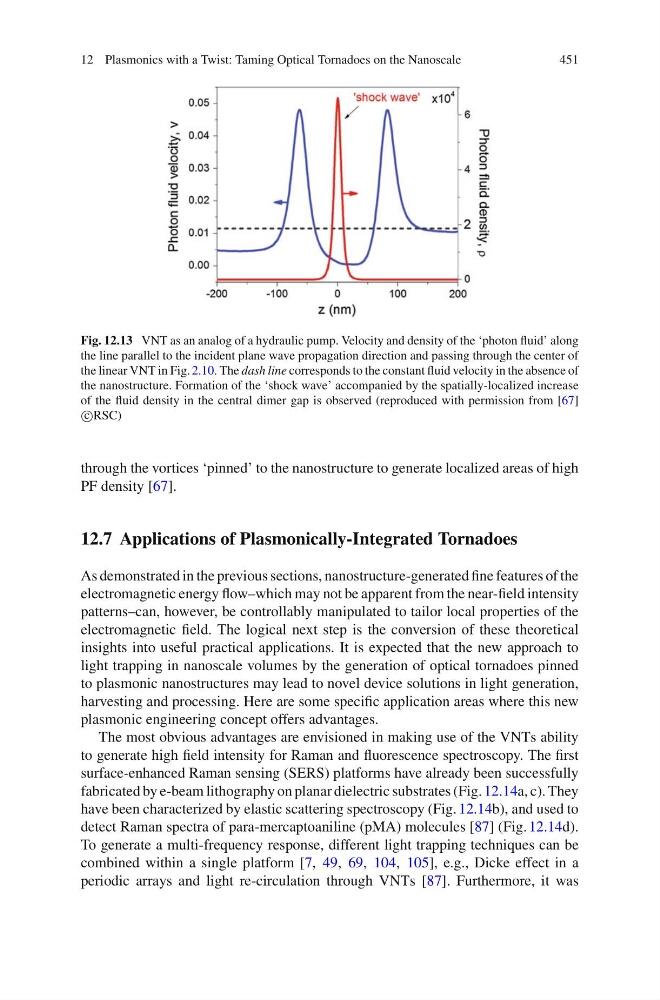
Fig. 12.13 VNT as an analog of a hydraulic pump. Velocity and density of the ‘photon fluid’ along
the line parallel to the incident plane wave propagation direction and passing through the center of
the linear VNT in Fig. 2.10. The dash line corresponds to the constant fluid velocity in the absence of
the nanostructure. Formation of the ‘shock wave’ accompanied by the spatially-localized increase
of the fluid density in the central dimer gap is observed (reproduced with permission from [67]
c
∪RSC)
through the vortices ‘pinned’ to the nanostructure to generate localized areas of high
PF density [67].
12.7 Applications of Plasmonically-Integrated Tornadoes
As demonstrated in the previous sections, nanostructure-generated fine features of the
electromagnetic energy flow–which may not be apparent from the near-field intensity
patterns–can, however, be controllably manipulated to tailor local properties of the
electromagnetic field. The logical next step is the conversion of these theoretical
insights into useful practical applications. It is expected that the new approach to
light trapping in nanoscale volumes by the generation of optical tornadoes pinned
to plasmonic nanostructures may lead to novel device solutions in light generation,
harvesting and processing. Here are some specific application areas where this new
plasmonic engineering concept offers advantages.
The most obvious advantages are envisioned in making use of the VNTs ability
to generate high field intensity for Raman and fluorescence spectroscopy. The first
surface-enhanced Raman sensing (SERS) platforms have already been successfully
fabricated by e-beam lithography on planar dielectric substrates (Fig. 12.14a, c). They
have been characterized by elastic scattering spectroscopy (Fig. 12.14b), and used to
detect Raman spectra of para-mercaptoaniline (pMA) molecules [87] (Fig. 12.14d).
To generate a multi-frequency response, different light trapping techniques can be
combined within a single platform [7, 49, 69, 104, 105], e.g., Dicke effect in a
periodic arrays and light re-circulation through VNTs [87]. Furthermore, it was
451
Fig. 12.13 VNT as an analog of a hydraulic pump. Velocity and density of the ‘photon fluid’ along
the line parallel to the incident plane wave propagation direction and passing through the center of
the linear VNT in Fig. 2.10. The dash line corresponds to the constant fluid velocity in the absence of
the nanostructure. Formation of the ‘shock wave’ accompanied by the spatially-localized increase
of the fluid density in the central dimer gap is observed (reproduced with permission from [67]
c
∪RSC)
through the vortices ‘pinned’ to the nanostructure to generate localized areas of high
PF density [67].
12.7 Applications of Plasmonically-Integrated Tornadoes
As demonstrated in the previous sections, nanostructure-generated fine features of the
electromagnetic energy flow–which may not be apparent from the near-field intensity
patterns–can, however, be controllably manipulated to tailor local properties of the
electromagnetic field. The logical next step is the conversion of these theoretical
insights into useful practical applications. It is expected that the new approach to
light trapping in nanoscale volumes by the generation of optical tornadoes pinned
to plasmonic nanostructures may lead to novel device solutions in light generation,
harvesting and processing. Here are some specific application areas where this new
plasmonic engineering concept offers advantages.
The most obvious advantages are envisioned in making use of the VNTs ability
to generate high field intensity for Raman and fluorescence spectroscopy. The first
surface-enhanced Raman sensing (SERS) platforms have already been successfully
fabricated by e-beam lithography on planar dielectric substrates (Fig. 12.14a, c). They
have been characterized by elastic scattering spectroscopy (Fig. 12.14b), and used to
detect Raman spectra of para-mercaptoaniline (pMA) molecules [87] (Fig. 12.14d).
To generate a multi-frequency response, different light trapping techniques can be
combined within a single platform [7, 49, 69, 104, 105], e.g., Dicke effect in a
periodic arrays and light re-circulation through VNTs [87]. Furthermore, it was