

440
S. V. Boriskina
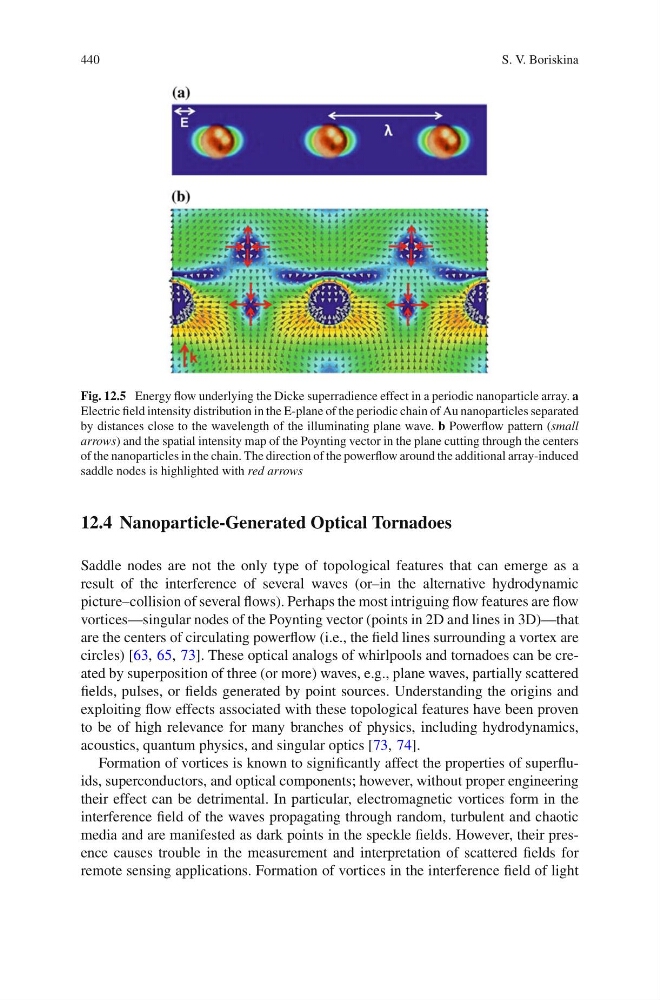
Fig. 12.5 Energy flow underlying the Dicke superradience effect in a periodic nanoparticle array. a
Electric field intensity distribution in the E-plane of the periodic chain of Au nanoparticles separated
by distances close to the wavelength of the illuminating plane wave. b Powerflow pattern (small
arrows) and the spatial intensity map of the Poynting vector in the plane cutting through the centers
of the nanoparticles in the chain. The direction of the powerflow around the additional array-induced
saddle nodes is highlighted with red arrows
12.4 Nanoparticle-Generated Optical Tornadoes
Saddle nodes are not the only type of topological features that can emerge as a
result of the interference of several waves (or–in the alternative hydrodynamic
picture–collision of several flows). Perhaps the most intriguing flow features are flow
vortices—singular nodes of the Poynting vector (points in 2D and lines in 3D)—that
are the centers of circulating powerflow (i.e., the field lines surrounding a vortex are
circles) [63, 65, 73]. These optical analogs of whirlpools and tornadoes can be created by superposition of three (or more) waves, e.g., plane waves, partially scattered
fields, pulses, or fields generated by point sources. Understanding the origins and
exploiting flow effects associated with these topological features have been proven
to be of high relevance for many branches of physics, including hydrodynamics,
acoustics, quantum physics, and singular optics [73, 74].
Formation of vortices is known to significantly affect the properties of superfluids, superconductors, and optical components; however, without proper engineering
their effect can be detrimental. In particular, electromagnetic vortices form in the
interference field of the waves propagating through random, turbulent and chaotic
media and are manifested as dark points in the speckle fields. However, their presence causes trouble in the measurement and interpretation of scattered fields for
remote sensing applications. Formation of vortices in the interference field of light
S. V. Boriskina
Fig. 12.5 Energy flow underlying the Dicke superradience effect in a periodic nanoparticle array. a
Electric field intensity distribution in the E-plane of the periodic chain of Au nanoparticles separated
by distances close to the wavelength of the illuminating plane wave. b Powerflow pattern (small
arrows) and the spatial intensity map of the Poynting vector in the plane cutting through the centers
of the nanoparticles in the chain. The direction of the powerflow around the additional array-induced
saddle nodes is highlighted with red arrows
12.4 Nanoparticle-Generated Optical Tornadoes
Saddle nodes are not the only type of topological features that can emerge as a
result of the interference of several waves (or–in the alternative hydrodynamic
picture–collision of several flows). Perhaps the most intriguing flow features are flow
vortices—singular nodes of the Poynting vector (points in 2D and lines in 3D)—that
are the centers of circulating powerflow (i.e., the field lines surrounding a vortex are
circles) [63, 65, 73]. These optical analogs of whirlpools and tornadoes can be created by superposition of three (or more) waves, e.g., plane waves, partially scattered
fields, pulses, or fields generated by point sources. Understanding the origins and
exploiting flow effects associated with these topological features have been proven
to be of high relevance for many branches of physics, including hydrodynamics,
acoustics, quantum physics, and singular optics [73, 74].
Formation of vortices is known to significantly affect the properties of superfluids, superconductors, and optical components; however, without proper engineering
their effect can be detrimental. In particular, electromagnetic vortices form in the
interference field of the waves propagating through random, turbulent and chaotic
media and are manifested as dark points in the speckle fields. However, their presence causes trouble in the measurement and interpretation of scattered fields for
remote sensing applications. Formation of vortices in the interference field of light