

404
A. Pors et al.
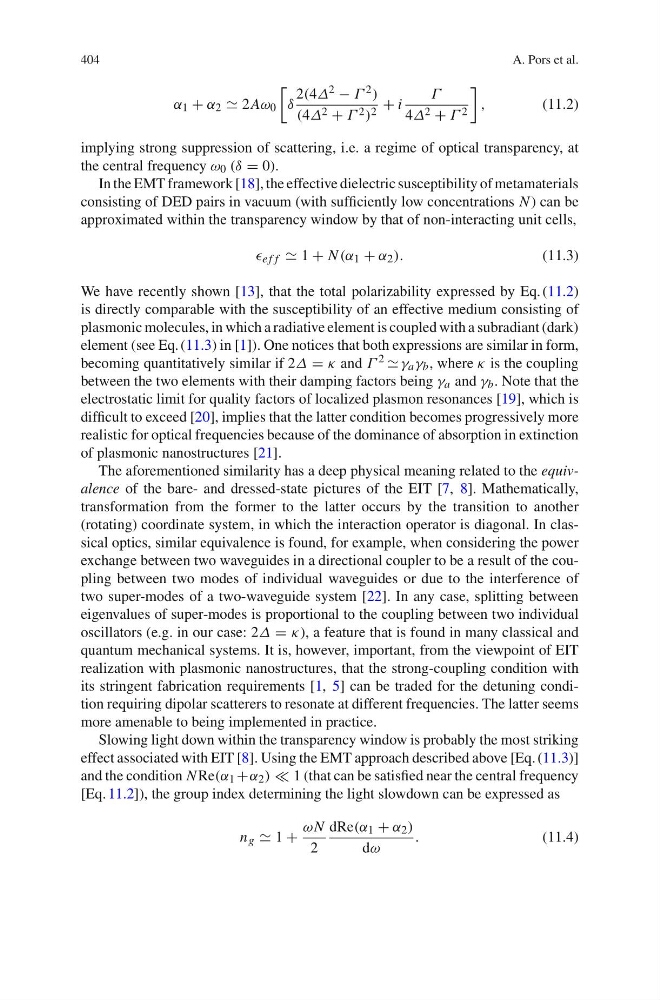
λ 1 + λ 2 ∼ 2 Aε 0
α
2(4π 2 − ω 2 )
(4π 2 + ω 2 ) 2 + i
ω
4π 2 + ω 2
,
(11.2)
implying strong suppression of scattering, i.e. a regime of optical transparency, at
the central frequency ε 0 (α = 0).
In the EMT framework [18], the effective dielectric susceptibility of metamaterials
consisting of DED pairs in vacuum (with sufficiently low concentrations N ) can be
approximated within the transparency window by that of non-interacting unit cells,
γ e f f ∼ 1 + N (λ 1 + λ 2 ).
(11.3)
We have recently shown [13], that the total polarizability expressed by Eq. (11.2)
is directly comparable with the susceptibility of an effective medium consisting of
plasmonic molecules, in which a radiative element is coupled with a subradiant (dark)
element (see Eq. (11.3) in [1]). One notices that both expressions are similar in form,
becoming quantitatively similar if 2π = ∂ and ω 2 ∼ Δ a Δ b , where ∂ is the coupling
between the two elements with their damping factors being Δ a and Δ b . Note that the
electrostatic limit for quality factors of localized plasmon resonances [19], which is
difficult to exceed [20], implies that the latter condition becomes progressively more
realistic for optical frequencies because of the dominance of absorption in extinction
of plasmonic nanostructures [21].
The aforementioned similarity has a deep physical meaning related to the equivalence of the bare- and dressed-state pictures of the EIT [7, 8]. Mathematically,
transformation from the former to the latter occurs by the transition to another
(rotating) coordinate system, in which the interaction operator is diagonal. In classical optics, similar equivalence is found, for example, when considering the power
exchange between two waveguides in a directional coupler to be a result of the coupling between two modes of individual waveguides or due to the interference of
two super-modes of a two-waveguide system [22]. In any case, splitting between
eigenvalues of super-modes is proportional to the coupling between two individual
oscillators (e.g. in our case: 2π = ∂), a feature that is found in many classical and
quantum mechanical systems. It is, however, important, from the viewpoint of EIT
realization with plasmonic nanostructures, that the strong-coupling condition with
its stringent fabrication requirements [1, 5] can be traded for the detuning condition requiring dipolar scatterers to resonate at different frequencies. The latter seems
more amenable to being implemented in practice.
Slowing light down within the transparency window is probably the most striking
effect associated with EIT [8]. Using the EMT approach described above [Eq. (11.3)]
and the condition N Re(λ 1 +λ 2 ) ∪ 1 (that can be satisfied near the central frequency
[Eq. 11.2]), the group index determining the light slowdown can be expressed as
n g ∼ 1 +
εN
2
dRe(λ 1 + λ 2 )
dε
.
(11.4)
A. Pors et al.
λ 1 + λ 2 ∼ 2 Aε 0
α
2(4π 2 − ω 2 )
(4π 2 + ω 2 ) 2 + i
ω
4π 2 + ω 2
,
(11.2)
implying strong suppression of scattering, i.e. a regime of optical transparency, at
the central frequency ε 0 (α = 0).
In the EMT framework [18], the effective dielectric susceptibility of metamaterials
consisting of DED pairs in vacuum (with sufficiently low concentrations N ) can be
approximated within the transparency window by that of non-interacting unit cells,
γ e f f ∼ 1 + N (λ 1 + λ 2 ).
(11.3)
We have recently shown [13], that the total polarizability expressed by Eq. (11.2)
is directly comparable with the susceptibility of an effective medium consisting of
plasmonic molecules, in which a radiative element is coupled with a subradiant (dark)
element (see Eq. (11.3) in [1]). One notices that both expressions are similar in form,
becoming quantitatively similar if 2π = ∂ and ω 2 ∼ Δ a Δ b , where ∂ is the coupling
between the two elements with their damping factors being Δ a and Δ b . Note that the
electrostatic limit for quality factors of localized plasmon resonances [19], which is
difficult to exceed [20], implies that the latter condition becomes progressively more
realistic for optical frequencies because of the dominance of absorption in extinction
of plasmonic nanostructures [21].
The aforementioned similarity has a deep physical meaning related to the equivalence of the bare- and dressed-state pictures of the EIT [7, 8]. Mathematically,
transformation from the former to the latter occurs by the transition to another
(rotating) coordinate system, in which the interaction operator is diagonal. In classical optics, similar equivalence is found, for example, when considering the power
exchange between two waveguides in a directional coupler to be a result of the coupling between two modes of individual waveguides or due to the interference of
two super-modes of a two-waveguide system [22]. In any case, splitting between
eigenvalues of super-modes is proportional to the coupling between two individual
oscillators (e.g. in our case: 2π = ∂), a feature that is found in many classical and
quantum mechanical systems. It is, however, important, from the viewpoint of EIT
realization with plasmonic nanostructures, that the strong-coupling condition with
its stringent fabrication requirements [1, 5] can be traded for the detuning condition requiring dipolar scatterers to resonate at different frequencies. The latter seems
more amenable to being implemented in practice.
Slowing light down within the transparency window is probably the most striking
effect associated with EIT [8]. Using the EMT approach described above [Eq. (11.3)]
and the condition N Re(λ 1 +λ 2 ) ∪ 1 (that can be satisfied near the central frequency
[Eq. 11.2]), the group index determining the light slowdown can be expressed as
n g ∼ 1 +
εN
2
dRe(λ 1 + λ 2 )
dε
.
(11.4)