

11 Plasmonic Functionalities Based on Detuned Electrical Dipoles
403
resonances involved: while atomic resonances are lifetime broadened, the linewidth
of plasmonic resonances is determined not only by radiation damping but also by
absorption, i.e. by direct loss of photons. In this case, the EIT phenomenon manifests
itself as the scattering suppression, whereas the absorption (becoming progressively
more important and even dominant at optical frequencies) is mainly determined by
the fundamental material properties and is impossible to eliminate no matter which
EIT realization approach is chosen [11]. For this reason, one should not expect to
achieve complete transparency when dealing with plasmonic nanostructures, as also
seen from the reported simulations [1, 12] and experiments [5].
We investigate in detail the optical properties of periodic arrays of paired gold
nanorods having different lengths. Essentially, the nanorod pairs represent two or
three dipolar scatterers resonating at different frequencies, i.e. detuned electrical
dipoles (DED), whose detuning is simply determined by their difference in length.
We demonstrate that the transmission spectra exhibit windows of enhanced transmission surrounded on both sides by transmission minima, a phenomenon that we have
attributed to the effect of optical transparency that emulates the dressed-state picture
of EIT [13]. We consider this intriguing effect from different viewpoints in detail by
numerical simulations and experiments. Additionally, we also demonstrate that DED
arrays can advantageously be used for very sensitive monitoring of environmental
refractive index, i.e. for plasmonic sensing [14] and as ultrathin metamaterial wave
retarders in reflection [15].
11.2 Detuned Electrical Dipole Metamaterials: Optical
Transparency and Slow Light
The concepts of optical transparency and slow light with DEDs can be illustrated
by considering a metamaterial with the unit cell consisting of two nearly identical
and non-interacting electric dipolar scatterers, whose resonances are equally detuned
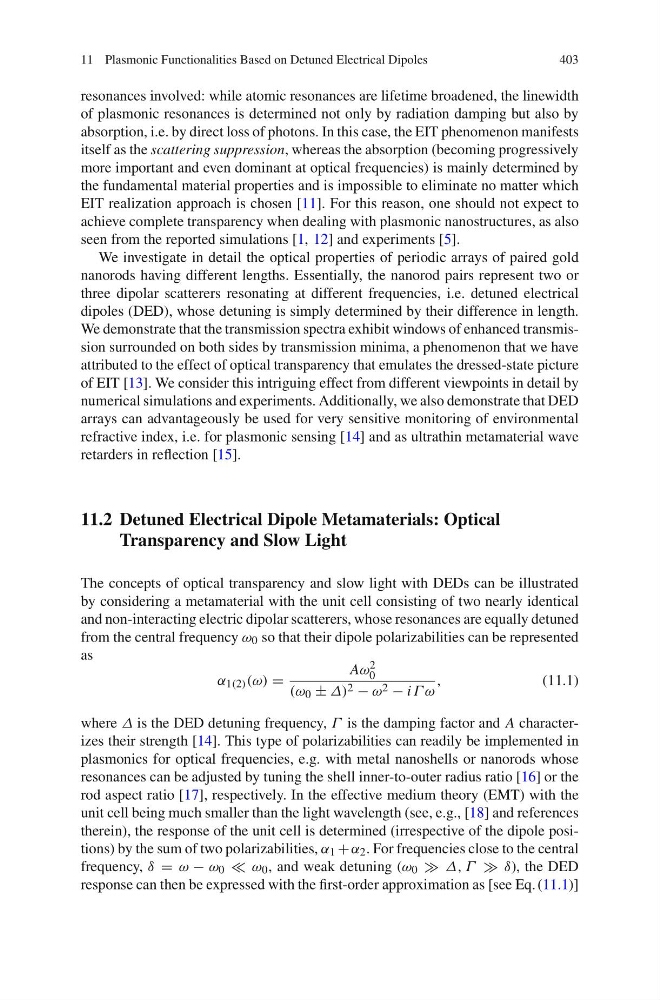
from the central frequency ε 0 so that their dipole polarizabilities can be represented
as
λ 1(2) (ε) =
Aε 2
0
(ε 0 ± π) 2 − ε 2 − iω ε
,
(11.1)
where π is the DED detuning frequency, ω is the damping factor and A characterizes their strength [14]. This type of polarizabilities can readily be implemented in
plasmonics for optical frequencies, e.g. with metal nanoshells or nanorods whose
resonances can be adjusted by tuning the shell inner-to-outer radius ratio [16] or the
rod aspect ratio [17], respectively. In the effective medium theory (EMT) with the
unit cell being much smaller than the light wavelength (see, e.g., [18] and references
therein), the response of the unit cell is determined (irrespective of the dipole positions) by the sum of two polarizabilities, λ 1 + λ 2 . For frequencies close to the central
frequency, α = ε − ε 0 ∪ ε 0 , and weak detuning (ε 0 ≈ π, ω ≈ α), the DED
response can then be expressed with the first-order approximation as [see Eq. (11.1)]
403
resonances involved: while atomic resonances are lifetime broadened, the linewidth
of plasmonic resonances is determined not only by radiation damping but also by
absorption, i.e. by direct loss of photons. In this case, the EIT phenomenon manifests
itself as the scattering suppression, whereas the absorption (becoming progressively
more important and even dominant at optical frequencies) is mainly determined by
the fundamental material properties and is impossible to eliminate no matter which
EIT realization approach is chosen [11]. For this reason, one should not expect to
achieve complete transparency when dealing with plasmonic nanostructures, as also
seen from the reported simulations [1, 12] and experiments [5].
We investigate in detail the optical properties of periodic arrays of paired gold
nanorods having different lengths. Essentially, the nanorod pairs represent two or
three dipolar scatterers resonating at different frequencies, i.e. detuned electrical
dipoles (DED), whose detuning is simply determined by their difference in length.
We demonstrate that the transmission spectra exhibit windows of enhanced transmission surrounded on both sides by transmission minima, a phenomenon that we have
attributed to the effect of optical transparency that emulates the dressed-state picture
of EIT [13]. We consider this intriguing effect from different viewpoints in detail by
numerical simulations and experiments. Additionally, we also demonstrate that DED
arrays can advantageously be used for very sensitive monitoring of environmental
refractive index, i.e. for plasmonic sensing [14] and as ultrathin metamaterial wave
retarders in reflection [15].
11.2 Detuned Electrical Dipole Metamaterials: Optical
Transparency and Slow Light
The concepts of optical transparency and slow light with DEDs can be illustrated
by considering a metamaterial with the unit cell consisting of two nearly identical
and non-interacting electric dipolar scatterers, whose resonances are equally detuned
from the central frequency ε 0 so that their dipole polarizabilities can be represented
as
λ 1(2) (ε) =
Aε 2
0
(ε 0 ± π) 2 − ε 2 − iω ε
,
(11.1)
where π is the DED detuning frequency, ω is the damping factor and A characterizes their strength [14]. This type of polarizabilities can readily be implemented in
plasmonics for optical frequencies, e.g. with metal nanoshells or nanorods whose
resonances can be adjusted by tuning the shell inner-to-outer radius ratio [16] or the
rod aspect ratio [17], respectively. In the effective medium theory (EMT) with the
unit cell being much smaller than the light wavelength (see, e.g., [18] and references
therein), the response of the unit cell is determined (irrespective of the dipole positions) by the sum of two polarizabilities, λ 1 + λ 2 . For frequencies close to the central
frequency, α = ε − ε 0 ∪ ε 0 , and weak detuning (ε 0 ≈ π, ω ≈ α), the DED
response can then be expressed with the first-order approximation as [see Eq. (11.1)]