

10 Waves on Subwalength Metallic Surfaces: A Microscopic View Point
391
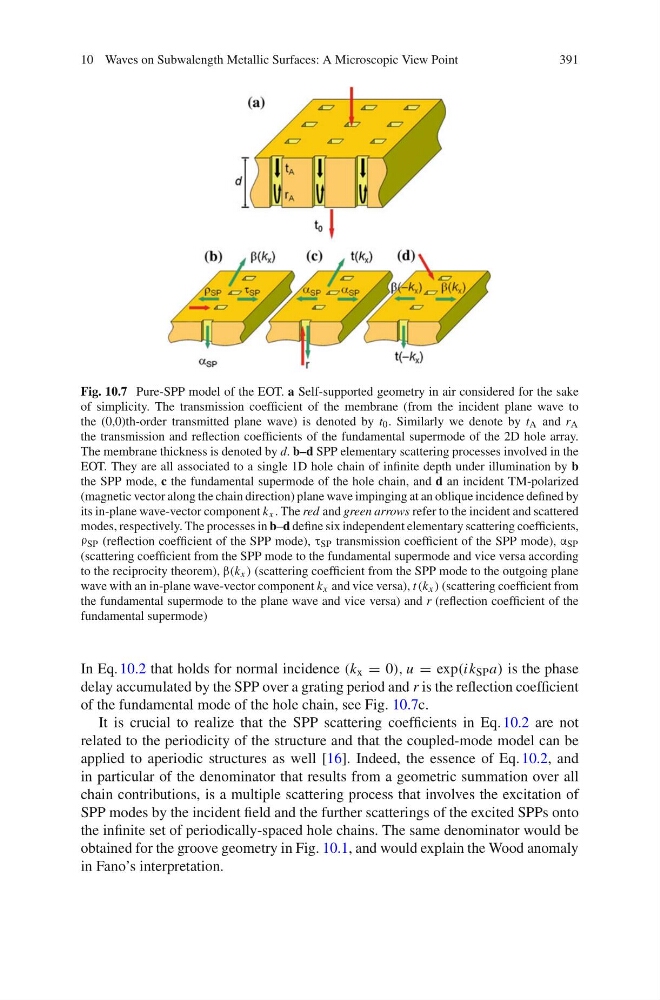
Fig. 10.7 Pure-SPP model of the EOT. a Self-supported geometry in air considered for the sake
of simplicity. The transmission coefficient of the membrane (from the incident plane wave to
the (0,0)th-order transmitted plane wave) is denoted by t 0 . Similarly we denote by t A and r A
the transmission and reflection coefficients of the fundamental supermode of the 2D hole array.
The membrane thickness is denoted by d. b–d SPP elementary scattering processes involved in the
EOT. They are all associated to a single 1D hole chain of infinite depth under illumination by b
the SPP mode, c the fundamental supermode of the hole chain, and d an incident TM-polarized
(magnetic vector along the chain direction) plane wave impinging at an oblique incidence defined by
its in-plane wave-vector component k x . The red and green arrows refer to the incident and scattered
modes, respectively. The processes in b–d define six independent elementary scattering coefficients,
ρ SP (reflection coefficient of the SPP mode), τ SP transmission coefficient of the SPP mode), α SP
(scattering coefficient from the SPP mode to the fundamental supermode and vice versa according
to the reciprocity theorem), β(k x ) (scattering coefficient from the SPP mode to the outgoing plane
wave with an in-plane wave-vector component k x and vice versa), t (k x ) (scattering coefficient from
the fundamental supermode to the plane wave and vice versa) and r (reflection coefficient of the
fundamental supermode)
In Eq. 10.2 that holds for normal incidence (k x = 0), u = exp(ik SP a) is the phase
delay accumulated by the SPP over a grating period and r is the reflection coefficient
of the fundamental mode of the hole chain, see Fig. 10.7c.
It is crucial to realize that the SPP scattering coefficients in Eq. 10.2 are not
related to the periodicity of the structure and that the coupled-mode model can be
applied to aperiodic structures as well [16]. Indeed, the essence of Eq. 10.2, and
in particular of the denominator that results from a geometric summation over all
chain contributions, is a multiple scattering process that involves the excitation of
SPP modes by the incident field and the further scatterings of the excited SPPs onto
the infinite set of periodically-spaced hole chains. The same denominator would be
obtained for the groove geometry in Fig. 10.1, and would explain the Wood anomaly
in Fano’s interpretation.
391
Fig. 10.7 Pure-SPP model of the EOT. a Self-supported geometry in air considered for the sake
of simplicity. The transmission coefficient of the membrane (from the incident plane wave to
the (0,0)th-order transmitted plane wave) is denoted by t 0 . Similarly we denote by t A and r A
the transmission and reflection coefficients of the fundamental supermode of the 2D hole array.
The membrane thickness is denoted by d. b–d SPP elementary scattering processes involved in the
EOT. They are all associated to a single 1D hole chain of infinite depth under illumination by b
the SPP mode, c the fundamental supermode of the hole chain, and d an incident TM-polarized
(magnetic vector along the chain direction) plane wave impinging at an oblique incidence defined by
its in-plane wave-vector component k x . The red and green arrows refer to the incident and scattered
modes, respectively. The processes in b–d define six independent elementary scattering coefficients,
ρ SP (reflection coefficient of the SPP mode), τ SP transmission coefficient of the SPP mode), α SP
(scattering coefficient from the SPP mode to the fundamental supermode and vice versa according
to the reciprocity theorem), β(k x ) (scattering coefficient from the SPP mode to the outgoing plane
wave with an in-plane wave-vector component k x and vice versa), t (k x ) (scattering coefficient from
the fundamental supermode to the plane wave and vice versa) and r (reflection coefficient of the
fundamental supermode)
In Eq. 10.2 that holds for normal incidence (k x = 0), u = exp(ik SP a) is the phase
delay accumulated by the SPP over a grating period and r is the reflection coefficient
of the fundamental mode of the hole chain, see Fig. 10.7c.
It is crucial to realize that the SPP scattering coefficients in Eq. 10.2 are not
related to the periodicity of the structure and that the coupled-mode model can be
applied to aperiodic structures as well [16]. Indeed, the essence of Eq. 10.2, and
in particular of the denominator that results from a geometric summation over all
chain contributions, is a multiple scattering process that involves the excitation of
SPP modes by the incident field and the further scatterings of the excited SPPs onto
the infinite set of periodically-spaced hole chains. The same denominator would be
obtained for the groove geometry in Fig. 10.1, and would explain the Wood anomaly
in Fano’s interpretation.