

24
M. I. Stockman
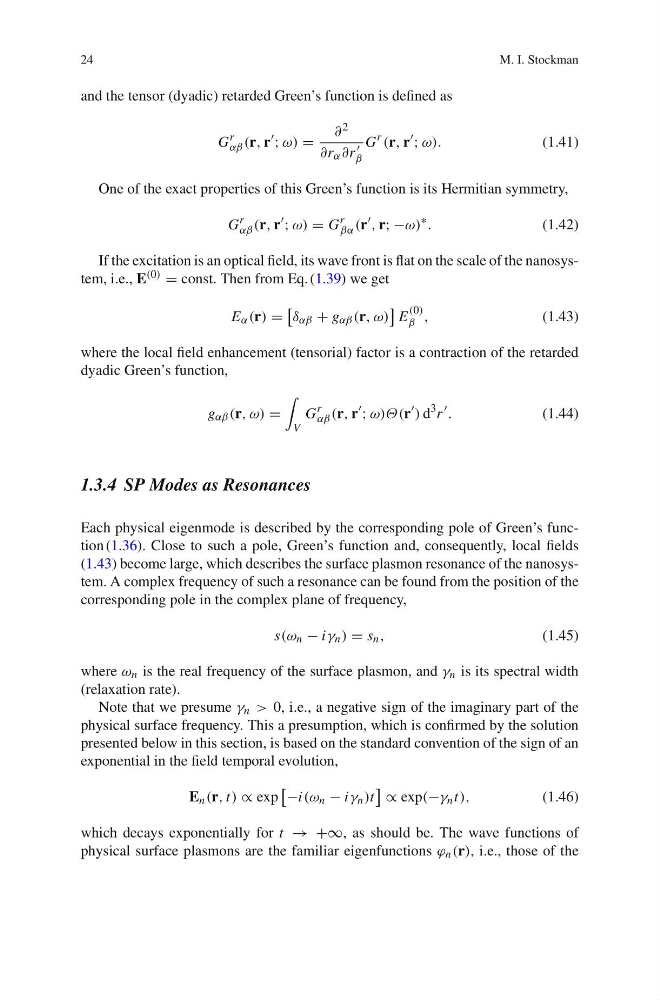
and the tensor (dyadic) retarded Green’s function is defined as
G
r
αβ (r, r
; ω) =
∂ 2
∂r α ∂r
β
G
r
(r, r
; ω).
(1.41)
One of the exact properties of this Green’s function is its Hermitian symmetry,
G
r
αβ (r, r
; ω) = G
r
βα (r
, r; −ω)
∗
.
(1.42)
If the excitation is an optical field, its wave front is flat on the scale of the nanosystem, i.e., E (0) = const. Then from Eq. (1.39) we get
E α (r) =
δ αβ + g αβ (r, ω)
E
(0)
β ,
(1.43)
where the local field enhancement (tensorial) factor is a contraction of the retarded
dyadic Green’s function,
g αβ (r, ω) =
V
G
r
αβ (r, r
; ω)Θ(r
) d
3 r
.
(1.44)
1.3.4 SP Modes as Resonances
Each physical eigenmode is described by the corresponding pole of Green’s function (1.36). Close to such a pole, Green’s function and, consequently, local fields
(1.43) become large, which describes the surface plasmon resonance of the nanosystem. A complex frequency of such a resonance can be found from the position of the
corresponding pole in the complex plane of frequency,
s(ω n − iγ n ) = s n ,
(1.45)
where ω n is the real frequency of the surface plasmon, and γ n is its spectral width
(relaxation rate).
Note that we presume γ n > 0, i.e., a negative sign of the imaginary part of the
physical surface frequency. This a presumption, which is confirmed by the solution
presented below in this section, is based on the standard convention of the sign of an
exponential in the field temporal evolution,
E n (r, t) ∝ exp
−i(ω n − iγ n )t
∝ exp(−γ n t),
(1.46)
which decays exponentially for t → +∞, as should be. The wave functions of
physical surface plasmons are the familiar eigenfunctions ϕ n (r), i.e., those of the
M. I. Stockman
and the tensor (dyadic) retarded Green’s function is defined as
G
r
αβ (r, r
; ω) =
∂ 2
∂r α ∂r
β
G
r
(r, r
; ω).
(1.41)
One of the exact properties of this Green’s function is its Hermitian symmetry,
G
r
αβ (r, r
; ω) = G
r
βα (r
, r; −ω)
∗
.
(1.42)
If the excitation is an optical field, its wave front is flat on the scale of the nanosystem, i.e., E (0) = const. Then from Eq. (1.39) we get
E α (r) =
δ αβ + g αβ (r, ω)
E
(0)
β ,
(1.43)
where the local field enhancement (tensorial) factor is a contraction of the retarded
dyadic Green’s function,
g αβ (r, ω) =
V
G
r
αβ (r, r
; ω)Θ(r
) d
3 r
.
(1.44)
1.3.4 SP Modes as Resonances
Each physical eigenmode is described by the corresponding pole of Green’s function (1.36). Close to such a pole, Green’s function and, consequently, local fields
(1.43) become large, which describes the surface plasmon resonance of the nanosystem. A complex frequency of such a resonance can be found from the position of the
corresponding pole in the complex plane of frequency,
s(ω n − iγ n ) = s n ,
(1.45)
where ω n is the real frequency of the surface plasmon, and γ n is its spectral width
(relaxation rate).
Note that we presume γ n > 0, i.e., a negative sign of the imaginary part of the
physical surface frequency. This a presumption, which is confirmed by the solution
presented below in this section, is based on the standard convention of the sign of an
exponential in the field temporal evolution,
E n (r, t) ∝ exp
−i(ω n − iγ n )t
∝ exp(−γ n t),
(1.46)
which decays exponentially for t → +∞, as should be. The wave functions of
physical surface plasmons are the familiar eigenfunctions ϕ n (r), i.e., those of the