

22
M. I. Stockman
30
x
30 z
0.1
0.3
|E
n | 2
|E
n | 2
|E
n | 2
|E
n | 2
30
30
x
30 z
0.01
0.03
30
30
x
30 z
0.
0.01
30
30
x
30 z
0
0.1
0.2
0.3
30
s n =0.1996, L n =2.2
Localized Luminous
s n =0.2015, L n =1.1
Localized Dark
s n =0.2011, L n =9.7
Delocalized Dark
s n =0.2000, L n =11.0
Delocalized Luminous
F n =0.07
F n ~10
−9
F n ~10
−9
F n =0.2
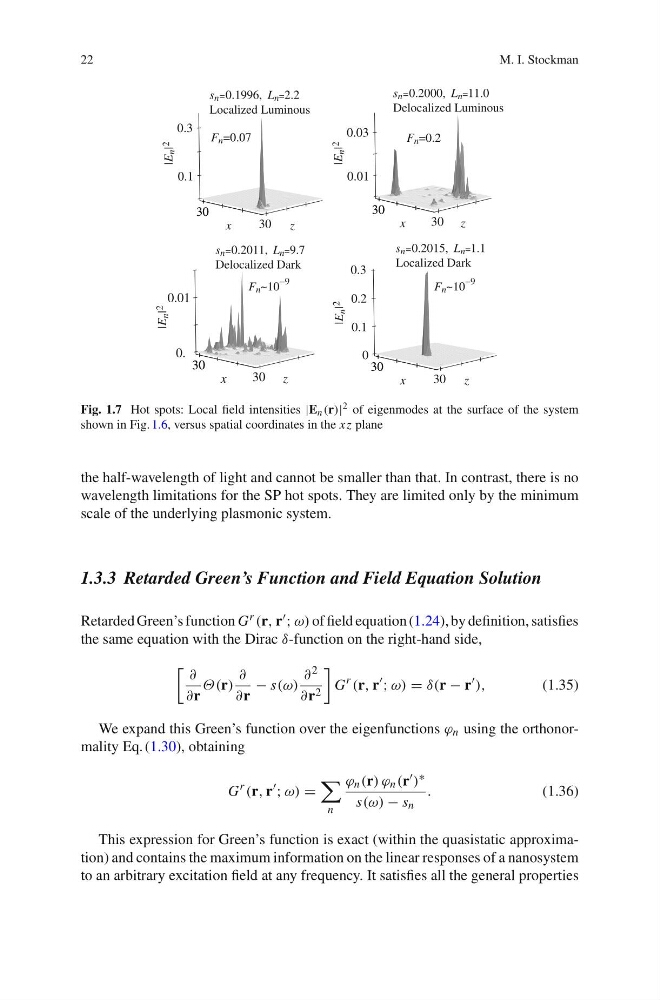
Fig. 1.7 Hot spots: Local field intensities |E n (r)| 2 of eigenmodes at the surface of the system
shown in Fig. 1.6, versus spatial coordinates in the xz plane
the half-wavelength of light and cannot be smaller than that. In contrast, there is no
wavelength limitations for the SP hot spots. They are limited only by the minimum
scale of the underlying plasmonic system.
1.3.3 Retarded Green’s Function and Field Equation Solution
Retarded Green’s function G r (r, r ; ω) of field equation (1.24), by definition, satisfies
the same equation with the Dirac δ-function on the right-hand side,
∂
∂r
Θ(r)
∂
∂r
− s(ω)
∂ 2
∂r 2
G
r
(r, r
; ω) = δ(r − r
),
(1.35)
We expand this Green’s function over the eigenfunctions ϕ n using the orthonormality Eq. (1.30), obtaining
G
r
(r, r
; ω) =
n
ϕ n (r) ϕ n (r ) ∗
s(ω) − s n
.
(1.36)
This expression for Green’s function is exact (within the quasistatic approximation) and contains the maximum information on the linear responses of a nanosystem
to an arbitrary excitation field at any frequency. It satisfies all the general properties
M. I. Stockman
30
x
30 z
0.1
0.3
|E
n | 2
|E
n | 2
|E
n | 2
|E
n | 2
30
30
x
30 z
0.01
0.03
30
30
x
30 z
0.
0.01
30
30
x
30 z
0
0.1
0.2
0.3
30
s n =0.1996, L n =2.2
Localized Luminous
s n =0.2015, L n =1.1
Localized Dark
s n =0.2011, L n =9.7
Delocalized Dark
s n =0.2000, L n =11.0
Delocalized Luminous
F n =0.07
F n ~10
−9
F n ~10
−9
F n =0.2
Fig. 1.7 Hot spots: Local field intensities |E n (r)| 2 of eigenmodes at the surface of the system
shown in Fig. 1.6, versus spatial coordinates in the xz plane
the half-wavelength of light and cannot be smaller than that. In contrast, there is no
wavelength limitations for the SP hot spots. They are limited only by the minimum
scale of the underlying plasmonic system.
1.3.3 Retarded Green’s Function and Field Equation Solution
Retarded Green’s function G r (r, r ; ω) of field equation (1.24), by definition, satisfies
the same equation with the Dirac δ-function on the right-hand side,
∂
∂r
Θ(r)
∂
∂r
− s(ω)
∂ 2
∂r 2
G
r
(r, r
; ω) = δ(r − r
),
(1.35)
We expand this Green’s function over the eigenfunctions ϕ n using the orthonormality Eq. (1.30), obtaining
G
r
(r, r
; ω) =
n
ϕ n (r) ϕ n (r ) ∗
s(ω) − s n
.
(1.36)
This expression for Green’s function is exact (within the quasistatic approximation) and contains the maximum information on the linear responses of a nanosystem
to an arbitrary excitation field at any frequency. It satisfies all the general properties