

9 Aperiodic Order in Nanoplasmonics
365
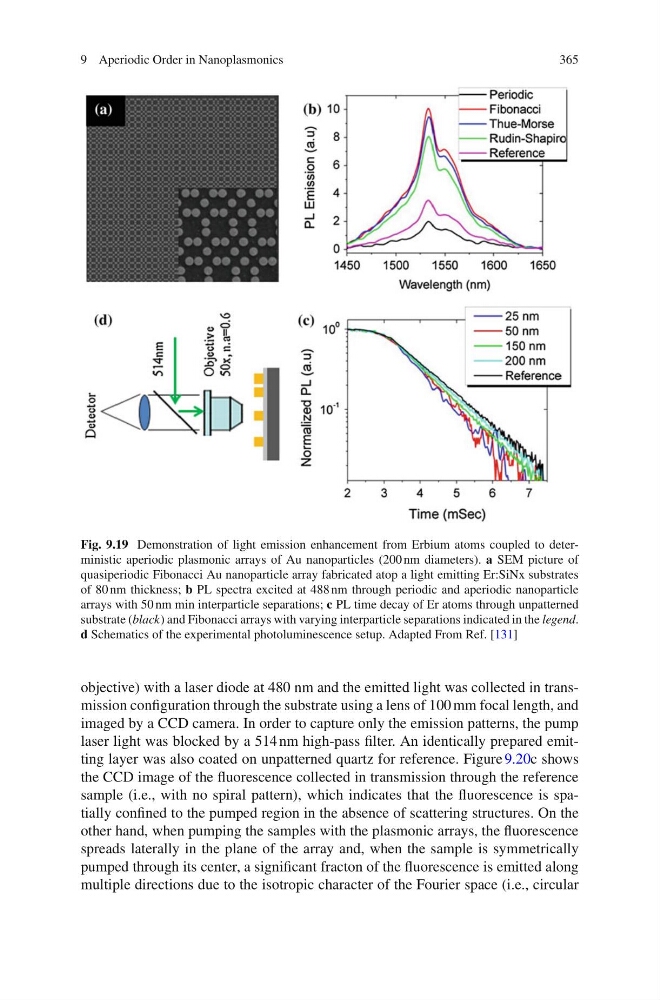
Fig. 9.19 Demonstration of light emission enhancement from Erbium atoms coupled to deterministic aperiodic plasmonic arrays of Au nanoparticles (200 nm diameters). a SEM picture of
quasiperiodic Fibonacci Au nanoparticle array fabricated atop a light emitting Er:SiNx substrates
of 80 nm thickness; b PL spectra excited at 488 nm through periodic and aperiodic nanoparticle
arrays with 50 nm min interparticle separations; c PL time decay of Er atoms through unpatterned
substrate (black) and Fibonacci arrays with varying interparticle separations indicated in the legend.
d Schematics of the experimental photoluminescence setup. Adapted From Ref. [131]
objective) with a laser diode at 480 nm and the emitted light was collected in transmission configuration through the substrate using a lens of 100 mm focal length, and
imaged by a CCD camera. In order to capture only the emission patterns, the pump
laser light was blocked by a 514 nm high-pass filter. An identically prepared emitting layer was also coated on unpatterned quartz for reference. Figure 9.20c shows
the CCD image of the fluorescence collected in transmission through the reference
sample (i.e., with no spiral pattern), which indicates that the fluorescence is spatially confined to the pumped region in the absence of scattering structures. On the
other hand, when pumping the samples with the plasmonic arrays, the fluorescence
spreads laterally in the plane of the array and, when the sample is symmetrically
pumped through its center, a significant fracton of the fluorescence is emitted along
multiple directions due to the isotropic character of the Fourier space (i.e., circular
365
Fig. 9.19 Demonstration of light emission enhancement from Erbium atoms coupled to deterministic aperiodic plasmonic arrays of Au nanoparticles (200 nm diameters). a SEM picture of
quasiperiodic Fibonacci Au nanoparticle array fabricated atop a light emitting Er:SiNx substrates
of 80 nm thickness; b PL spectra excited at 488 nm through periodic and aperiodic nanoparticle
arrays with 50 nm min interparticle separations; c PL time decay of Er atoms through unpatterned
substrate (black) and Fibonacci arrays with varying interparticle separations indicated in the legend.
d Schematics of the experimental photoluminescence setup. Adapted From Ref. [131]
objective) with a laser diode at 480 nm and the emitted light was collected in transmission configuration through the substrate using a lens of 100 mm focal length, and
imaged by a CCD camera. In order to capture only the emission patterns, the pump
laser light was blocked by a 514 nm high-pass filter. An identically prepared emitting layer was also coated on unpatterned quartz for reference. Figure 9.20c shows
the CCD image of the fluorescence collected in transmission through the reference
sample (i.e., with no spiral pattern), which indicates that the fluorescence is spatially confined to the pumped region in the absence of scattering structures. On the
other hand, when pumping the samples with the plasmonic arrays, the fluorescence
spreads laterally in the plane of the array and, when the sample is symmetrically
pumped through its center, a significant fracton of the fluorescence is emitted along
multiple directions due to the isotropic character of the Fourier space (i.e., circular