

362
L. D. Negro et al.
Light scattering from nano-patterned deterministic aperiodic surfaces, which
occurs over a broad spectral-angular range, leads to the formation of colorimetric
fingerprints, in their near and far-field zones, which can be captured with conventional dark-field microscopy, as demonstrated in Fig. 9.17. The distinctive colorimetric fingerprints of aperiodic surfaces can be used as a transduction mechanism
for novel types of highly sensitive label-free multiplexed sensors [86]. In particular,
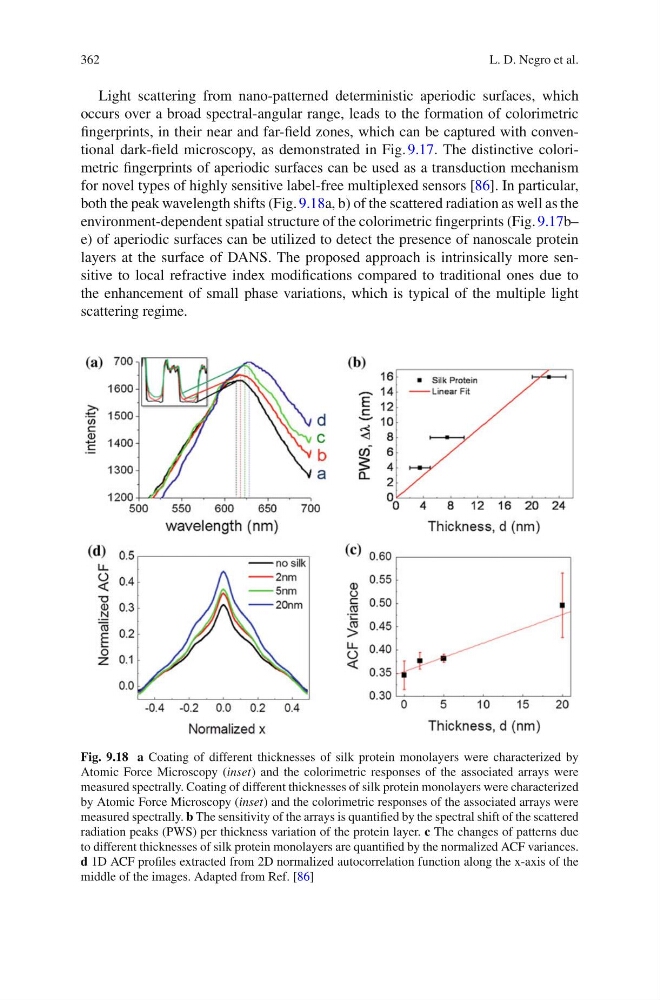
both the peak wavelength shifts (Fig. 9.18a, b) of the scattered radiation as well as the
environment-dependent spatial structure of the colorimetric fingerprints (Fig. 9.17b–
e) of aperiodic surfaces can be utilized to detect the presence of nanoscale protein
layers at the surface of DANS. The proposed approach is intrinsically more sensitive to local refractive index modifications compared to traditional ones due to
the enhancement of small phase variations, which is typical of the multiple light
scattering regime.
Fig. 9.18 a Coating of different thicknesses of silk protein monolayers were characterized by
Atomic Force Microscopy (inset) and the colorimetric responses of the associated arrays were
measured spectrally. Coating of different thicknesses of silk protein monolayers were characterized
by Atomic Force Microscopy (inset) and the colorimetric responses of the associated arrays were
measured spectrally. b The sensitivity of the arrays is quantified by the spectral shift of the scattered
radiation peaks (PWS) per thickness variation of the protein layer. c The changes of patterns due
to different thicknesses of silk protein monolayers are quantified by the normalized ACF variances.
d 1D ACF profiles extracted from 2D normalized autocorrelation function along the x-axis of the
middle of the images. Adapted from Ref. [86]
L. D. Negro et al.
Light scattering from nano-patterned deterministic aperiodic surfaces, which
occurs over a broad spectral-angular range, leads to the formation of colorimetric
fingerprints, in their near and far-field zones, which can be captured with conventional dark-field microscopy, as demonstrated in Fig. 9.17. The distinctive colorimetric fingerprints of aperiodic surfaces can be used as a transduction mechanism
for novel types of highly sensitive label-free multiplexed sensors [86]. In particular,
both the peak wavelength shifts (Fig. 9.18a, b) of the scattered radiation as well as the
environment-dependent spatial structure of the colorimetric fingerprints (Fig. 9.17b–
e) of aperiodic surfaces can be utilized to detect the presence of nanoscale protein
layers at the surface of DANS. The proposed approach is intrinsically more sensitive to local refractive index modifications compared to traditional ones due to
the enhancement of small phase variations, which is typical of the multiple light
scattering regime.
Fig. 9.18 a Coating of different thicknesses of silk protein monolayers were characterized by
Atomic Force Microscopy (inset) and the colorimetric responses of the associated arrays were
measured spectrally. Coating of different thicknesses of silk protein monolayers were characterized
by Atomic Force Microscopy (inset) and the colorimetric responses of the associated arrays were
measured spectrally. b The sensitivity of the arrays is quantified by the spectral shift of the scattered
radiation peaks (PWS) per thickness variation of the protein layer. c The changes of patterns due
to different thicknesses of silk protein monolayers are quantified by the normalized ACF variances.
d 1D ACF profiles extracted from 2D normalized autocorrelation function along the x-axis of the
middle of the images. Adapted from Ref. [86]