

9 Aperiodic Order in Nanoplasmonics
335
calculated Fourier spectra of one-dimensional Fibonacci, Thue–Morse, and Rudin–
Shapiro symbolic sequences are displayed in Fig. 9.1.
The substitution approach described above can be rigorously generalized to higher
dimensions using the theory of automatic sequences [40–42]. Alternatively, 2D quasiperiodic Fibonacci arrays can be easily generated by alternating two complementary
Fibonacci substitution rules along the horizontal and the vertical directions [32].
This way, a square 2D Fibonacci matrix can be obtained. Extending this approach,
our group recently introduced 2D generalizations of Thue–Morse and Rudin–Shapiro
sequences for the design of planar metallic nanoparticle arrays of interest in nanoplasmonics device technology [43].
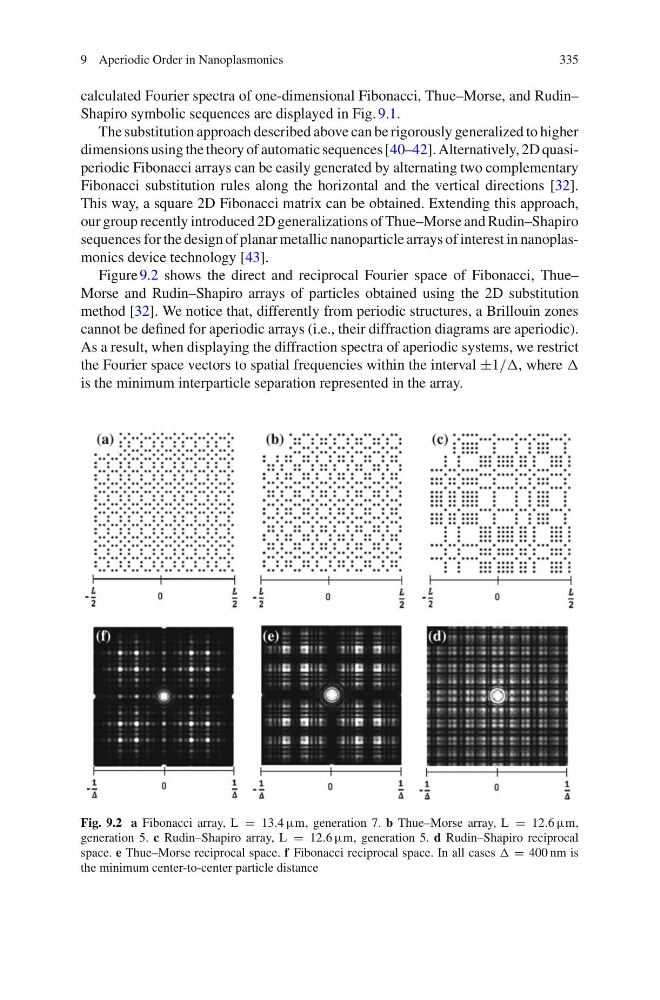
Figure 9.2 shows the direct and reciprocal Fourier space of Fibonacci, Thue–
Morse and Rudin–Shapiro arrays of particles obtained using the 2D substitution
method [32]. We notice that, differently from periodic structures, a Brillouin zones
cannot be defined for aperiodic arrays (i.e., their diffraction diagrams are aperiodic).
As a result, when displaying the diffraction spectra of aperiodic systems, we restrict
the Fourier space vectors to spatial frequencies within the interval ±1/π, where π
is the minimum interparticle separation represented in the array.
Fig. 9.2 a Fibonacci array, L = 13.4 μm, generation 7. b Thue–Morse array, L = 12.6 μm,
generation 5. c Rudin–Shapiro array, L = 12.6 μm, generation 5. d Rudin–Shapiro reciprocal
space. e Thue–Morse reciprocal space. f Fibonacci reciprocal space. In all cases π = 400 nm is
the minimum center-to-center particle distance
335
calculated Fourier spectra of one-dimensional Fibonacci, Thue–Morse, and Rudin–
Shapiro symbolic sequences are displayed in Fig. 9.1.
The substitution approach described above can be rigorously generalized to higher
dimensions using the theory of automatic sequences [40–42]. Alternatively, 2D quasiperiodic Fibonacci arrays can be easily generated by alternating two complementary
Fibonacci substitution rules along the horizontal and the vertical directions [32].
This way, a square 2D Fibonacci matrix can be obtained. Extending this approach,
our group recently introduced 2D generalizations of Thue–Morse and Rudin–Shapiro
sequences for the design of planar metallic nanoparticle arrays of interest in nanoplasmonics device technology [43].
Figure 9.2 shows the direct and reciprocal Fourier space of Fibonacci, Thue–
Morse and Rudin–Shapiro arrays of particles obtained using the 2D substitution
method [32]. We notice that, differently from periodic structures, a Brillouin zones
cannot be defined for aperiodic arrays (i.e., their diffraction diagrams are aperiodic).
As a result, when displaying the diffraction spectra of aperiodic systems, we restrict
the Fourier space vectors to spatial frequencies within the interval ±1/π, where π
is the minimum interparticle separation represented in the array.
Fig. 9.2 a Fibonacci array, L = 13.4 μm, generation 7. b Thue–Morse array, L = 12.6 μm,
generation 5. c Rudin–Shapiro array, L = 12.6 μm, generation 5. d Rudin–Shapiro reciprocal
space. e Thue–Morse reciprocal space. f Fibonacci reciprocal space. In all cases π = 400 nm is
the minimum center-to-center particle distance