

334
L. D. Negro et al.
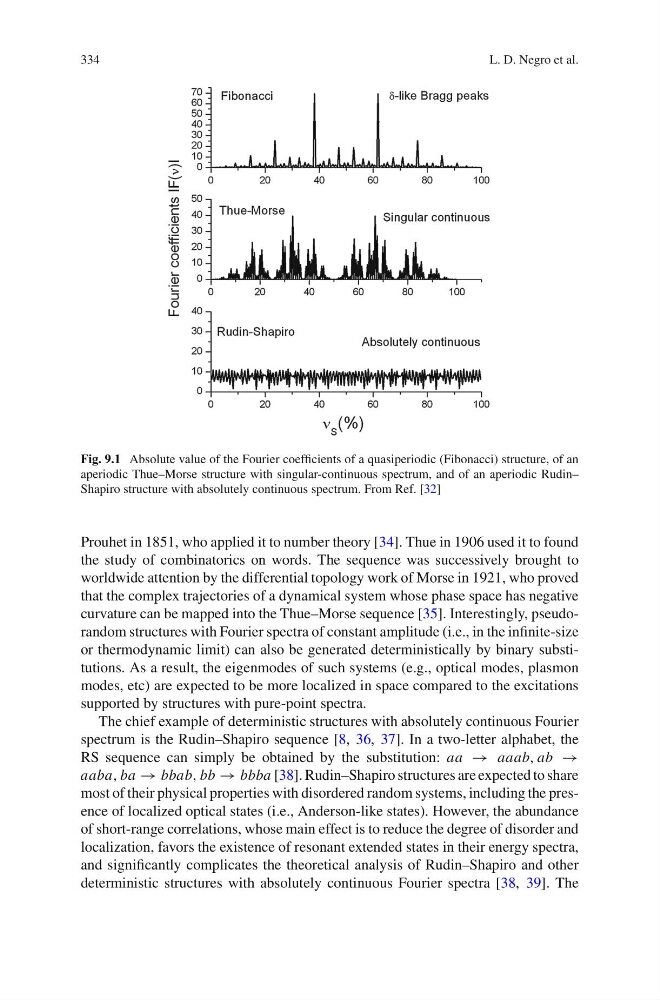
Fig. 9.1 Absolute value of the Fourier coefficients of a quasiperiodic (Fibonacci) structure, of an
aperiodic Thue–Morse structure with singular-continuous spectrum, and of an aperiodic Rudin–
Shapiro structure with absolutely continuous spectrum. From Ref. [32]
Prouhet in 1851, who applied it to number theory [34]. Thue in 1906 used it to found
the study of combinatorics on words. The sequence was successively brought to
worldwide attention by the differential topology work of Morse in 1921, who proved
that the complex trajectories of a dynamical system whose phase space has negative
curvature can be mapped into the Thue–Morse sequence [35]. Interestingly, pseudorandom structures with Fourier spectra of constant amplitude (i.e., in the infinite-size
or thermodynamic limit) can also be generated deterministically by binary substitutions. As a result, the eigenmodes of such systems (e.g., optical modes, plasmon
modes, etc) are expected to be more localized in space compared to the excitations
supported by structures with pure-point spectra.
The chief example of deterministic structures with absolutely continuous Fourier
spectrum is the Rudin–Shapiro sequence [8, 36, 37]. In a two-letter alphabet, the
RS sequence can simply be obtained by the substitution: aa ≈ aaab, ab ≈
aaba, ba ≈ bbab, bb ≈ bbba [38]. Rudin–Shapiro structures are expected to share
most of their physical properties with disordered random systems, including the presence of localized optical states (i.e., Anderson-like states). However, the abundance
of short-range correlations, whose main effect is to reduce the degree of disorder and
localization, favors the existence of resonant extended states in their energy spectra,
and significantly complicates the theoretical analysis of Rudin–Shapiro and other
deterministic structures with absolutely continuous Fourier spectra [38, 39]. The
L. D. Negro et al.
Fig. 9.1 Absolute value of the Fourier coefficients of a quasiperiodic (Fibonacci) structure, of an
aperiodic Thue–Morse structure with singular-continuous spectrum, and of an aperiodic Rudin–
Shapiro structure with absolutely continuous spectrum. From Ref. [32]
Prouhet in 1851, who applied it to number theory [34]. Thue in 1906 used it to found
the study of combinatorics on words. The sequence was successively brought to
worldwide attention by the differential topology work of Morse in 1921, who proved
that the complex trajectories of a dynamical system whose phase space has negative
curvature can be mapped into the Thue–Morse sequence [35]. Interestingly, pseudorandom structures with Fourier spectra of constant amplitude (i.e., in the infinite-size
or thermodynamic limit) can also be generated deterministically by binary substitutions. As a result, the eigenmodes of such systems (e.g., optical modes, plasmon
modes, etc) are expected to be more localized in space compared to the excitations
supported by structures with pure-point spectra.
The chief example of deterministic structures with absolutely continuous Fourier
spectrum is the Rudin–Shapiro sequence [8, 36, 37]. In a two-letter alphabet, the
RS sequence can simply be obtained by the substitution: aa ≈ aaab, ab ≈
aaba, ba ≈ bbab, bb ≈ bbba [38]. Rudin–Shapiro structures are expected to share
most of their physical properties with disordered random systems, including the presence of localized optical states (i.e., Anderson-like states). However, the abundance
of short-range correlations, whose main effect is to reduce the degree of disorder and
localization, favors the existence of resonant extended states in their energy spectra,
and significantly complicates the theoretical analysis of Rudin–Shapiro and other
deterministic structures with absolutely continuous Fourier spectra [38, 39]. The