

316
P. Ben-Abdallah et al.
121] for thermal photons. Here we present heat-flux modulation based on actively
changing the relative orientation of electrically anisotropic materials while keeping
a fixed (small) distance between them.
With the explicit expressions for the reflection matrices, we can calculate the
transmission factor in (8.13) and therefore the heat transfer (8.8) with (8.12). In order
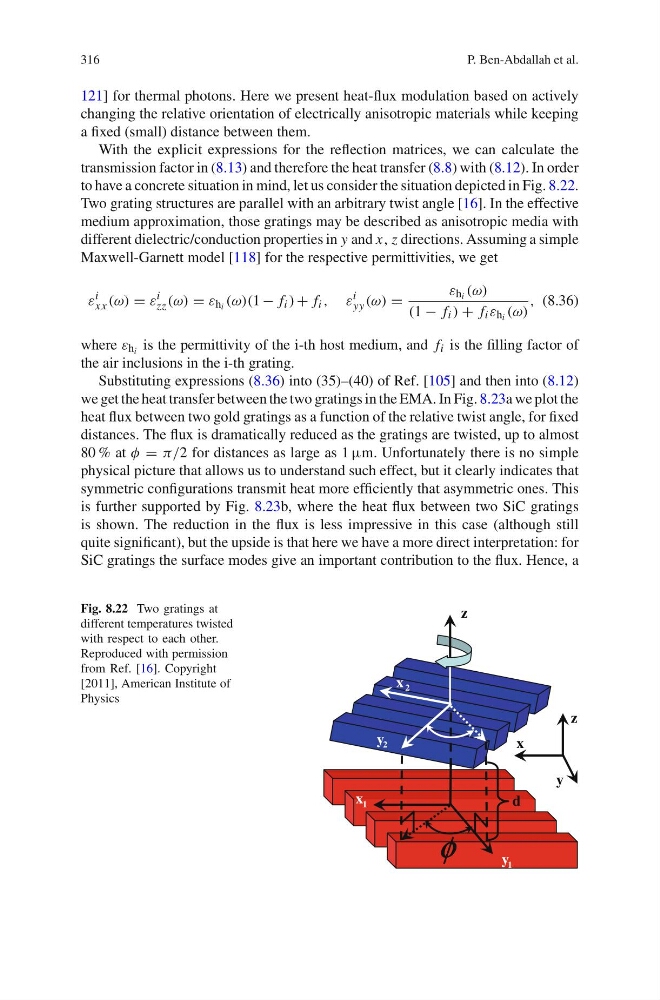
to have a concrete situation in mind, let us consider the situation depicted in Fig. 8.22.
Two grating structures are parallel with an arbitrary twist angle [16]. In the effective
medium approximation, those gratings may be described as anisotropic media with
different dielectric/conduction properties in y and x, z directions. Assuming a simple
Maxwell-Garnett model [118] for the respective permittivities, we get
ε
i
x x (ω) = ε
i
zz (ω) = ε h i (ω)(1 − f i ) + f i , ε
i
yy (ω) =
ε h i (ω)
(1 − f i ) + f i ε h i (ω)
, (8.36)
where ε h i is the permittivity of the i-th host medium, and f i is the filling factor of
the air inclusions in the i-th grating.
Substituting expressions (8.36) into (35)–(40) of Ref. [105] and then into (8.12)
we get the heat transfer between the two gratings in the EMA. In Fig. 8.23a we plot the
heat flux between two gold gratings as a function of the relative twist angle, for fixed
distances. The flux is dramatically reduced as the gratings are twisted, up to almost
80 % at φ = π/2 for distances as large as 1 µm. Unfortunately there is no simple
physical picture that allows us to understand such effect, but it clearly indicates that
symmetric configurations transmit heat more efficiently that asymmetric ones. This
is further supported by Fig. 8.23b, where the heat flux between two SiC gratings
is shown. The reduction in the flux is less impressive in this case (although still
quite significant), but the upside is that here we have a more direct interpretation: for
SiC gratings the surface modes give an important contribution to the flux. Hence, a
Fig. 8.22 Two gratings at
different temperatures twisted
with respect to each other.
Reproduced with permission
from Ref. [16]. Copyright
[2011], American Institute of
Physics
1
2
2
y
y
y
z
z
x
x
x
1
d
P. Ben-Abdallah et al.
121] for thermal photons. Here we present heat-flux modulation based on actively
changing the relative orientation of electrically anisotropic materials while keeping
a fixed (small) distance between them.
With the explicit expressions for the reflection matrices, we can calculate the
transmission factor in (8.13) and therefore the heat transfer (8.8) with (8.12). In order
to have a concrete situation in mind, let us consider the situation depicted in Fig. 8.22.
Two grating structures are parallel with an arbitrary twist angle [16]. In the effective
medium approximation, those gratings may be described as anisotropic media with
different dielectric/conduction properties in y and x, z directions. Assuming a simple
Maxwell-Garnett model [118] for the respective permittivities, we get
ε
i
x x (ω) = ε
i
zz (ω) = ε h i (ω)(1 − f i ) + f i , ε
i
yy (ω) =
ε h i (ω)
(1 − f i ) + f i ε h i (ω)
, (8.36)
where ε h i is the permittivity of the i-th host medium, and f i is the filling factor of
the air inclusions in the i-th grating.
Substituting expressions (8.36) into (35)–(40) of Ref. [105] and then into (8.12)
we get the heat transfer between the two gratings in the EMA. In Fig. 8.23a we plot the
heat flux between two gold gratings as a function of the relative twist angle, for fixed
distances. The flux is dramatically reduced as the gratings are twisted, up to almost
80 % at φ = π/2 for distances as large as 1 µm. Unfortunately there is no simple
physical picture that allows us to understand such effect, but it clearly indicates that
symmetric configurations transmit heat more efficiently that asymmetric ones. This
is further supported by Fig. 8.23b, where the heat flux between two SiC gratings
is shown. The reduction in the flux is less impressive in this case (although still
quite significant), but the upside is that here we have a more direct interpretation: for
SiC gratings the surface modes give an important contribution to the flux. Hence, a
Fig. 8.22 Two gratings at
different temperatures twisted
with respect to each other.
Reproduced with permission
from Ref. [16]. Copyright
[2011], American Institute of
Physics
1
2
2
y
y
y
z
z
x
x
x
1
d