

298
P. Ben-Abdallah et al.
8.1.6 Crossed Gratings
In this section, we discuss the possibility of designing a directional source using
surface phonon polaritons. When using a single grating, it has been shown that
emission can be directional provided that the emission frequency lies in the region
where the dispersion relation is close to the light cone. However, light is emitted into
a cone and not along a single direction. It is possible to design a two-dimensional
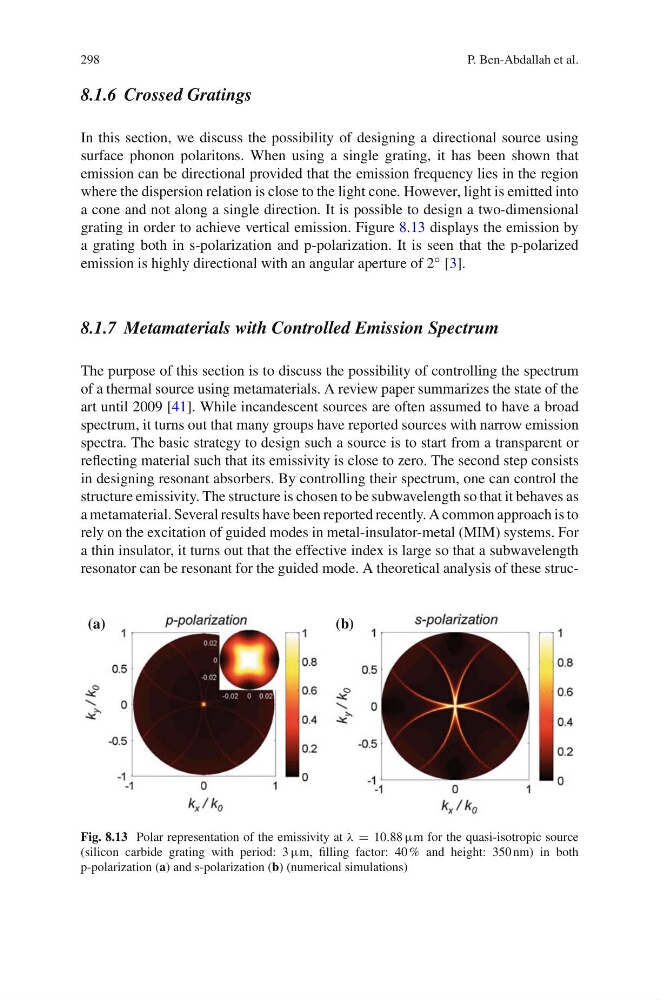
grating in order to achieve vertical emission. Figure 8.13 displays the emission by
a grating both in s-polarization and p-polarization. It is seen that the p-polarized
emission is highly directional with an angular aperture of 2 ◦ [3].
8.1.7 Metamaterials with Controlled Emission Spectrum
The purpose of this section is to discuss the possibility of controlling the spectrum
of a thermal source using metamaterials. A review paper summarizes the state of the
art until 2009 [41]. While incandescent sources are often assumed to have a broad
spectrum, it turns out that many groups have reported sources with narrow emission
spectra. The basic strategy to design such a source is to start from a transparent or
reflecting material such that its emissivity is close to zero. The second step consists
in designing resonant absorbers. By controlling their spectrum, one can control the
structure emissivity. The structure is chosen to be subwavelength so that it behaves as
a metamaterial. Several results have been reported recently. A common approach is to
rely on the excitation of guided modes in metal-insulator-metal (MIM) systems. For
a thin insulator, it turns out that the effective index is large so that a subwavelength
resonator can be resonant for the guided mode. A theoretical analysis of these struc(a)
(b)
Fig. 8.13 Polar representation of the emissivity at λ = 10.88 µm for the quasi-isotropic source
(silicon carbide grating with period: 3 µm, filling factor: 40 % and height: 350 nm) in both
p-polarization (a) and s-polarization (b) (numerical simulations)
P. Ben-Abdallah et al.
8.1.6 Crossed Gratings
In this section, we discuss the possibility of designing a directional source using
surface phonon polaritons. When using a single grating, it has been shown that
emission can be directional provided that the emission frequency lies in the region
where the dispersion relation is close to the light cone. However, light is emitted into
a cone and not along a single direction. It is possible to design a two-dimensional
grating in order to achieve vertical emission. Figure 8.13 displays the emission by
a grating both in s-polarization and p-polarization. It is seen that the p-polarized
emission is highly directional with an angular aperture of 2 ◦ [3].
8.1.7 Metamaterials with Controlled Emission Spectrum
The purpose of this section is to discuss the possibility of controlling the spectrum
of a thermal source using metamaterials. A review paper summarizes the state of the
art until 2009 [41]. While incandescent sources are often assumed to have a broad
spectrum, it turns out that many groups have reported sources with narrow emission
spectra. The basic strategy to design such a source is to start from a transparent or
reflecting material such that its emissivity is close to zero. The second step consists
in designing resonant absorbers. By controlling their spectrum, one can control the
structure emissivity. The structure is chosen to be subwavelength so that it behaves as
a metamaterial. Several results have been reported recently. A common approach is to
rely on the excitation of guided modes in metal-insulator-metal (MIM) systems. For
a thin insulator, it turns out that the effective index is large so that a subwavelength
resonator can be resonant for the guided mode. A theoretical analysis of these struc(a)
(b)
Fig. 8.13 Polar representation of the emissivity at λ = 10.88 µm for the quasi-isotropic source
(silicon carbide grating with period: 3 µm, filling factor: 40 % and height: 350 nm) in both
p-polarization (a) and s-polarization (b) (numerical simulations)