

268
M. B. Raschke et al.
k(ω)
k(2 ω)
k(2 ω)
s
p
p
s
Nano-cone
90 o illumination/detection
p out
s out
sphere
cone
p
p
p
p
s
s
s
s
Nano-sphere and cone
collinear illumination/detection
(a)
(b)
(c)
P (2) (2ω)
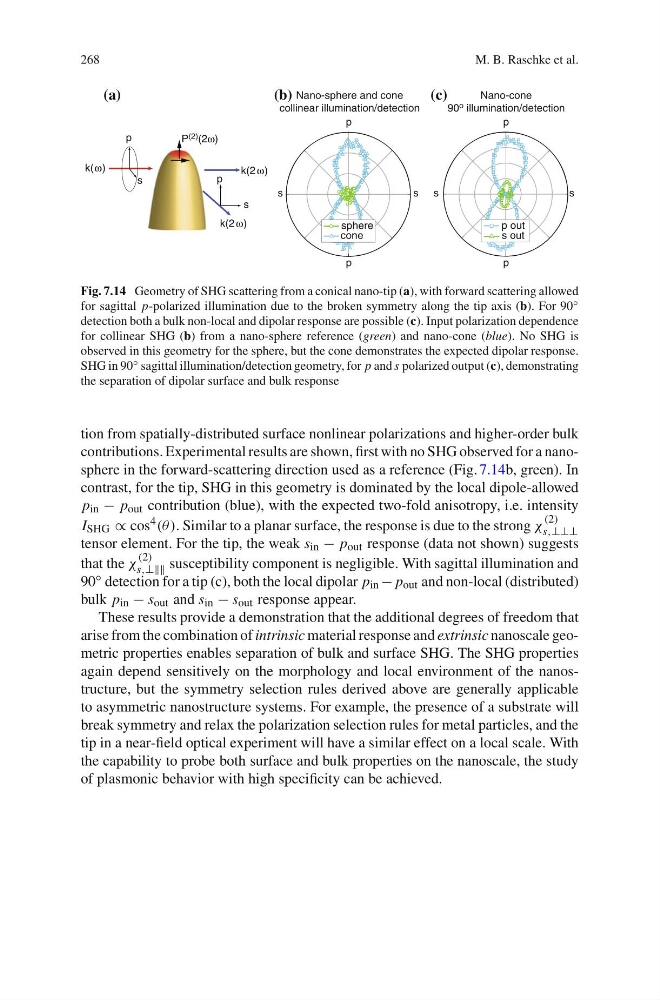
Fig. 7.14 Geometry of SHG scattering from a conical nano-tip (a), with forward scattering allowed
for sagittal p-polarized illumination due to the broken symmetry along the tip axis (b). For 90 ◦
detection both a bulk non-local and dipolar response are possible (c). Input polarization dependence
for collinear SHG (b) from a nano-sphere reference (green) and nano-cone (blue). No SHG is
observed in this geometry for the sphere, but the cone demonstrates the expected dipolar response.
SHG in 90 ◦ sagittal illumination/detection geometry, for p and s polarized output (c), demonstrating
the separation of dipolar surface and bulk response
tion from spatially-distributed surface nonlinear polarizations and higher-order bulk
contributions. Experimental results are shown, first with no SHG observed for a nanosphere in the forward-scattering direction used as a reference (Fig. 7.14b, green). In
contrast, for the tip, SHG in this geometry is dominated by the local dipole-allowed
p in − p out contribution (blue), with the expected two-fold anisotropy, i.e. intensity
I SHG ◦ cos 4 (θ ). Similar to a planar surface, the response is due to the strong χ
(2)
s,∞∞∞
tensor element. For the tip, the weak s in − p out response (data not shown) suggests
that the χ
(2)
s,∞∗∗ susceptibility component is negligible. With sagittal illumination and
90 ◦ detection for a tip (c), both the local dipolar p in − p out and non-local (distributed)
bulk p in − s out and s in − s out response appear.
These results provide a demonstration that the additional degrees of freedom that
arise from the combination of intrinsic material response and extrinsic nanoscale geometric properties enables separation of bulk and surface SHG. The SHG properties
again depend sensitively on the morphology and local environment of the nanostructure, but the symmetry selection rules derived above are generally applicable
to asymmetric nanostructure systems. For example, the presence of a substrate will
break symmetry and relax the polarization selection rules for metal particles, and the
tip in a near-field optical experiment will have a similar effect on a local scale. With
the capability to probe both surface and bulk properties on the nanoscale, the study
of plasmonic behavior with high specificity can be achieved.
M. B. Raschke et al.
k(ω)
k(2 ω)
k(2 ω)
s
p
p
s
Nano-cone
90 o illumination/detection
p out
s out
sphere
cone
p
p
p
p
s
s
s
s
Nano-sphere and cone
collinear illumination/detection
(a)
(b)
(c)
P (2) (2ω)
Fig. 7.14 Geometry of SHG scattering from a conical nano-tip (a), with forward scattering allowed
for sagittal p-polarized illumination due to the broken symmetry along the tip axis (b). For 90 ◦
detection both a bulk non-local and dipolar response are possible (c). Input polarization dependence
for collinear SHG (b) from a nano-sphere reference (green) and nano-cone (blue). No SHG is
observed in this geometry for the sphere, but the cone demonstrates the expected dipolar response.
SHG in 90 ◦ sagittal illumination/detection geometry, for p and s polarized output (c), demonstrating
the separation of dipolar surface and bulk response
tion from spatially-distributed surface nonlinear polarizations and higher-order bulk
contributions. Experimental results are shown, first with no SHG observed for a nanosphere in the forward-scattering direction used as a reference (Fig. 7.14b, green). In
contrast, for the tip, SHG in this geometry is dominated by the local dipole-allowed
p in − p out contribution (blue), with the expected two-fold anisotropy, i.e. intensity
I SHG ◦ cos 4 (θ ). Similar to a planar surface, the response is due to the strong χ
(2)
s,∞∞∞
tensor element. For the tip, the weak s in − p out response (data not shown) suggests
that the χ
(2)
s,∞∗∗ susceptibility component is negligible. With sagittal illumination and
90 ◦ detection for a tip (c), both the local dipolar p in − p out and non-local (distributed)
bulk p in − s out and s in − s out response appear.
These results provide a demonstration that the additional degrees of freedom that
arise from the combination of intrinsic material response and extrinsic nanoscale geometric properties enables separation of bulk and surface SHG. The SHG properties
again depend sensitively on the morphology and local environment of the nanostructure, but the symmetry selection rules derived above are generally applicable
to asymmetric nanostructure systems. For example, the presence of a substrate will
break symmetry and relax the polarization selection rules for metal particles, and the
tip in a near-field optical experiment will have a similar effect on a local scale. With
the capability to probe both surface and bulk properties on the nanoscale, the study
of plasmonic behavior with high specificity can be achieved.