

7 Ultrafast and Nonlinear Plasmon Dynamics
267
ω
ω
2ω
2ω
P
(2) (2ω)
P
(2) (2ω)
P
(2) (2ω)
2ω
loc
P
(2) (2ω)
nonloc
loc
loc
P
(2) (2ω)
nonloc
(a)
(b)
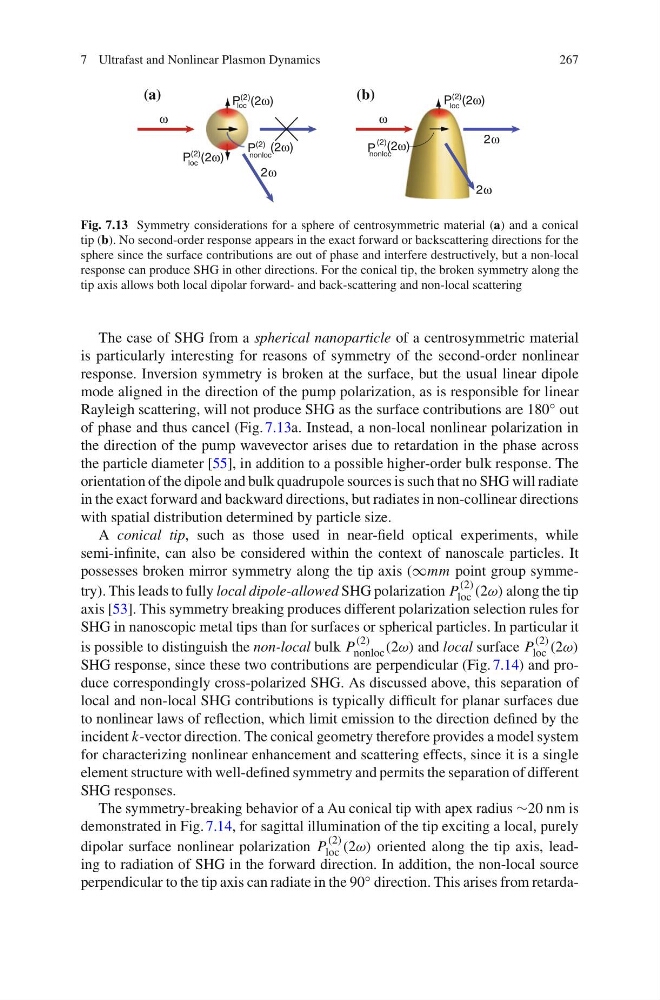
Fig. 7.13 Symmetry considerations for a sphere of centrosymmetric material (a) and a conical
tip (b). No second-order response appears in the exact forward or backscattering directions for the
sphere since the surface contributions are out of phase and interfere destructively, but a non-local
response can produce SHG in other directions. For the conical tip, the broken symmetry along the
tip axis allows both local dipolar forward- and back-scattering and non-local scattering
The case of SHG from a spherical nanoparticle of a centrosymmetric material
is particularly interesting for reasons of symmetry of the second-order nonlinear
response. Inversion symmetry is broken at the surface, but the usual linear dipole
mode aligned in the direction of the pump polarization, as is responsible for linear
Rayleigh scattering, will not produce SHG as the surface contributions are 180 ◦ out
of phase and thus cancel (Fig. 7.13a. Instead, a non-local nonlinear polarization in
the direction of the pump wavevector arises due to retardation in the phase across
the particle diameter [55], in addition to a possible higher-order bulk response. The
orientation of the dipole and bulk quadrupole sources is such that no SHG will radiate
in the exact forward and backward directions, but radiates in non-collinear directions
with spatial distribution determined by particle size.
A conical tip, such as those used in near-field optical experiments, while
semi-infinite, can also be considered within the context of nanoscale particles. It
possesses broken mirror symmetry along the tip axis (≈mm point group symmetry). This leads to fully local dipole-allowed SHG polarization P
(2)
loc (2ω) along the tip
axis [53]. This symmetry breaking produces different polarization selection rules for
SHG in nanoscopic metal tips than for surfaces or spherical particles. In particular it
is possible to distinguish the non-local bulk P
(2)
nonloc (2ω) and local surface P
(2)
loc (2ω)
SHG response, since these two contributions are perpendicular (Fig. 7.14) and produce correspondingly cross-polarized SHG. As discussed above, this separation of
local and non-local SHG contributions is typically difficult for planar surfaces due
to nonlinear laws of reflection, which limit emission to the direction defined by the
incident k-vector direction. The conical geometry therefore provides a model system
for characterizing nonlinear enhancement and scattering effects, since it is a single
element structure with well-defined symmetry and permits the separation of different
SHG responses.
The symmetry-breaking behavior of a Au conical tip with apex radius ∝20 nm is
demonstrated in Fig. 7.14, for sagittal illumination of the tip exciting a local, purely
dipolar surface nonlinear polarization P
(2)
loc (2ω) oriented along the tip axis, leading to radiation of SHG in the forward direction. In addition, the non-local source
perpendicular to the tip axis can radiate in the 90 ◦ direction. This arises from retarda-
267
ω
ω
2ω
2ω
P
(2) (2ω)
P
(2) (2ω)
P
(2) (2ω)
2ω
loc
P
(2) (2ω)
nonloc
loc
loc
P
(2) (2ω)
nonloc
(a)
(b)
Fig. 7.13 Symmetry considerations for a sphere of centrosymmetric material (a) and a conical
tip (b). No second-order response appears in the exact forward or backscattering directions for the
sphere since the surface contributions are out of phase and interfere destructively, but a non-local
response can produce SHG in other directions. For the conical tip, the broken symmetry along the
tip axis allows both local dipolar forward- and back-scattering and non-local scattering
The case of SHG from a spherical nanoparticle of a centrosymmetric material
is particularly interesting for reasons of symmetry of the second-order nonlinear
response. Inversion symmetry is broken at the surface, but the usual linear dipole
mode aligned in the direction of the pump polarization, as is responsible for linear
Rayleigh scattering, will not produce SHG as the surface contributions are 180 ◦ out
of phase and thus cancel (Fig. 7.13a. Instead, a non-local nonlinear polarization in
the direction of the pump wavevector arises due to retardation in the phase across
the particle diameter [55], in addition to a possible higher-order bulk response. The
orientation of the dipole and bulk quadrupole sources is such that no SHG will radiate
in the exact forward and backward directions, but radiates in non-collinear directions
with spatial distribution determined by particle size.
A conical tip, such as those used in near-field optical experiments, while
semi-infinite, can also be considered within the context of nanoscale particles. It
possesses broken mirror symmetry along the tip axis (≈mm point group symmetry). This leads to fully local dipole-allowed SHG polarization P
(2)
loc (2ω) along the tip
axis [53]. This symmetry breaking produces different polarization selection rules for
SHG in nanoscopic metal tips than for surfaces or spherical particles. In particular it
is possible to distinguish the non-local bulk P
(2)
nonloc (2ω) and local surface P
(2)
loc (2ω)
SHG response, since these two contributions are perpendicular (Fig. 7.14) and produce correspondingly cross-polarized SHG. As discussed above, this separation of
local and non-local SHG contributions is typically difficult for planar surfaces due
to nonlinear laws of reflection, which limit emission to the direction defined by the
incident k-vector direction. The conical geometry therefore provides a model system
for characterizing nonlinear enhancement and scattering effects, since it is a single
element structure with well-defined symmetry and permits the separation of different
SHG responses.
The symmetry-breaking behavior of a Au conical tip with apex radius ∝20 nm is
demonstrated in Fig. 7.14, for sagittal illumination of the tip exciting a local, purely
dipolar surface nonlinear polarization P
(2)
loc (2ω) oriented along the tip axis, leading to radiation of SHG in the forward direction. In addition, the non-local source
perpendicular to the tip axis can radiate in the 90 ◦ direction. This arises from retarda-