

248
M. B. Raschke et al.
6
4 3 2 1
a / b = 8
0
0.2
0.4
0.8
0.6
1
|α|
2
(arb. units)
1
2
2 . 5
1.5
3
Energy (eV)
Aspect Ratio (a/b)
1
1.5
2
2.5
Peak Position (eV)
2
4
6
8
1 0
Dephasing Time (fs)
5
10
15
20
(d)
(a)
(b)
(c)
a / b = 2, τ = 4.3 fs
a / b = 4, τ = 13.2 fs
a / b = 6, τ = 18.3 fs
a / b = 8, τ = 19.4 fs
0
0.2
0.4
0.6
0.8
1
Norm. Amplitude
0
1 0
2 0
3 0
4 0
Time (fs)
a
b
Free-induction decay
SPP resonance
E
P
E scat
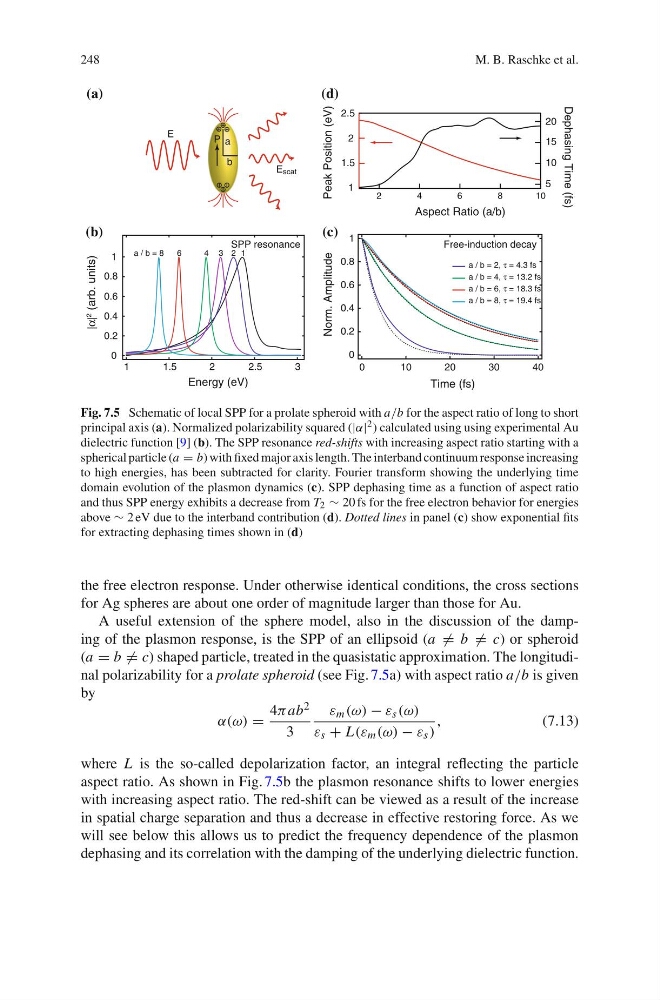
Fig. 7.5 Schematic of local SPP for a prolate spheroid with a/b for the aspect ratio of long to short
principal axis (a). Normalized polarizability squared (|α| 2 ) calculated using using experimental Au
dielectric function [9] (b). The SPP resonance red-shifts with increasing aspect ratio starting with a
spherical particle (a = b) with fixed major axis length. The interband continuum response increasing
to high energies, has been subtracted for clarity. Fourier transform showing the underlying time
domain evolution of the plasmon dynamics (c). SPP dephasing time as a function of aspect ratio
and thus SPP energy exhibits a decrease from T 2 ∝ 20 fs for the free electron behavior for energies
above ∝ 2 eV due to the interband contribution (d). Dotted lines in panel (c) show exponential fits
for extracting dephasing times shown in (d)
the free electron response. Under otherwise identical conditions, the cross sections
for Ag spheres are about one order of magnitude larger than those for Au.
A useful extension of the sphere model, also in the discussion of the damping of the plasmon response, is the SPP of an ellipsoid (a ≤ = b ≤ = c) or spheroid
(a = b ≤ = c) shaped particle, treated in the quasistatic approximation. The longitudinal polarizability for a prolate spheroid (see Fig. 7.5a) with aspect ratio a/b is given
by
α(ω) =
4πab 2
3
ε m (ω) − ε s (ω)
ε s + L(ε m (ω) − ε s )
,
(7.13)
where L is the so-called depolarization factor, an integral reflecting the particle
aspect ratio. As shown in Fig. 7.5b the plasmon resonance shifts to lower energies
with increasing aspect ratio. The red-shift can be viewed as a result of the increase
in spatial charge separation and thus a decrease in effective restoring force. As we
will see below this allows us to predict the frequency dependence of the plasmon
dephasing and its correlation with the damping of the underlying dielectric function.
M. B. Raschke et al.
6
4 3 2 1
a / b = 8
0
0.2
0.4
0.8
0.6
1
|α|
2
(arb. units)
1
2
2 . 5
1.5
3
Energy (eV)
Aspect Ratio (a/b)
1
1.5
2
2.5
Peak Position (eV)
2
4
6
8
1 0
Dephasing Time (fs)
5
10
15
20
(d)
(a)
(b)
(c)
a / b = 2, τ = 4.3 fs
a / b = 4, τ = 13.2 fs
a / b = 6, τ = 18.3 fs
a / b = 8, τ = 19.4 fs
0
0.2
0.4
0.6
0.8
1
Norm. Amplitude
0
1 0
2 0
3 0
4 0
Time (fs)
a
b
Free-induction decay
SPP resonance
E
P
E scat
Fig. 7.5 Schematic of local SPP for a prolate spheroid with a/b for the aspect ratio of long to short
principal axis (a). Normalized polarizability squared (|α| 2 ) calculated using using experimental Au
dielectric function [9] (b). The SPP resonance red-shifts with increasing aspect ratio starting with a
spherical particle (a = b) with fixed major axis length. The interband continuum response increasing
to high energies, has been subtracted for clarity. Fourier transform showing the underlying time
domain evolution of the plasmon dynamics (c). SPP dephasing time as a function of aspect ratio
and thus SPP energy exhibits a decrease from T 2 ∝ 20 fs for the free electron behavior for energies
above ∝ 2 eV due to the interband contribution (d). Dotted lines in panel (c) show exponential fits
for extracting dephasing times shown in (d)
the free electron response. Under otherwise identical conditions, the cross sections
for Ag spheres are about one order of magnitude larger than those for Au.
A useful extension of the sphere model, also in the discussion of the damping of the plasmon response, is the SPP of an ellipsoid (a ≤ = b ≤ = c) or spheroid
(a = b ≤ = c) shaped particle, treated in the quasistatic approximation. The longitudinal polarizability for a prolate spheroid (see Fig. 7.5a) with aspect ratio a/b is given
by
α(ω) =
4πab 2
3
ε m (ω) − ε s (ω)
ε s + L(ε m (ω) − ε s )
,
(7.13)
where L is the so-called depolarization factor, an integral reflecting the particle
aspect ratio. As shown in Fig. 7.5b the plasmon resonance shifts to lower energies
with increasing aspect ratio. The red-shift can be viewed as a result of the increase
in spatial charge separation and thus a decrease in effective restoring force. As we
will see below this allows us to predict the frequency dependence of the plasmon
dephasing and its correlation with the damping of the underlying dielectric function.