

7 Ultrafast and Nonlinear Plasmon Dynamics
247
of a flat surface. For a spherical particles discussed here as an example, R is the radius. In analogy to the wavelength of a surface wave of λ = 2π/k, with wavevector
k, for a spherical particle the local mode can be described by an effective wavelength
λ eff given by the circumference as λ eff = 2π R. This analogy implies k ∝ 1/R. 6
The optical response of a sphere of arbitrary radius can be solved exactly using
(the albeit computationally intensive) Mie theory [11, 12], discussed here and also
further below in the context of damping. Analyzing the limiting case of a spherical
particle provides insight into the basic mechanisms underlying the particle response
and its dependence on different input parameters. Many of the conclusions can be
generalized to other simple geometries, such as rods, discs, etc.
For particles which are small compared to the wavelength, the response can be
more simply described by an induced optical dipole in the lowest order approximation, when neglecting retardation. In that quasistatic limit (R √ λ), provided the
particle is still large enough to avoid finite size effects on the intrinsic dielectric
properties, 7 the field distribution of the particle follows from the Laplace equation
in spherical polar coordinates. The field outside the sphere is equivalent to the field
of a point dipole at the center of the sphere with dipole moment p = ε 0 ε s α E. The
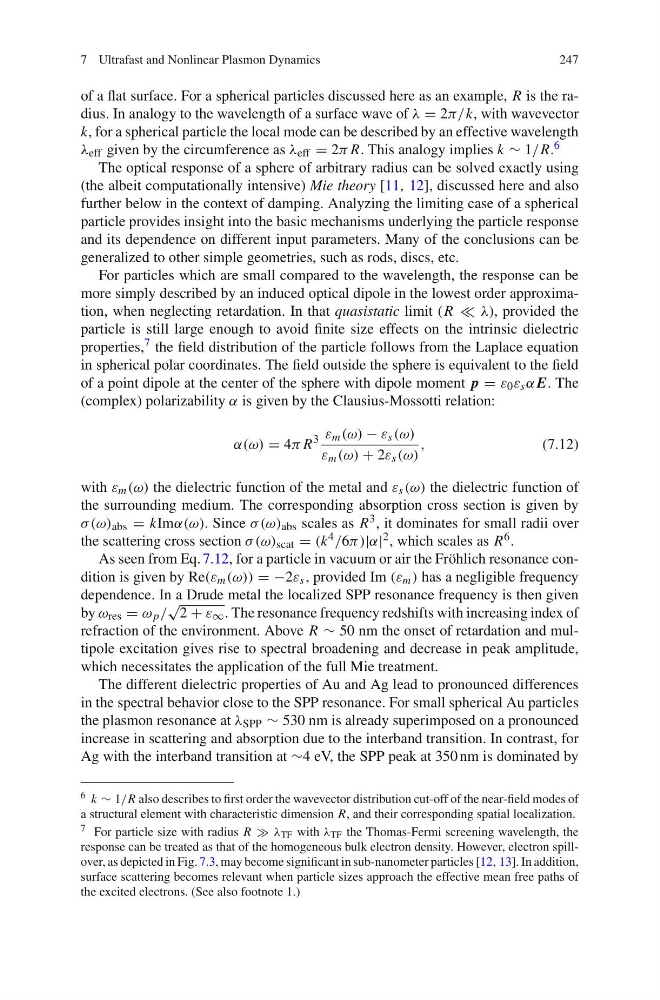
(complex) polarizability α is given by the Clausius-Mossotti relation:
α(ω) = 4π R
3 ε m (ω) − ε s (ω)
ε m (ω) + 2ε s (ω)
,
(7.12)
with ε m (ω) the dielectric function of the metal and ε s (ω) the dielectric function of
the surrounding medium. The corresponding absorption cross section is given by
σ (ω) abs = kImα(ω). Since σ (ω) abs scales as R 3 , it dominates for small radii over
the scattering cross section σ (ω) scat = (k 4 /6π)|α| 2 , which scales as R 6 .
As seen from Eq. 7.12, for a particle in vacuum or air the Fröhlich resonance condition is given by Re(ε m (ω)) = −2ε s , provided Im (ε m ) has a negligible frequency
dependence. In a Drude metal the localized SPP resonance frequency is then given
by ω res = ω p /
∪
2 + ε ≈ . The resonance frequency redshifts with increasing index of
refraction of the environment. Above R ∝ 50 nm the onset of retardation and multipole excitation gives rise to spectral broadening and decrease in peak amplitude,
which necessitates the application of the full Mie treatment.
The different dielectric properties of Au and Ag lead to pronounced differences
in the spectral behavior close to the SPP resonance. For small spherical Au particles
the plasmon resonance at λ SPP ∝ 530 nm is already superimposed on a pronounced
increase in scattering and absorption due to the interband transition. In contrast, for
Ag with the interband transition at ∝4 eV, the SPP peak at 350 nm is dominated by
6 k ∝ 1/R also describes to first order the wavevector distribution cut-off of the near-field modes of
a structural element with characteristic dimension R, and their corresponding spatial localization.
7 For particle size with radius R ≡ λ TF with λ TF the Thomas-Fermi screening wavelength, the
response can be treated as that of the homogeneous bulk electron density. However, electron spillover, as depicted in Fig. 7.3, may become significant in sub-nanometer particles [12, 13]. In addition,
surface scattering becomes relevant when particle sizes approach the effective mean free paths of
the excited electrons. (See also footnote 1.)
247
of a flat surface. For a spherical particles discussed here as an example, R is the radius. In analogy to the wavelength of a surface wave of λ = 2π/k, with wavevector
k, for a spherical particle the local mode can be described by an effective wavelength
λ eff given by the circumference as λ eff = 2π R. This analogy implies k ∝ 1/R. 6
The optical response of a sphere of arbitrary radius can be solved exactly using
(the albeit computationally intensive) Mie theory [11, 12], discussed here and also
further below in the context of damping. Analyzing the limiting case of a spherical
particle provides insight into the basic mechanisms underlying the particle response
and its dependence on different input parameters. Many of the conclusions can be
generalized to other simple geometries, such as rods, discs, etc.
For particles which are small compared to the wavelength, the response can be
more simply described by an induced optical dipole in the lowest order approximation, when neglecting retardation. In that quasistatic limit (R √ λ), provided the
particle is still large enough to avoid finite size effects on the intrinsic dielectric
properties, 7 the field distribution of the particle follows from the Laplace equation
in spherical polar coordinates. The field outside the sphere is equivalent to the field
of a point dipole at the center of the sphere with dipole moment p = ε 0 ε s α E. The
(complex) polarizability α is given by the Clausius-Mossotti relation:
α(ω) = 4π R
3 ε m (ω) − ε s (ω)
ε m (ω) + 2ε s (ω)
,
(7.12)
with ε m (ω) the dielectric function of the metal and ε s (ω) the dielectric function of
the surrounding medium. The corresponding absorption cross section is given by
σ (ω) abs = kImα(ω). Since σ (ω) abs scales as R 3 , it dominates for small radii over
the scattering cross section σ (ω) scat = (k 4 /6π)|α| 2 , which scales as R 6 .
As seen from Eq. 7.12, for a particle in vacuum or air the Fröhlich resonance condition is given by Re(ε m (ω)) = −2ε s , provided Im (ε m ) has a negligible frequency
dependence. In a Drude metal the localized SPP resonance frequency is then given
by ω res = ω p /
∪
2 + ε ≈ . The resonance frequency redshifts with increasing index of
refraction of the environment. Above R ∝ 50 nm the onset of retardation and multipole excitation gives rise to spectral broadening and decrease in peak amplitude,
which necessitates the application of the full Mie treatment.
The different dielectric properties of Au and Ag lead to pronounced differences
in the spectral behavior close to the SPP resonance. For small spherical Au particles
the plasmon resonance at λ SPP ∝ 530 nm is already superimposed on a pronounced
increase in scattering and absorption due to the interband transition. In contrast, for
Ag with the interband transition at ∝4 eV, the SPP peak at 350 nm is dominated by
6 k ∝ 1/R also describes to first order the wavevector distribution cut-off of the near-field modes of
a structural element with characteristic dimension R, and their corresponding spatial localization.
7 For particle size with radius R ≡ λ TF with λ TF the Thomas-Fermi screening wavelength, the
response can be treated as that of the homogeneous bulk electron density. However, electron spillover, as depicted in Fig. 7.3, may become significant in sub-nanometer particles [12, 13]. In addition,
surface scattering becomes relevant when particle sizes approach the effective mean free paths of
the excited electrons. (See also footnote 1.)