

244
M. B. Raschke et al.
of sp and d bands (copper (3d − 4sp), silver (4d − 5sp), and gold (5d − 6sp)), which
gives rise to mutual polarization of the s and d electrons and deviations from the
ideal free electron behavior. The d-band is therefore an integral part of the collective electron excitation, even in the regime where the free electron model effectively
describes the optical response.
The contribution of the d-bands can empirically be accounted for by writing ε(ω)
in the form ε(ω) = ε Drude (ω) + ε d (ω). The Drude term is well described by the sp
electron density behavior. The d-bands can then be described in an extended Drude
or Drude-Lorentz type model, with the d-electrons assigned an effective Coulomb
restoring force, and with a certain density of oscillators, to parametrize the response.
7.1.7 Optics at Metal Interfaces
Following the general discussion of the optical properties of basic metals expressed
through their dielectric function, we proceed to the description of surface plasmon
polaritons (SPPs) as a collective excitation. A unified description of optical surface
wave phenomena, in particular the notion of SPPs, was developed from the work of
Sommerfeld, Zenneck, and Wood at the beginning of twentieth century, with subsequent experimental studies by Ritchie, Stern, Kretschmann, and Raether, together
with related work by Mie. The optical excitation of the free electrons at the interface
of a metal with vacuum or a dielectric medium gives rise to a collective oscillation of
the carriers. This surface charge density oscillation is associated with a time varying
optical field, hence the notion of a surface plasmon polariton. 3
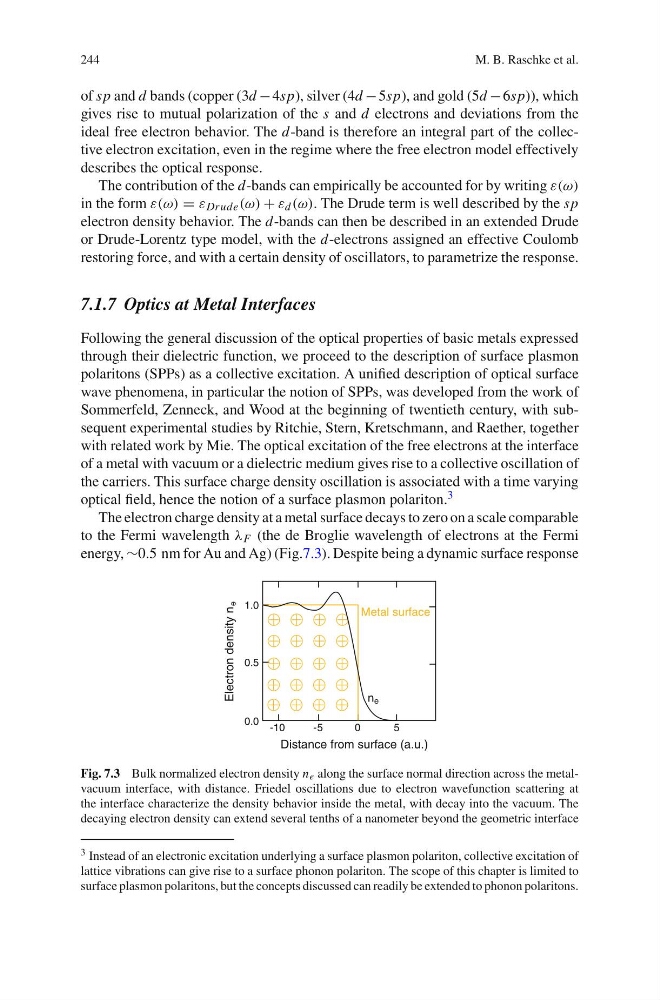
The electron charge density at a metal surface decays to zero on a scale comparable
to the Fermi wavelength λ F (the de Broglie wavelength of electrons at the Fermi
energy, ∝0.5 nm for Au and Ag) (Fig.7.3). Despite being a dynamic surface response
-10
-5
0
Distance from surface (a.u.)
Electron density n
e
1.0
0.0
Metal surface
5
0.5
n e
Fig. 7.3 Bulk normalized electron density n e along the surface normal direction across the metalvacuum interface, with distance. Friedel oscillations due to electron wavefunction scattering at
the interface characterize the density behavior inside the metal, with decay into the vacuum. The
decaying electron density can extend several tenths of a nanometer beyond the geometric interface
3 Instead of an electronic excitation underlying a surface plasmon polariton, collective excitation of
lattice vibrations can give rise to a surface phonon polariton. The scope of this chapter is limited to
surface plasmon polaritons, but the concepts discussed can readily be extended to phonon polaritons.
M. B. Raschke et al.
of sp and d bands (copper (3d − 4sp), silver (4d − 5sp), and gold (5d − 6sp)), which
gives rise to mutual polarization of the s and d electrons and deviations from the
ideal free electron behavior. The d-band is therefore an integral part of the collective electron excitation, even in the regime where the free electron model effectively
describes the optical response.
The contribution of the d-bands can empirically be accounted for by writing ε(ω)
in the form ε(ω) = ε Drude (ω) + ε d (ω). The Drude term is well described by the sp
electron density behavior. The d-bands can then be described in an extended Drude
or Drude-Lorentz type model, with the d-electrons assigned an effective Coulomb
restoring force, and with a certain density of oscillators, to parametrize the response.
7.1.7 Optics at Metal Interfaces
Following the general discussion of the optical properties of basic metals expressed
through their dielectric function, we proceed to the description of surface plasmon
polaritons (SPPs) as a collective excitation. A unified description of optical surface
wave phenomena, in particular the notion of SPPs, was developed from the work of
Sommerfeld, Zenneck, and Wood at the beginning of twentieth century, with subsequent experimental studies by Ritchie, Stern, Kretschmann, and Raether, together
with related work by Mie. The optical excitation of the free electrons at the interface
of a metal with vacuum or a dielectric medium gives rise to a collective oscillation of
the carriers. This surface charge density oscillation is associated with a time varying
optical field, hence the notion of a surface plasmon polariton. 3
The electron charge density at a metal surface decays to zero on a scale comparable
to the Fermi wavelength λ F (the de Broglie wavelength of electrons at the Fermi
energy, ∝0.5 nm for Au and Ag) (Fig.7.3). Despite being a dynamic surface response
-10
-5
0
Distance from surface (a.u.)
Electron density n
e
1.0
0.0
Metal surface
5
0.5
n e
Fig. 7.3 Bulk normalized electron density n e along the surface normal direction across the metalvacuum interface, with distance. Friedel oscillations due to electron wavefunction scattering at
the interface characterize the density behavior inside the metal, with decay into the vacuum. The
decaying electron density can extend several tenths of a nanometer beyond the geometric interface
3 Instead of an electronic excitation underlying a surface plasmon polariton, collective excitation of
lattice vibrations can give rise to a surface phonon polariton. The scope of this chapter is limited to
surface plasmon polaritons, but the concepts discussed can readily be extended to phonon polaritons.