

242
M. B. Raschke et al.
current. This reflects the hypothetical picture of a current that will persist infinitely
long after a field is no longer applied.
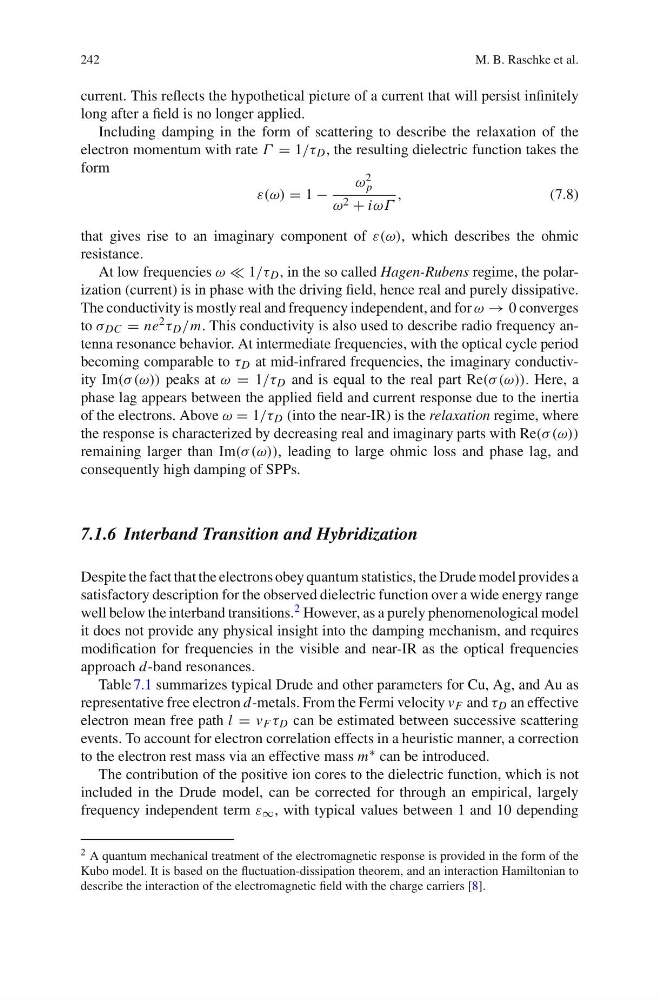
Including damping in the form of scattering to describe the relaxation of the
electron momentum with rate Γ = 1/τ D , the resulting dielectric function takes the
form
ε(ω) = 1 −
ω 2
p
ω 2 + iωΓ
,
(7.8)
that gives rise to an imaginary component of ε(ω), which describes the ohmic
resistance.
At low frequencies ω √ 1/τ D , in the so called Hagen-Rubens regime, the polarization (current) is in phase with the driving field, hence real and purely dissipative.
The conductivity is mostly real and frequency independent, and for ω ∈ 0 converges
to σ DC = ne 2 τ D /m. This conductivity is also used to describe radio frequency antenna resonance behavior. At intermediate frequencies, with the optical cycle period
becoming comparable to τ D at mid-infrared frequencies, the imaginary conductivity Im(σ (ω)) peaks at ω = 1/τ D and is equal to the real part Re(σ (ω)). Here, a
phase lag appears between the applied field and current response due to the inertia
of the electrons. Above ω = 1/τ D (into the near-IR) is the relaxation regime, where
the response is characterized by decreasing real and imaginary parts with Re(σ (ω))
remaining larger than Im(σ (ω)), leading to large ohmic loss and phase lag, and
consequently high damping of SPPs.
7.1.6 Interband Transition and Hybridization
Despite the fact that the electrons obey quantum statistics, the Drude model provides a
satisfactory description for the observed dielectric function over a wide energy range
well below the interband transitions. 2 However, as a purely phenomenological model
it does not provide any physical insight into the damping mechanism, and requires
modification for frequencies in the visible and near-IR as the optical frequencies
approach d-band resonances.
Table 7.1 summarizes typical Drude and other parameters for Cu, Ag, and Au as
representative free electron d-metals. From the Fermi velocity v F and τ D an effective
electron mean free path l = v F τ D can be estimated between successive scattering
events. To account for electron correlation effects in a heuristic manner, a correction
to the electron rest mass via an effective mass m ≥ can be introduced.
The contribution of the positive ion cores to the dielectric function, which is not
included in the Drude model, can be corrected for through an empirical, largely
frequency independent term ε ≈ , with typical values between 1 and 10 depending
2 A quantum mechanical treatment of the electromagnetic response is provided in the form of the
Kubo model. It is based on the fluctuation-dissipation theorem, and an interaction Hamiltonian to
describe the interaction of the electromagnetic field with the charge carriers [8].
M. B. Raschke et al.
current. This reflects the hypothetical picture of a current that will persist infinitely
long after a field is no longer applied.
Including damping in the form of scattering to describe the relaxation of the
electron momentum with rate Γ = 1/τ D , the resulting dielectric function takes the
form
ε(ω) = 1 −
ω 2
p
ω 2 + iωΓ
,
(7.8)
that gives rise to an imaginary component of ε(ω), which describes the ohmic
resistance.
At low frequencies ω √ 1/τ D , in the so called Hagen-Rubens regime, the polarization (current) is in phase with the driving field, hence real and purely dissipative.
The conductivity is mostly real and frequency independent, and for ω ∈ 0 converges
to σ DC = ne 2 τ D /m. This conductivity is also used to describe radio frequency antenna resonance behavior. At intermediate frequencies, with the optical cycle period
becoming comparable to τ D at mid-infrared frequencies, the imaginary conductivity Im(σ (ω)) peaks at ω = 1/τ D and is equal to the real part Re(σ (ω)). Here, a
phase lag appears between the applied field and current response due to the inertia
of the electrons. Above ω = 1/τ D (into the near-IR) is the relaxation regime, where
the response is characterized by decreasing real and imaginary parts with Re(σ (ω))
remaining larger than Im(σ (ω)), leading to large ohmic loss and phase lag, and
consequently high damping of SPPs.
7.1.6 Interband Transition and Hybridization
Despite the fact that the electrons obey quantum statistics, the Drude model provides a
satisfactory description for the observed dielectric function over a wide energy range
well below the interband transitions. 2 However, as a purely phenomenological model
it does not provide any physical insight into the damping mechanism, and requires
modification for frequencies in the visible and near-IR as the optical frequencies
approach d-band resonances.
Table 7.1 summarizes typical Drude and other parameters for Cu, Ag, and Au as
representative free electron d-metals. From the Fermi velocity v F and τ D an effective
electron mean free path l = v F τ D can be estimated between successive scattering
events. To account for electron correlation effects in a heuristic manner, a correction
to the electron rest mass via an effective mass m ≥ can be introduced.
The contribution of the positive ion cores to the dielectric function, which is not
included in the Drude model, can be corrected for through an empirical, largely
frequency independent term ε ≈ , with typical values between 1 and 10 depending
2 A quantum mechanical treatment of the electromagnetic response is provided in the form of the
Kubo model. It is based on the fluctuation-dissipation theorem, and an interaction Hamiltonian to
describe the interaction of the electromagnetic field with the charge carriers [8].