

218
M. Kauranen et al.
vertical and horizontal bars [84]. This gives rise to chirality of the dimer, which can
be addressed by SHG with circularly-polarized fundamental light. More specifically,
chirality is expected to lead to different SHG responses for left- and right-hand
circularly-polarized fundamental beams [34, 85]. This can be quantified by the SHG
circular-difference (CD) response defined as
C D R = 2
I L HC (2ω) − I R HC (2ω)
I L HC (2ω) + I R HC (2ω)
,
(6.3)
where LHC and RHC refer to the circular polarizations of the fundamental beam.
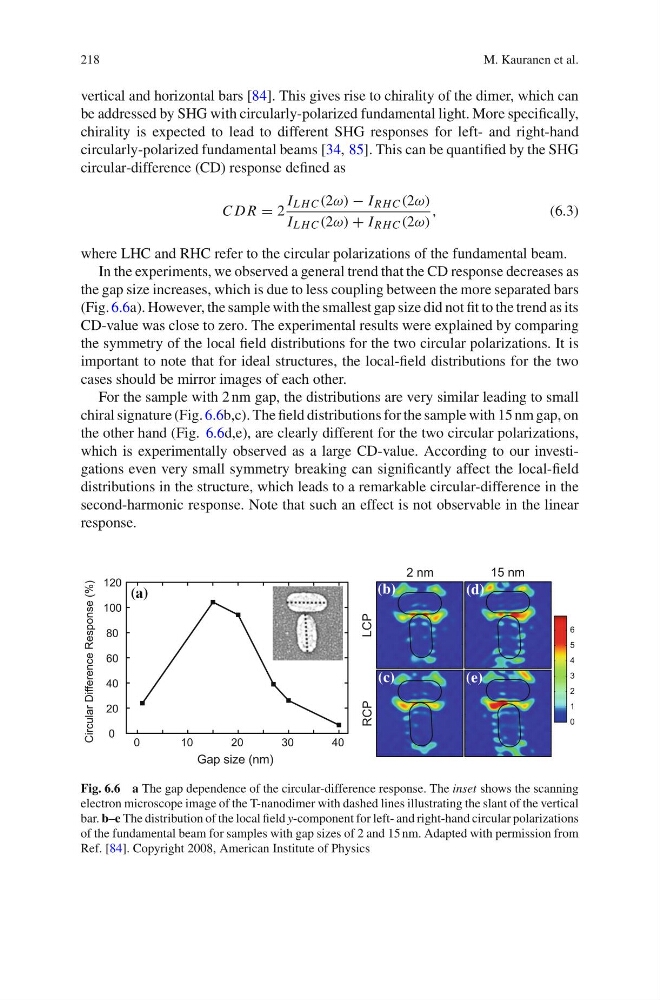
In the experiments, we observed a general trend that the CD response decreases as
the gap size increases, which is due to less coupling between the more separated bars
(Fig. 6.6a). However, the sample with the smallest gap size did not fit to the trend as its
CD-value was close to zero. The experimental results were explained by comparing
the symmetry of the local field distributions for the two circular polarizations. It is
important to note that for ideal structures, the local-field distributions for the two
cases should be mirror images of each other.
For the sample with 2 nm gap, the distributions are very similar leading to small
chiral signature (Fig. 6.6b,c). The field distributions for the sample with 15 nm gap, on
the other hand (Fig. 6.6d,e), are clearly different for the two circular polarizations,
which is experimentally observed as a large CD-value. According to our investigations even very small symmetry breaking can significantly affect the local-field
distributions in the structure, which leads to a remarkable circular-difference in the
second-harmonic response. Note that such an effect is not observable in the linear
response.
(a)
(b)
(c)
(d)
(e)
Fig. 6.6 a The gap dependence of the circular-difference response. The inset shows the scanning
electron microscope image of the T-nanodimer with dashed lines illustrating the slant of the vertical
bar. b–e The distribution of the local field y-component for left- and right-hand circular polarizations
of the fundamental beam for samples with gap sizes of 2 and 15 nm. Adapted with permission from
Ref. [84]. Copyright 2008, American Institute of Physics
M. Kauranen et al.
vertical and horizontal bars [84]. This gives rise to chirality of the dimer, which can
be addressed by SHG with circularly-polarized fundamental light. More specifically,
chirality is expected to lead to different SHG responses for left- and right-hand
circularly-polarized fundamental beams [34, 85]. This can be quantified by the SHG
circular-difference (CD) response defined as
C D R = 2
I L HC (2ω) − I R HC (2ω)
I L HC (2ω) + I R HC (2ω)
,
(6.3)
where LHC and RHC refer to the circular polarizations of the fundamental beam.
In the experiments, we observed a general trend that the CD response decreases as
the gap size increases, which is due to less coupling between the more separated bars
(Fig. 6.6a). However, the sample with the smallest gap size did not fit to the trend as its
CD-value was close to zero. The experimental results were explained by comparing
the symmetry of the local field distributions for the two circular polarizations. It is
important to note that for ideal structures, the local-field distributions for the two
cases should be mirror images of each other.
For the sample with 2 nm gap, the distributions are very similar leading to small
chiral signature (Fig. 6.6b,c). The field distributions for the sample with 15 nm gap, on
the other hand (Fig. 6.6d,e), are clearly different for the two circular polarizations,
which is experimentally observed as a large CD-value. According to our investigations even very small symmetry breaking can significantly affect the local-field
distributions in the structure, which leads to a remarkable circular-difference in the
second-harmonic response. Note that such an effect is not observable in the linear
response.
(a)
(b)
(c)
(d)
(e)
Fig. 6.6 a The gap dependence of the circular-difference response. The inset shows the scanning
electron microscope image of the T-nanodimer with dashed lines illustrating the slant of the vertical
bar. b–e The distribution of the local field y-component for left- and right-hand circular polarizations
of the fundamental beam for samples with gap sizes of 2 and 15 nm. Adapted with permission from
Ref. [84]. Copyright 2008, American Institute of Physics