

6 Second-Order Nonlinear Optical Properties of Plasmonic Nanostructures
217
mixing, a third-order process with no symmetry constraints [81]. One of the spheres
was attached to a scanning arm, allowing the gap size to be varied. The four-wavemixing signal was found to increase with decreasing gap size down to the ångstrom
regime where quantum effects start limiting the local-field enhancement for nearly
touching particles. For SHG, it has been predicted that a self-similar chain of nanodots
of decreasing size, which results in a noncentrosymmetric structure, can channel
the optical energy to the gap between the two smallest spheres, thereby enhancing
SHG [82].
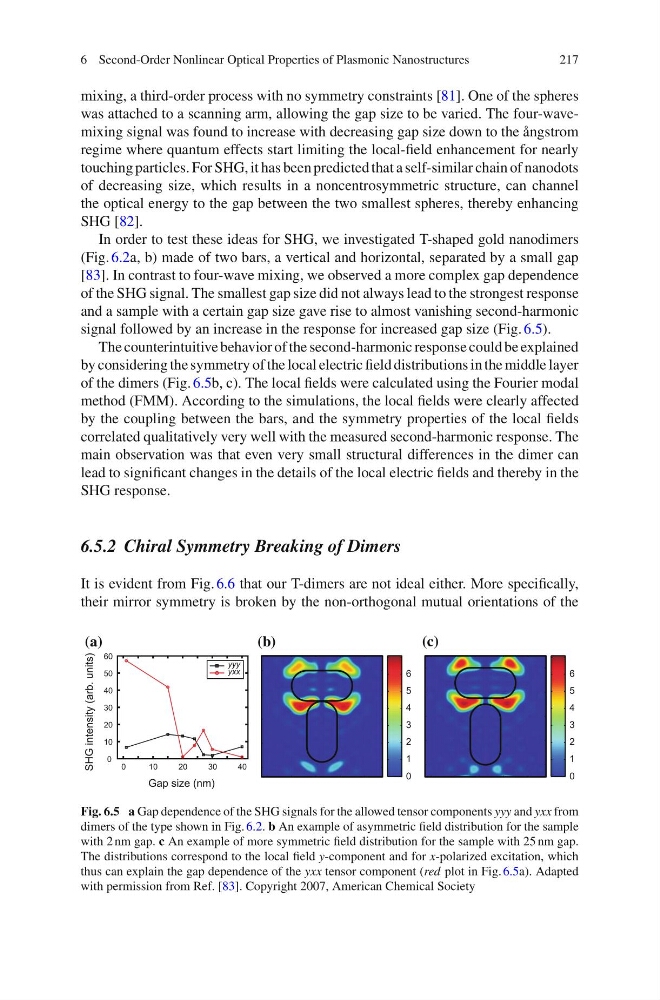
In order to test these ideas for SHG, we investigated T-shaped gold nanodimers
(Fig. 6.2a, b) made of two bars, a vertical and horizontal, separated by a small gap
[83]. In contrast to four-wave mixing, we observed a more complex gap dependence
of the SHG signal. The smallest gap size did not always lead to the strongest response
and a sample with a certain gap size gave rise to almost vanishing second-harmonic
signal followed by an increase in the response for increased gap size (Fig. 6.5).
The counterintuitive behavior of the second-harmonic response could be explained
by considering the symmetry of the local electric field distributions in the middle layer
of the dimers (Fig. 6.5b, c). The local fields were calculated using the Fourier modal
method (FMM). According to the simulations, the local fields were clearly affected
by the coupling between the bars, and the symmetry properties of the local fields
correlated qualitatively very well with the measured second-harmonic response. The
main observation was that even very small structural differences in the dimer can
lead to significant changes in the details of the local electric fields and thereby in the
SHG response.
6.5.2 Chiral Symmetry Breaking of Dimers
It is evident from Fig. 6.6 that our T-dimers are not ideal either. More specifically,
their mirror symmetry is broken by the non-orthogonal mutual orientations of the
(a)
(b)
(c)
Fig. 6.5 a Gap dependence of the SHG signals for the allowed tensor components yyy and yxx from
dimers of the type shown in Fig. 6.2. b An example of asymmetric field distribution for the sample
with 2 nm gap. c An example of more symmetric field distribution for the sample with 25 nm gap.
The distributions correspond to the local field y-component and for x-polarized excitation, which
thus can explain the gap dependence of the yxx tensor component (red plot in Fig. 6.5a). Adapted
with permission from Ref. [83]. Copyright 2007, American Chemical Society
217
mixing, a third-order process with no symmetry constraints [81]. One of the spheres
was attached to a scanning arm, allowing the gap size to be varied. The four-wavemixing signal was found to increase with decreasing gap size down to the ångstrom
regime where quantum effects start limiting the local-field enhancement for nearly
touching particles. For SHG, it has been predicted that a self-similar chain of nanodots
of decreasing size, which results in a noncentrosymmetric structure, can channel
the optical energy to the gap between the two smallest spheres, thereby enhancing
SHG [82].
In order to test these ideas for SHG, we investigated T-shaped gold nanodimers
(Fig. 6.2a, b) made of two bars, a vertical and horizontal, separated by a small gap
[83]. In contrast to four-wave mixing, we observed a more complex gap dependence
of the SHG signal. The smallest gap size did not always lead to the strongest response
and a sample with a certain gap size gave rise to almost vanishing second-harmonic
signal followed by an increase in the response for increased gap size (Fig. 6.5).
The counterintuitive behavior of the second-harmonic response could be explained
by considering the symmetry of the local electric field distributions in the middle layer
of the dimers (Fig. 6.5b, c). The local fields were calculated using the Fourier modal
method (FMM). According to the simulations, the local fields were clearly affected
by the coupling between the bars, and the symmetry properties of the local fields
correlated qualitatively very well with the measured second-harmonic response. The
main observation was that even very small structural differences in the dimer can
lead to significant changes in the details of the local electric fields and thereby in the
SHG response.
6.5.2 Chiral Symmetry Breaking of Dimers
It is evident from Fig. 6.6 that our T-dimers are not ideal either. More specifically,
their mirror symmetry is broken by the non-orthogonal mutual orientations of the
(a)
(b)
(c)
Fig. 6.5 a Gap dependence of the SHG signals for the allowed tensor components yyy and yxx from
dimers of the type shown in Fig. 6.2. b An example of asymmetric field distribution for the sample
with 2 nm gap. c An example of more symmetric field distribution for the sample with 25 nm gap.
The distributions correspond to the local field y-component and for x-polarized excitation, which
thus can explain the gap dependence of the yxx tensor component (red plot in Fig. 6.5a). Adapted
with permission from Ref. [83]. Copyright 2007, American Chemical Society