

194
F. Vallée and N. Del Fatti
0
100
200
300
400
(a)
σ
abs
(nm
2
)
-200
-100
0
100
(b)
a 2
a 1
a
1,2
(nm
2
)
0
1
2
3
4
5
6
7
(d)
σ
abs
(x 10
3
nm
2
)
-2
-1
0
1
a 2
a 1
a
1,2
(x 10
3
nm
2
)
(e)
1.5
2.0
2.5
3.0
-15
-10
-5
0
5
(c)
ω (eV)
Δσ
abs
(nm
2
)
1.4
1.5
1.6
1.7
-10
-5
0
5
10
ω (eV)
Δσ
abs
(nm
2
)
(f)
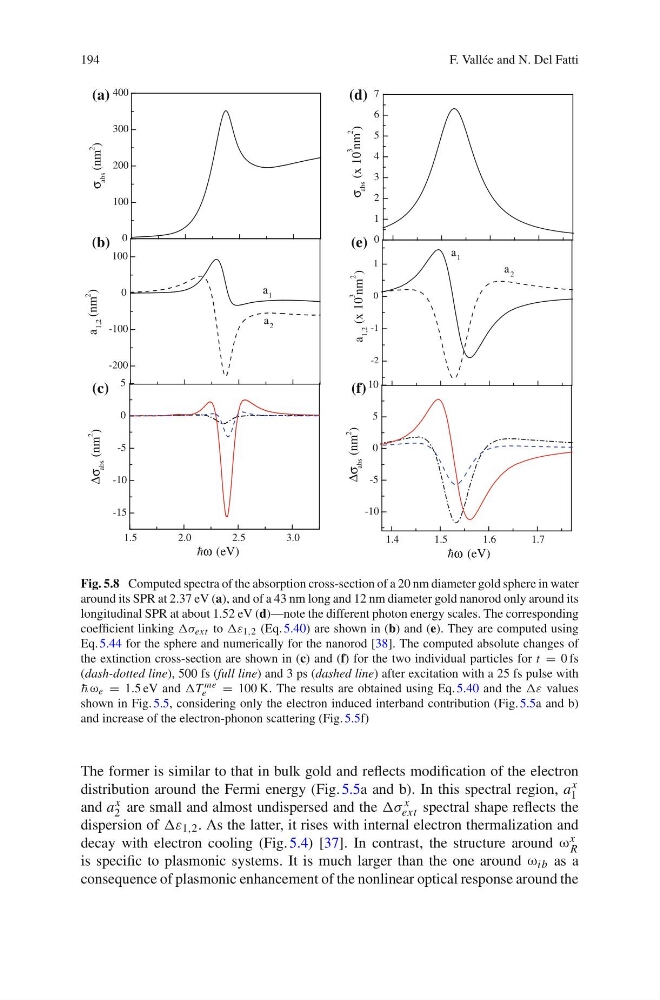
Fig. 5.8 Computed spectra of the absorption cross-section of a 20 nm diameter gold sphere in water
around its SPR at 2.37 eV (a), and of a 43 nm long and 12 nm diameter gold nanorod only around its
longitudinal SPR at about 1.52 eV (d)—note the different photon energy scales. The corresponding
coefficient linking ωη ext to ωε 1,2 (Eq. 5.40) are shown in (b) and (e). They are computed using
Eq. 5.44 for the sphere and numerically for the nanorod [38]. The computed absolute changes of
the extinction cross-section are shown in (c) and (f) for the two individual particles for t = 0 fs
(dash-dotted line), 500 fs (full line) and 3 ps (dashed line) after excitation with a 25 fs pulse with
ω e = 1.5 eV and ωT me
e
= 100 K. The results are obtained using Eq. 5.40 and the ωε values
shown in Fig. 5.5, considering only the electron induced interband contribution (Fig. 5.5a and b)
and increase of the electron-phonon scattering (Fig. 5.5f)
The former is similar to that in bulk gold and reflects modification of the electron
distribution around the Fermi energy (Fig. 5.5a and b). In this spectral region, a x
1
and a x
2 are small and almost undispersed and the ωη x
ext spectral shape reflects the
dispersion of ωε 1,2 . As the latter, it rises with internal electron thermalization and
decay with electron cooling (Fig. 5.4) [37]. In contrast, the structure around ω x
R
is specific to plasmonic systems. It is much larger than the one around ω ib as a
consequence of plasmonic enhancement of the nonlinear optical response around the
F. Vallée and N. Del Fatti
0
100
200
300
400
(a)
σ
abs
(nm
2
)
-200
-100
0
100
(b)
a 2
a 1
a
1,2
(nm
2
)
0
1
2
3
4
5
6
7
(d)
σ
abs
(x 10
3
nm
2
)
-2
-1
0
1
a 2
a 1
a
1,2
(x 10
3
nm
2
)
(e)
1.5
2.0
2.5
3.0
-15
-10
-5
0
5
(c)
ω (eV)
Δσ
abs
(nm
2
)
1.4
1.5
1.6
1.7
-10
-5
0
5
10
ω (eV)
Δσ
abs
(nm
2
)
(f)
Fig. 5.8 Computed spectra of the absorption cross-section of a 20 nm diameter gold sphere in water
around its SPR at 2.37 eV (a), and of a 43 nm long and 12 nm diameter gold nanorod only around its
longitudinal SPR at about 1.52 eV (d)—note the different photon energy scales. The corresponding
coefficient linking ωη ext to ωε 1,2 (Eq. 5.40) are shown in (b) and (e). They are computed using
Eq. 5.44 for the sphere and numerically for the nanorod [38]. The computed absolute changes of
the extinction cross-section are shown in (c) and (f) for the two individual particles for t = 0 fs
(dash-dotted line), 500 fs (full line) and 3 ps (dashed line) after excitation with a 25 fs pulse with
ω e = 1.5 eV and ωT me
e
= 100 K. The results are obtained using Eq. 5.40 and the ωε values
shown in Fig. 5.5, considering only the electron induced interband contribution (Fig. 5.5a and b)
and increase of the electron-phonon scattering (Fig. 5.5f)
The former is similar to that in bulk gold and reflects modification of the electron
distribution around the Fermi energy (Fig. 5.5a and b). In this spectral region, a x
1
and a x
2 are small and almost undispersed and the ωη x
ext spectral shape reflects the
dispersion of ωε 1,2 . As the latter, it rises with internal electron thermalization and
decay with electron cooling (Fig. 5.4) [37]. In contrast, the structure around ω x
R
is specific to plasmonic systems. It is much larger than the one around ω ib as a
consequence of plasmonic enhancement of the nonlinear optical response around the