

5 Ultrafast Nonlinear Plasmonics
191
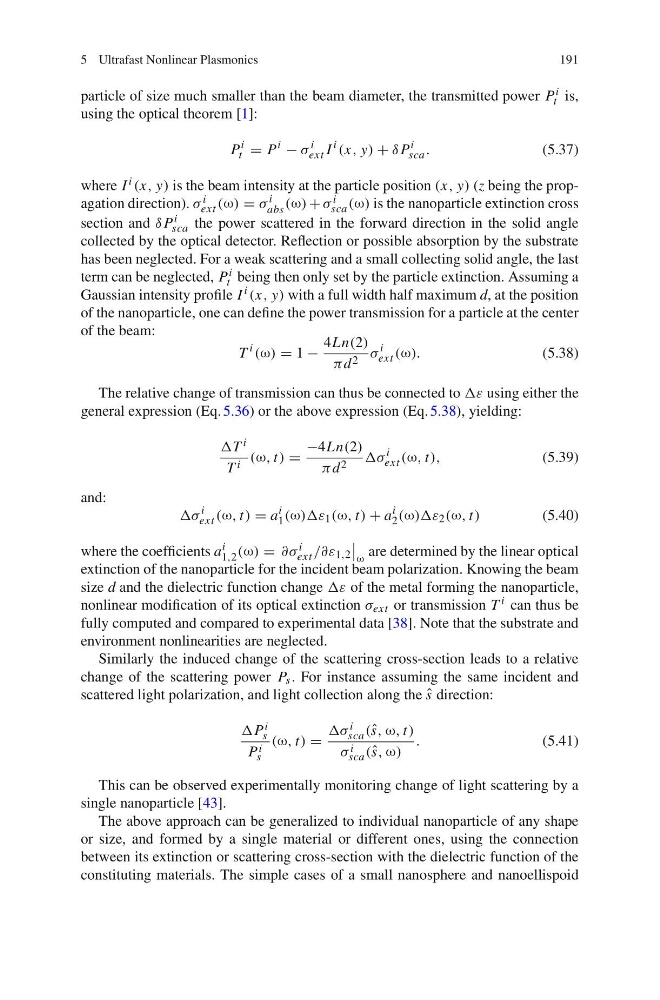
particle of size much smaller than the beam diameter, the transmitted power P i
t is,
using the optical theorem [1]:
P
i
t = P
i
− η
i
ext I
i
(x, y) + ∂ P
i
sca .
(5.37)
where I i (x, y) is the beam intensity at the particle position (x, y) (z being the propagation direction). η i
ext (ω) = η i
abs (ω) + η i
sca (ω) is the nanoparticle extinction cross
section and ∂ P i
sca the power scattered in the forward direction in the solid angle
collected by the optical detector. Reflection or possible absorption by the substrate
has been neglected. For a weak scattering and a small collecting solid angle, the last
term can be neglected, P i
t being then only set by the particle extinction. Assuming a
Gaussian intensity profile I i (x, y) with a full width half maximum d, at the position
of the nanoparticle, one can define the power transmission for a particle at the center
of the beam:
T
i
(ω) = 1 −
4Ln(2)
π d 2 η
i
ext (ω).
(5.38)
The relative change of transmission can thus be connected to ωε using either the
general expression (Eq. 5.36) or the above expression (Eq. 5.38), yielding:
ωT i
T i (ω, t) =
−4Ln(2)
π d 2 ωη
i
ext (ω, t),
(5.39)
and:
ωη
i
ext (ω, t) = a
i
1 (ω)ωε 1 (ω, t) + a
i
2 (ω)ωε 2 (ω, t)
(5.40)
where the coefficients a i
1,2 (ω) = γη i
ext /γε 1,2
ω are determined by the linear optical
extinction of the nanoparticle for the incident beam polarization. Knowing the beam
size d and the dielectric function change ωε of the metal forming the nanoparticle,
nonlinear modification of its optical extinction η ext or transmission T i can thus be
fully computed and compared to experimental data [38]. Note that the substrate and
environment nonlinearities are neglected.
Similarly the induced change of the scattering cross-section leads to a relative
change of the scattering power P s . For instance assuming the same incident and
scattered light polarization, and light collection along the ˆ
s direction:
ωP i
s
P i
s
(ω, t) =
ωη i
sca (ˆ s, ω, t)
η i
sca (ˆ s, ω)
.
(5.41)
This can be observed experimentally monitoring change of light scattering by a
single nanoparticle [43].
The above approach can be generalized to individual nanoparticle of any shape
or size, and formed by a single material or different ones, using the connection
between its extinction or scattering cross-section with the dielectric function of the
constituting materials. The simple cases of a small nanosphere and nanoellispoid
191
particle of size much smaller than the beam diameter, the transmitted power P i
t is,
using the optical theorem [1]:
P
i
t = P
i
− η
i
ext I
i
(x, y) + ∂ P
i
sca .
(5.37)
where I i (x, y) is the beam intensity at the particle position (x, y) (z being the propagation direction). η i
ext (ω) = η i
abs (ω) + η i
sca (ω) is the nanoparticle extinction cross
section and ∂ P i
sca the power scattered in the forward direction in the solid angle
collected by the optical detector. Reflection or possible absorption by the substrate
has been neglected. For a weak scattering and a small collecting solid angle, the last
term can be neglected, P i
t being then only set by the particle extinction. Assuming a
Gaussian intensity profile I i (x, y) with a full width half maximum d, at the position
of the nanoparticle, one can define the power transmission for a particle at the center
of the beam:
T
i
(ω) = 1 −
4Ln(2)
π d 2 η
i
ext (ω).
(5.38)
The relative change of transmission can thus be connected to ωε using either the
general expression (Eq. 5.36) or the above expression (Eq. 5.38), yielding:
ωT i
T i (ω, t) =
−4Ln(2)
π d 2 ωη
i
ext (ω, t),
(5.39)
and:
ωη
i
ext (ω, t) = a
i
1 (ω)ωε 1 (ω, t) + a
i
2 (ω)ωε 2 (ω, t)
(5.40)
where the coefficients a i
1,2 (ω) = γη i
ext /γε 1,2
ω are determined by the linear optical
extinction of the nanoparticle for the incident beam polarization. Knowing the beam
size d and the dielectric function change ωε of the metal forming the nanoparticle,
nonlinear modification of its optical extinction η ext or transmission T i can thus be
fully computed and compared to experimental data [38]. Note that the substrate and
environment nonlinearities are neglected.
Similarly the induced change of the scattering cross-section leads to a relative
change of the scattering power P s . For instance assuming the same incident and
scattered light polarization, and light collection along the ˆ
s direction:
ωP i
s
P i
s
(ω, t) =
ωη i
sca (ˆ s, ω, t)
η i
sca (ˆ s, ω)
.
(5.41)
This can be observed experimentally monitoring change of light scattering by a
single nanoparticle [43].
The above approach can be generalized to individual nanoparticle of any shape
or size, and formed by a single material or different ones, using the connection
between its extinction or scattering cross-section with the dielectric function of the
constituting materials. The simple cases of a small nanosphere and nanoellispoid