

170
F. Vallée and N. Del Fatti
λ e− ph (ω, T L , T e ) =
G ph
ω
∞
0
√
E
√
E + ω f (E) (1 − f (E + ω))d E, (5.3)
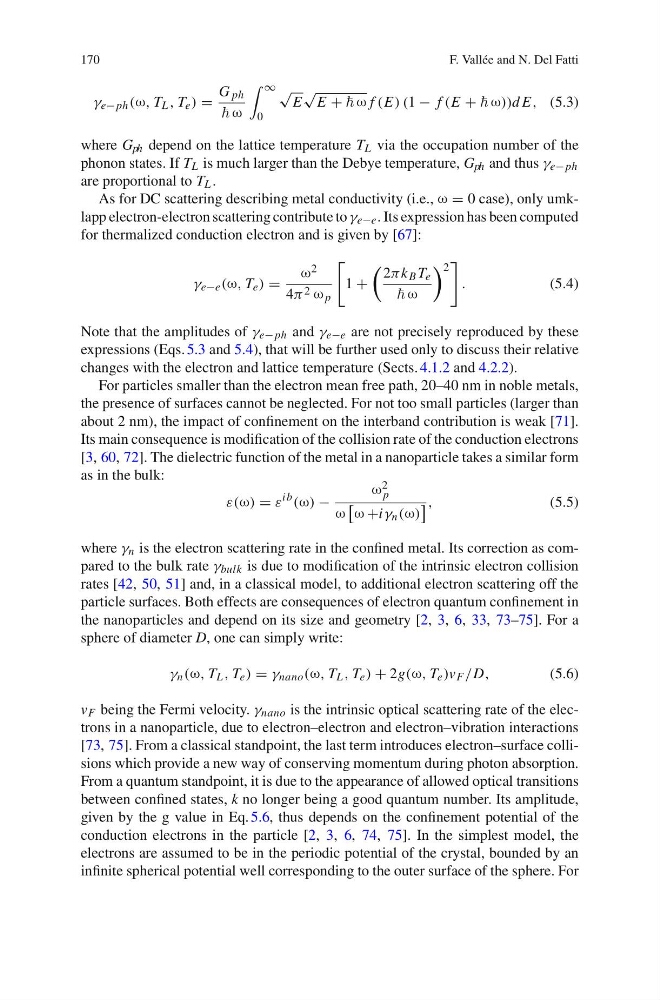
where G ph depend on the lattice temperature T L via the occupation number of the
phonon states. If T L is much larger than the Debye temperature, G ph and thus λ e− ph
are proportional to T L .
As for DC scattering describing metal conductivity (i.e., ω = 0 case), only umklapp electron-electron scattering contribute to λ e−e . Its expression has been computed
for thermalized conduction electron and is given by [67]:
λ e−e (ω, T e ) =
ω 2
4π 2 ω p
1 +
2π k B T e
ω
2
.
(5.4)
Note that the amplitudes of λ e− ph and λ e−e are not precisely reproduced by these
expressions (Eqs. 5.3 and 5.4), that will be further used only to discuss their relative
changes with the electron and lattice temperature (Sects. 4.1.2 and 4.2.2).
For particles smaller than the electron mean free path, 20–40 nm in noble metals,
the presence of surfaces cannot be neglected. For not too small particles (larger than
about 2 nm), the impact of confinement on the interband contribution is weak [71].
Its main consequence is modification of the collision rate of the conduction electrons
[3, 60, 72]. The dielectric function of the metal in a nanoparticle takes a similar form
as in the bulk:
ε(ω) = ε
ib
(ω) −
ω 2
p
ω
ω +iλ n (ω)
,
(5.5)
where λ n is the electron scattering rate in the confined metal. Its correction as compared to the bulk rate λ bulk is due to modification of the intrinsic electron collision
rates [42, 50, 51] and, in a classical model, to additional electron scattering off the
particle surfaces. Both effects are consequences of electron quantum confinement in
the nanoparticles and depend on its size and geometry [2, 3, 6, 33, 73–75]. For a
sphere of diameter D, one can simply write:
λ n (ω, T L , T e ) = λ nano (ω, T L , T e ) + 2g(ω, T e )v F /D,
(5.6)
v F being the Fermi velocity. λ nano is the intrinsic optical scattering rate of the electrons in a nanoparticle, due to electron–electron and electron–vibration interactions
[73, 75]. From a classical standpoint, the last term introduces electron–surface collisions which provide a new way of conserving momentum during photon absorption.
From a quantum standpoint, it is due to the appearance of allowed optical transitions
between confined states, k no longer being a good quantum number. Its amplitude,
given by the g value in Eq. 5.6, thus depends on the confinement potential of the
conduction electrons in the particle [2, 3, 6, 74, 75]. In the simplest model, the
electrons are assumed to be in the periodic potential of the crystal, bounded by an
infinite spherical potential well corresponding to the outer surface of the sphere. For
F. Vallée and N. Del Fatti
λ e− ph (ω, T L , T e ) =
G ph
ω
∞
0
√
E
√
E + ω f (E) (1 − f (E + ω))d E, (5.3)
where G ph depend on the lattice temperature T L via the occupation number of the
phonon states. If T L is much larger than the Debye temperature, G ph and thus λ e− ph
are proportional to T L .
As for DC scattering describing metal conductivity (i.e., ω = 0 case), only umklapp electron-electron scattering contribute to λ e−e . Its expression has been computed
for thermalized conduction electron and is given by [67]:
λ e−e (ω, T e ) =
ω 2
4π 2 ω p
1 +
2π k B T e
ω
2
.
(5.4)
Note that the amplitudes of λ e− ph and λ e−e are not precisely reproduced by these
expressions (Eqs. 5.3 and 5.4), that will be further used only to discuss their relative
changes with the electron and lattice temperature (Sects. 4.1.2 and 4.2.2).
For particles smaller than the electron mean free path, 20–40 nm in noble metals,
the presence of surfaces cannot be neglected. For not too small particles (larger than
about 2 nm), the impact of confinement on the interband contribution is weak [71].
Its main consequence is modification of the collision rate of the conduction electrons
[3, 60, 72]. The dielectric function of the metal in a nanoparticle takes a similar form
as in the bulk:
ε(ω) = ε
ib
(ω) −
ω 2
p
ω
ω +iλ n (ω)
,
(5.5)
where λ n is the electron scattering rate in the confined metal. Its correction as compared to the bulk rate λ bulk is due to modification of the intrinsic electron collision
rates [42, 50, 51] and, in a classical model, to additional electron scattering off the
particle surfaces. Both effects are consequences of electron quantum confinement in
the nanoparticles and depend on its size and geometry [2, 3, 6, 33, 73–75]. For a
sphere of diameter D, one can simply write:
λ n (ω, T L , T e ) = λ nano (ω, T L , T e ) + 2g(ω, T e )v F /D,
(5.6)
v F being the Fermi velocity. λ nano is the intrinsic optical scattering rate of the electrons in a nanoparticle, due to electron–electron and electron–vibration interactions
[73, 75]. From a classical standpoint, the last term introduces electron–surface collisions which provide a new way of conserving momentum during photon absorption.
From a quantum standpoint, it is due to the appearance of allowed optical transitions
between confined states, k no longer being a good quantum number. Its amplitude,
given by the g value in Eq. 5.6, thus depends on the confinement potential of the
conduction electrons in the particle [2, 3, 6, 74, 75]. In the simplest model, the
electrons are assumed to be in the periodic potential of the crystal, bounded by an
infinite spherical potential well corresponding to the outer surface of the sphere. For