

5 Ultrafast Nonlinear Plasmonics
169
impact of the different mechanisms on modification of the metal dielectric function
on different time-scales will be first introduced, based on a modeling developed for
bulk metals [26, 29, 52, 61, 65]. The induced changes of the observable optical
properties of the material will then be discussed, focusing to the case of single metal
nanoparticles and composite nanomaterials formed by an ensemble of nanoparticles
dispersed in a dielectric matrix.
5.2 Dielectric Function of Metals and Metal Nanoparticles
The response of a bulk or nanostructured system in the optical domain directly reflects
interaction of the electrons of the constituting material with the electromagnetic
field. It is described via the dielectric functions of the material components, possibly
modified by quantum confinement effects and material coupling. In the case of a bulk
metal, the dielectric function ε bulk can be separated into two types of contributions: a
quasi-free electron one due to electrons in the conduction band and an interband one
due to transitions between electronic bands. The former, related to intraband optical
absorption, is well described by a Drude expression (free electron response), so that
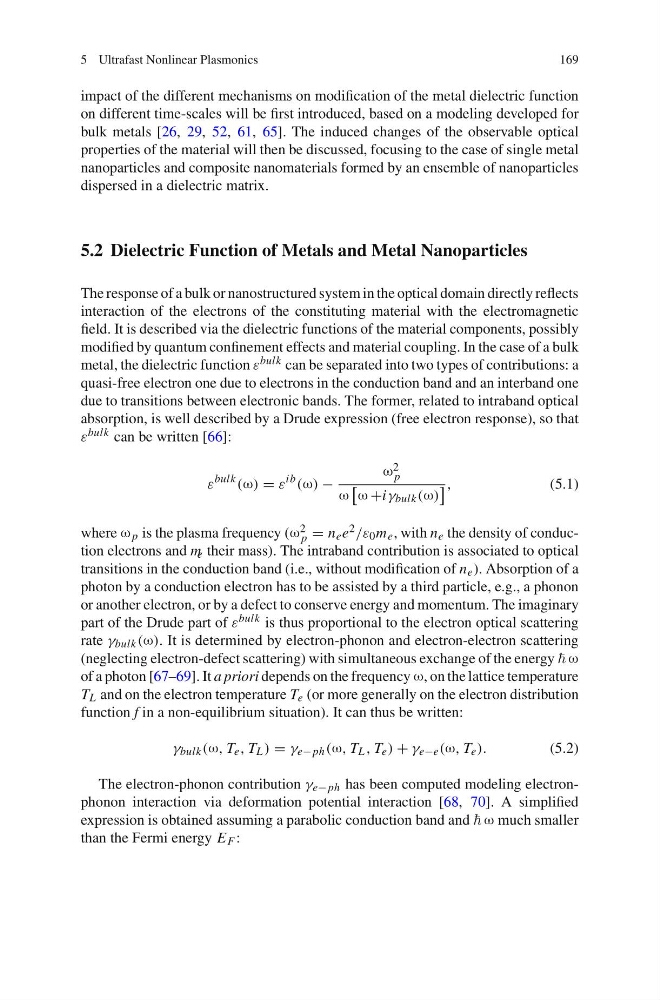
ε bulk can be written [66]:
ε
bulk
(ω) = ε
ib
(ω) −
ω 2
p
ω
ω +iλ bulk (ω)
,
(5.1)
where ω p is the plasma frequency (ω 2
p = n e e 2 /ε 0 m e , with n e the density of conduction electrons and m e their mass). The intraband contribution is associated to optical
transitions in the conduction band (i.e., without modification of n e ). Absorption of a
photon by a conduction electron has to be assisted by a third particle, e.g., a phonon
or another electron, or by a defect to conserve energy and momentum. The imaginary
part of the Drude part of ε bulk is thus proportional to the electron optical scattering
rate λ bulk (ω). It is determined by electron-phonon and electron-electron scattering
(neglecting electron-defect scattering) with simultaneous exchange of the energy ω
of a photon [67–69]. It a priori depends on the frequency ω, on the lattice temperature
T L and on the electron temperature T e (or more generally on the electron distribution
function f in a non-equilibrium situation). It can thus be written:
λ bulk (ω, T e , T L ) = λ e− ph (ω, T L , T e ) + λ e−e (ω, T e ).
(5.2)
The electron-phonon contribution λ e− ph has been computed modeling electronphonon interaction via deformation potential interaction [68, 70]. A simplified
expression is obtained assuming a parabolic conduction band and ω much smaller
than the Fermi energy E F :
169
impact of the different mechanisms on modification of the metal dielectric function
on different time-scales will be first introduced, based on a modeling developed for
bulk metals [26, 29, 52, 61, 65]. The induced changes of the observable optical
properties of the material will then be discussed, focusing to the case of single metal
nanoparticles and composite nanomaterials formed by an ensemble of nanoparticles
dispersed in a dielectric matrix.
5.2 Dielectric Function of Metals and Metal Nanoparticles
The response of a bulk or nanostructured system in the optical domain directly reflects
interaction of the electrons of the constituting material with the electromagnetic
field. It is described via the dielectric functions of the material components, possibly
modified by quantum confinement effects and material coupling. In the case of a bulk
metal, the dielectric function ε bulk can be separated into two types of contributions: a
quasi-free electron one due to electrons in the conduction band and an interband one
due to transitions between electronic bands. The former, related to intraband optical
absorption, is well described by a Drude expression (free electron response), so that
ε bulk can be written [66]:
ε
bulk
(ω) = ε
ib
(ω) −
ω 2
p
ω
ω +iλ bulk (ω)
,
(5.1)
where ω p is the plasma frequency (ω 2
p = n e e 2 /ε 0 m e , with n e the density of conduction electrons and m e their mass). The intraband contribution is associated to optical
transitions in the conduction band (i.e., without modification of n e ). Absorption of a
photon by a conduction electron has to be assisted by a third particle, e.g., a phonon
or another electron, or by a defect to conserve energy and momentum. The imaginary
part of the Drude part of ε bulk is thus proportional to the electron optical scattering
rate λ bulk (ω). It is determined by electron-phonon and electron-electron scattering
(neglecting electron-defect scattering) with simultaneous exchange of the energy ω
of a photon [67–69]. It a priori depends on the frequency ω, on the lattice temperature
T L and on the electron temperature T e (or more generally on the electron distribution
function f in a non-equilibrium situation). It can thus be written:
λ bulk (ω, T e , T L ) = λ e− ph (ω, T L , T e ) + λ e−e (ω, T e ).
(5.2)
The electron-phonon contribution λ e− ph has been computed modeling electronphonon interaction via deformation potential interaction [68, 70]. A simplified
expression is obtained assuming a parabolic conduction band and ω much smaller
than the Fermi energy E F :