

2 Plasmonics for Enhanced Vibrational Signatures
111
vibrational information at the high energy side of the excitation laser, which is free
from disturbing fluorescence.
SEPARS generates an incoherent anti-Stokes signal. The large effective cross
section can be explained by the nature of the process, which is a two-photon process
using the vibrational level as a real intermediate state. The effective Raman cross
section strongly benefits from enhanced local fields. In an analogous fashion to
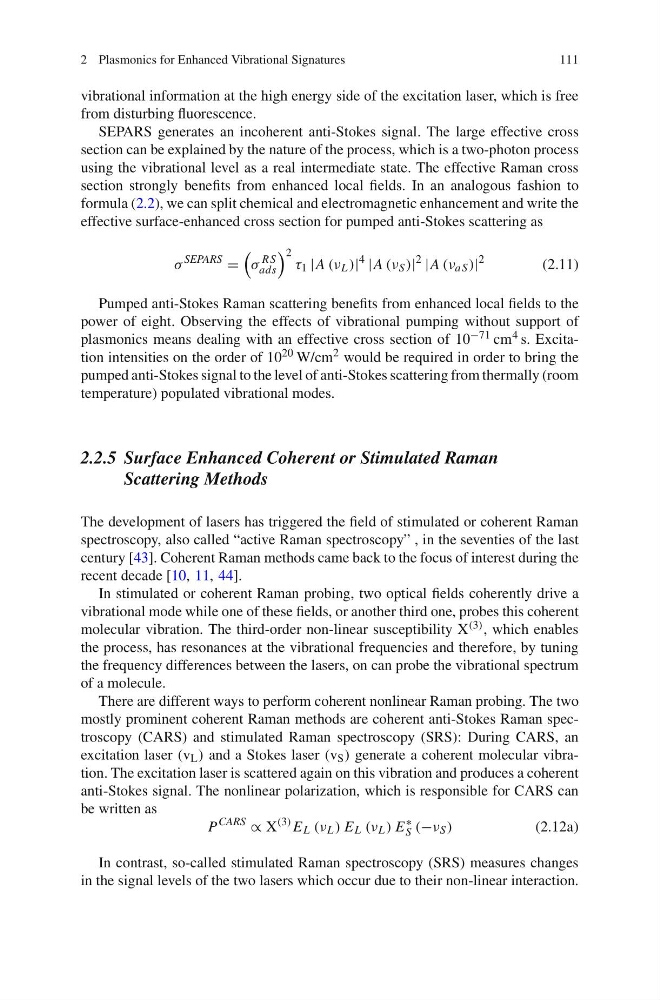
formula (2.2), we can split chemical and electromagnetic enhancement and write the
effective surface-enhanced cross section for pumped anti-Stokes scattering as
σ
SEPARS
=
σ
RS
ads
2 τ 1 |A (ν L )|
4
|A (ν S )|
2
|A (ν aS )|
2
(2.11)
Pumped anti-Stokes Raman scattering benefits from enhanced local fields to the
power of eight. Observing the effects of vibrational pumping without support of
plasmonics means dealing with an effective cross section of 10 −71 cm 4 s. Excitation intensities on the order of 10 20 W/cm 2 would be required in order to bring the
pumped anti-Stokes signal to the level of anti-Stokes scattering from thermally (room
temperature) populated vibrational modes.
2.2.5 Surface Enhanced Coherent or Stimulated Raman
Scattering Methods
The development of lasers has triggered the field of stimulated or coherent Raman
spectroscopy, also called “active Raman spectroscopy” , in the seventies of the last
century [43]. Coherent Raman methods came back to the focus of interest during the
recent decade [10, 11, 44].
In stimulated or coherent Raman probing, two optical fields coherently drive a
vibrational mode while one of these fields, or another third one, probes this coherent
molecular vibration. The third-order non-linear susceptibility X (3) , which enables
the process, has resonances at the vibrational frequencies and therefore, by tuning
the frequency differences between the lasers, on can probe the vibrational spectrum
of a molecule.
There are different ways to perform coherent nonlinear Raman probing. The two
mostly prominent coherent Raman methods are coherent anti-Stokes Raman spectroscopy (CARS) and stimulated Raman spectroscopy (SRS): During CARS, an
excitation laser (v L ) and a Stokes laser (v S ) generate a coherent molecular vibration. The excitation laser is scattered again on this vibration and produces a coherent
anti-Stokes signal. The nonlinear polarization, which is responsible for CARS can
be written as
P
CARS
∝ X
(3) E L (ν L ) E L (ν L ) E
∗
S (−ν S )
(2.12a)
In contrast, so-called stimulated Raman spectroscopy (SRS) measures changes
in the signal levels of the two lasers which occur due to their non-linear interaction.
111
vibrational information at the high energy side of the excitation laser, which is free
from disturbing fluorescence.
SEPARS generates an incoherent anti-Stokes signal. The large effective cross
section can be explained by the nature of the process, which is a two-photon process
using the vibrational level as a real intermediate state. The effective Raman cross
section strongly benefits from enhanced local fields. In an analogous fashion to
formula (2.2), we can split chemical and electromagnetic enhancement and write the
effective surface-enhanced cross section for pumped anti-Stokes scattering as
σ
SEPARS
=
σ
RS
ads
2 τ 1 |A (ν L )|
4
|A (ν S )|
2
|A (ν aS )|
2
(2.11)
Pumped anti-Stokes Raman scattering benefits from enhanced local fields to the
power of eight. Observing the effects of vibrational pumping without support of
plasmonics means dealing with an effective cross section of 10 −71 cm 4 s. Excitation intensities on the order of 10 20 W/cm 2 would be required in order to bring the
pumped anti-Stokes signal to the level of anti-Stokes scattering from thermally (room
temperature) populated vibrational modes.
2.2.5 Surface Enhanced Coherent or Stimulated Raman
Scattering Methods
The development of lasers has triggered the field of stimulated or coherent Raman
spectroscopy, also called “active Raman spectroscopy” , in the seventies of the last
century [43]. Coherent Raman methods came back to the focus of interest during the
recent decade [10, 11, 44].
In stimulated or coherent Raman probing, two optical fields coherently drive a
vibrational mode while one of these fields, or another third one, probes this coherent
molecular vibration. The third-order non-linear susceptibility X (3) , which enables
the process, has resonances at the vibrational frequencies and therefore, by tuning
the frequency differences between the lasers, on can probe the vibrational spectrum
of a molecule.
There are different ways to perform coherent nonlinear Raman probing. The two
mostly prominent coherent Raman methods are coherent anti-Stokes Raman spectroscopy (CARS) and stimulated Raman spectroscopy (SRS): During CARS, an
excitation laser (v L ) and a Stokes laser (v S ) generate a coherent molecular vibration. The excitation laser is scattered again on this vibration and produces a coherent
anti-Stokes signal. The nonlinear polarization, which is responsible for CARS can
be written as
P
CARS
∝ X
(3) E L (ν L ) E L (ν L ) E
∗
S (−ν S )
(2.12a)
In contrast, so-called stimulated Raman spectroscopy (SRS) measures changes
in the signal levels of the two lasers which occur due to their non-linear interaction.