

110
K. Kneipp et al.
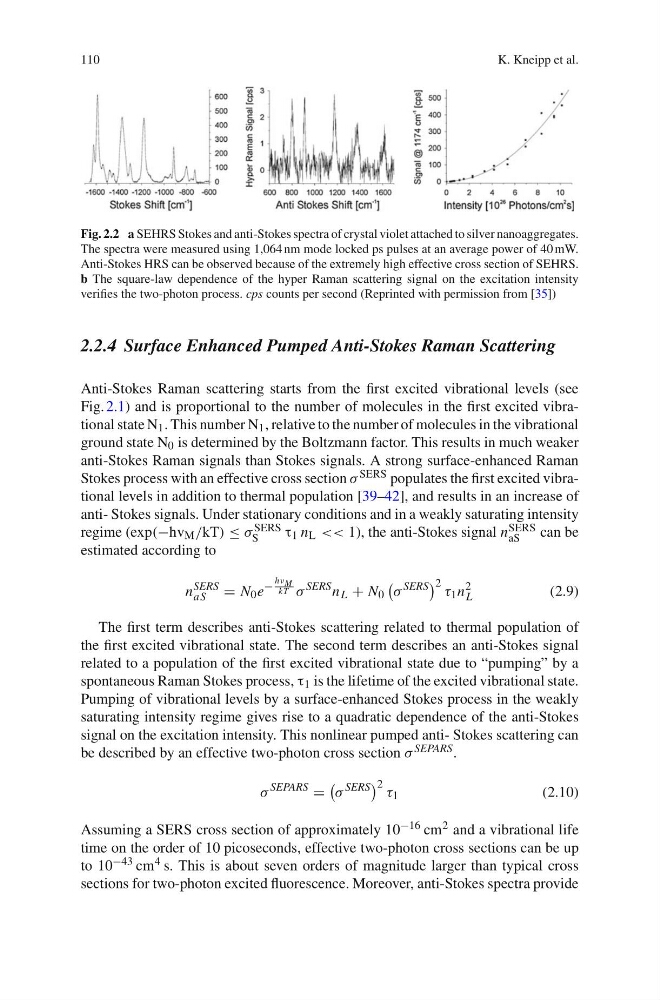
Fig. 2.2 a SEHRS Stokes and anti-Stokes spectra of crystal violet attached to silver nanoaggregates.
The spectra were measured using 1,064 nm mode locked ps pulses at an average power of 40 mW.
Anti-Stokes HRS can be observed because of the extremely high effective cross section of SEHRS.
b The square-law dependence of the hyper Raman scattering signal on the excitation intensity
verifies the two-photon process. cps counts per second (Reprinted with permission from [35])
2.2.4 Surface Enhanced Pumped Anti-Stokes Raman Scattering
Anti-Stokes Raman scattering starts from the first excited vibrational levels (see
Fig. 2.1) and is proportional to the number of molecules in the first excited vibrational state N 1 . This number N 1 , relative to the number of molecules in the vibrational
ground state N 0 is determined by the Boltzmann factor. This results in much weaker
anti-Stokes Raman signals than Stokes signals. A strong surface-enhanced Raman
Stokes process with an effective cross section σ SERS populates the first excited vibrational levels in addition to thermal population [39–42], and results in an increase of
anti- Stokes signals. Under stationary conditions and in a weakly saturating intensity
regime (exp(−hv M /kT) ≤ σ SERS
S
τ 1 n L << 1), the anti-Stokes signal n SERS
aS
can be
estimated according to
n
SERS
aS
= N 0 e
−
hν M
kT σ
SERS n L + N 0
σ
SERS
2 τ 1 n
2
L
(2.9)
The first term describes anti-Stokes scattering related to thermal population of
the first excited vibrational state. The second term describes an anti-Stokes signal
related to a population of the first excited vibrational state due to “pumping” by a
spontaneous Raman Stokes process, τ 1 is the lifetime of the excited vibrational state.
Pumping of vibrational levels by a surface-enhanced Stokes process in the weakly
saturating intensity regime gives rise to a quadratic dependence of the anti-Stokes
signal on the excitation intensity. This nonlinear pumped anti- Stokes scattering can
be described by an effective two-photon cross section σ SEPARS .
σ
SEPARS
=
σ
SERS
2 τ 1
(2.10)
Assuming a SERS cross section of approximately 10 −16 cm 2 and a vibrational life
time on the order of 10 picoseconds, effective two-photon cross sections can be up
to 10 −43 cm 4 s. This is about seven orders of magnitude larger than typical cross
sections for two-photon excited fluorescence. Moreover, anti-Stokes spectra provide
K. Kneipp et al.
Fig. 2.2 a SEHRS Stokes and anti-Stokes spectra of crystal violet attached to silver nanoaggregates.
The spectra were measured using 1,064 nm mode locked ps pulses at an average power of 40 mW.
Anti-Stokes HRS can be observed because of the extremely high effective cross section of SEHRS.
b The square-law dependence of the hyper Raman scattering signal on the excitation intensity
verifies the two-photon process. cps counts per second (Reprinted with permission from [35])
2.2.4 Surface Enhanced Pumped Anti-Stokes Raman Scattering
Anti-Stokes Raman scattering starts from the first excited vibrational levels (see
Fig. 2.1) and is proportional to the number of molecules in the first excited vibrational state N 1 . This number N 1 , relative to the number of molecules in the vibrational
ground state N 0 is determined by the Boltzmann factor. This results in much weaker
anti-Stokes Raman signals than Stokes signals. A strong surface-enhanced Raman
Stokes process with an effective cross section σ SERS populates the first excited vibrational levels in addition to thermal population [39–42], and results in an increase of
anti- Stokes signals. Under stationary conditions and in a weakly saturating intensity
regime (exp(−hv M /kT) ≤ σ SERS
S
τ 1 n L << 1), the anti-Stokes signal n SERS
aS
can be
estimated according to
n
SERS
aS
= N 0 e
−
hν M
kT σ
SERS n L + N 0
σ
SERS
2 τ 1 n
2
L
(2.9)
The first term describes anti-Stokes scattering related to thermal population of
the first excited vibrational state. The second term describes an anti-Stokes signal
related to a population of the first excited vibrational state due to “pumping” by a
spontaneous Raman Stokes process, τ 1 is the lifetime of the excited vibrational state.
Pumping of vibrational levels by a surface-enhanced Stokes process in the weakly
saturating intensity regime gives rise to a quadratic dependence of the anti-Stokes
signal on the excitation intensity. This nonlinear pumped anti- Stokes scattering can
be described by an effective two-photon cross section σ SEPARS .
σ
SEPARS
=
σ
SERS
2 τ 1
(2.10)
Assuming a SERS cross section of approximately 10 −16 cm 2 and a vibrational life
time on the order of 10 picoseconds, effective two-photon cross sections can be up
to 10 −43 cm 4 s. This is about seven orders of magnitude larger than typical cross
sections for two-photon excited fluorescence. Moreover, anti-Stokes spectra provide