

108
K. Kneipp et al.
2.2.2 Surface Enhanced Infrared Absorption
In principle, all photon-driven processes should benefit from enhanced local optical
fields, and in fact, successful attempts to increase IR absorption signals were reported
only a few years after the discovery of SERS [28]. The sensitivity of infrared (IR)
vibration spectroscopy can be enhanced by several orders of magnitude if plasmonic
electromagnetic nearfield enhancement is exploited. In contrast to scattering, where
at least two photons are involved, SEIRA signals, as the result of a one-photon
absorption process, benefit from local field enhancement A(v) only to the power of
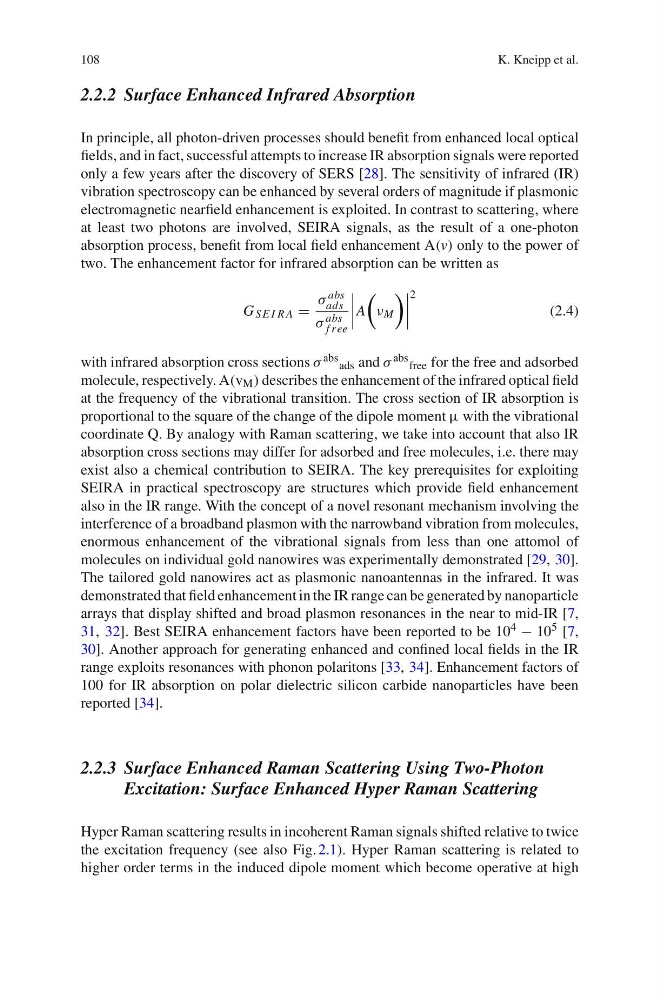
two. The enhancement factor for infrared absorption can be written as
G SE I R A =
σ abs
ads
σ abs
f ree
A
ν M
2
(2.4)
with infrared absorption cross sections σ abs ads and σ abs free for the free and adsorbed
molecule, respectively. A(v M ) describes the enhancement of the infrared optical field
at the frequency of the vibrational transition. The cross section of IR absorption is
proportional to the square of the change of the dipole moment μ with the vibrational
coordinate Q. By analogy with Raman scattering, we take into account that also IR
absorption cross sections may differ for adsorbed and free molecules, i.e. there may
exist also a chemical contribution to SEIRA. The key prerequisites for exploiting
SEIRA in practical spectroscopy are structures which provide field enhancement
also in the IR range. With the concept of a novel resonant mechanism involving the
interference of a broadband plasmon with the narrowband vibration from molecules,
enormous enhancement of the vibrational signals from less than one attomol of
molecules on individual gold nanowires was experimentally demonstrated [29, 30].
The tailored gold nanowires act as plasmonic nanoantennas in the infrared. It was
demonstrated that field enhancement in the IR range can be generated by nanoparticle
arrays that display shifted and broad plasmon resonances in the near to mid-IR [7,
31, 32]. Best SEIRA enhancement factors have been reported to be 10 4 − 10 5 [7,
30]. Another approach for generating enhanced and confined local fields in the IR
range exploits resonances with phonon polaritons [33, 34]. Enhancement factors of
100 for IR absorption on polar dielectric silicon carbide nanoparticles have been
reported [34].
2.2.3 Surface Enhanced Raman Scattering Using Two-Photon
Excitation: Surface Enhanced Hyper Raman Scattering
Hyper Raman scattering results in incoherent Raman signals shifted relative to twice
the excitation frequency (see also Fig. 2.1). Hyper Raman scattering is related to
higher order terms in the induced dipole moment which become operative at high
K. Kneipp et al.
2.2.2 Surface Enhanced Infrared Absorption
In principle, all photon-driven processes should benefit from enhanced local optical
fields, and in fact, successful attempts to increase IR absorption signals were reported
only a few years after the discovery of SERS [28]. The sensitivity of infrared (IR)
vibration spectroscopy can be enhanced by several orders of magnitude if plasmonic
electromagnetic nearfield enhancement is exploited. In contrast to scattering, where
at least two photons are involved, SEIRA signals, as the result of a one-photon
absorption process, benefit from local field enhancement A(v) only to the power of
two. The enhancement factor for infrared absorption can be written as
G SE I R A =
σ abs
ads
σ abs
f ree
A
ν M
2
(2.4)
with infrared absorption cross sections σ abs ads and σ abs free for the free and adsorbed
molecule, respectively. A(v M ) describes the enhancement of the infrared optical field
at the frequency of the vibrational transition. The cross section of IR absorption is
proportional to the square of the change of the dipole moment μ with the vibrational
coordinate Q. By analogy with Raman scattering, we take into account that also IR
absorption cross sections may differ for adsorbed and free molecules, i.e. there may
exist also a chemical contribution to SEIRA. The key prerequisites for exploiting
SEIRA in practical spectroscopy are structures which provide field enhancement
also in the IR range. With the concept of a novel resonant mechanism involving the
interference of a broadband plasmon with the narrowband vibration from molecules,
enormous enhancement of the vibrational signals from less than one attomol of
molecules on individual gold nanowires was experimentally demonstrated [29, 30].
The tailored gold nanowires act as plasmonic nanoantennas in the infrared. It was
demonstrated that field enhancement in the IR range can be generated by nanoparticle
arrays that display shifted and broad plasmon resonances in the near to mid-IR [7,
31, 32]. Best SEIRA enhancement factors have been reported to be 10 4 − 10 5 [7,
30]. Another approach for generating enhanced and confined local fields in the IR
range exploits resonances with phonon polaritons [33, 34]. Enhancement factors of
100 for IR absorption on polar dielectric silicon carbide nanoparticles have been
reported [34].
2.2.3 Surface Enhanced Raman Scattering Using Two-Photon
Excitation: Surface Enhanced Hyper Raman Scattering
Hyper Raman scattering results in incoherent Raman signals shifted relative to twice
the excitation frequency (see also Fig. 2.1). Hyper Raman scattering is related to
higher order terms in the induced dipole moment which become operative at high