

2 Plasmonics for Enhanced Vibrational Signatures
107
proportional to the square of the change of polarizability α with the vibrational coordinate Q. It is generally agreed that both so-called “electromagnetic” field enhancement effects and “chemical first layer” effects contribute to surface enhanced Raman
signals [22]. The chemical effects include enhancement mechanism(s) of the Raman
signal that can be explained in terms of specific interactions, i.e. electronic coupling
between molecule and metal [23–25], resulting in a larger Raman cross section of
the adsorbed molecule σ RS ads compared to that of the molecule without coupling to
the metal σ RS free . The electromagnetic field enhancement arises from the enhanced
local optical field at the location of the molecule in the vicinity of a plasmonic nanostructure [18, 26, 27]. It can be described by field enhancement factors A(v). Using
these field enhancement factors for the excitation and scattered fields, an effective
SERS cross section can be written as
σ
SERS
= σ
RS
ads |A (ν L )|
2
|A (ν S )|
2
(2.2)
with
|A (ν)|
2
=
|E (ν)|
2
E (0) (ν)
2
(2.2a)
where E(v) is the local optical field (laser and the scattered field, respectively), and
E (0) (v) are the same fields in the absence of the metal nanostructures.
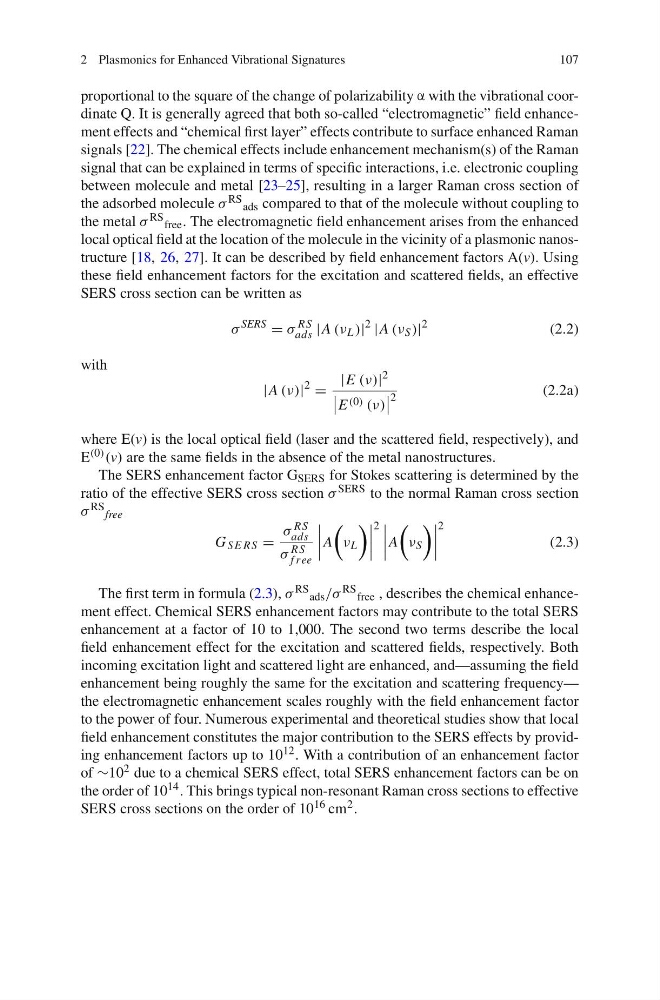
The SERS enhancement factor G SERS for Stokes scattering is determined by the
ratio of the effective SERS cross section σ SERS to the normal Raman cross section
σ RS free
G SE RS =
σ RS
ads
σ RS
f ree
A
ν L
2
A
ν S
2
(2.3)
The first term in formula (2.3), σ RS ads /σ RS free , describes the chemical enhancement effect. Chemical SERS enhancement factors may contribute to the total SERS
enhancement at a factor of 10 to 1,000. The second two terms describe the local
field enhancement effect for the excitation and scattered fields, respectively. Both
incoming excitation light and scattered light are enhanced, and—assuming the field
enhancement being roughly the same for the excitation and scattering frequency—
the electromagnetic enhancement scales roughly with the field enhancement factor
to the power of four. Numerous experimental and theoretical studies show that local
field enhancement constitutes the major contribution to the SERS effects by providing enhancement factors up to 10 12 . With a contribution of an enhancement factor
of ∼10 2 due to a chemical SERS effect, total SERS enhancement factors can be on
the order of 10 14 . This brings typical non-resonant Raman cross sections to effective
SERS cross sections on the order of 10 16 cm 2 .
107
proportional to the square of the change of polarizability α with the vibrational coordinate Q. It is generally agreed that both so-called “electromagnetic” field enhancement effects and “chemical first layer” effects contribute to surface enhanced Raman
signals [22]. The chemical effects include enhancement mechanism(s) of the Raman
signal that can be explained in terms of specific interactions, i.e. electronic coupling
between molecule and metal [23–25], resulting in a larger Raman cross section of
the adsorbed molecule σ RS ads compared to that of the molecule without coupling to
the metal σ RS free . The electromagnetic field enhancement arises from the enhanced
local optical field at the location of the molecule in the vicinity of a plasmonic nanostructure [18, 26, 27]. It can be described by field enhancement factors A(v). Using
these field enhancement factors for the excitation and scattered fields, an effective
SERS cross section can be written as
σ
SERS
= σ
RS
ads |A (ν L )|
2
|A (ν S )|
2
(2.2)
with
|A (ν)|
2
=
|E (ν)|
2
E (0) (ν)
2
(2.2a)
where E(v) is the local optical field (laser and the scattered field, respectively), and
E (0) (v) are the same fields in the absence of the metal nanostructures.
The SERS enhancement factor G SERS for Stokes scattering is determined by the
ratio of the effective SERS cross section σ SERS to the normal Raman cross section
σ RS free
G SE RS =
σ RS
ads
σ RS
f ree
A
ν L
2
A
ν S
2
(2.3)
The first term in formula (2.3), σ RS ads /σ RS free , describes the chemical enhancement effect. Chemical SERS enhancement factors may contribute to the total SERS
enhancement at a factor of 10 to 1,000. The second two terms describe the local
field enhancement effect for the excitation and scattered fields, respectively. Both
incoming excitation light and scattered light are enhanced, and—assuming the field
enhancement being roughly the same for the excitation and scattering frequency—
the electromagnetic enhancement scales roughly with the field enhancement factor
to the power of four. Numerous experimental and theoretical studies show that local
field enhancement constitutes the major contribution to the SERS effects by providing enhancement factors up to 10 12 . With a contribution of an enhancement factor
of ∼10 2 due to a chemical SERS effect, total SERS enhancement factors can be on
the order of 10 14 . This brings typical non-resonant Raman cross sections to effective
SERS cross sections on the order of 10 16 cm 2 .