

5 Introduction to Quantum Vibrational Spectroscopy
87
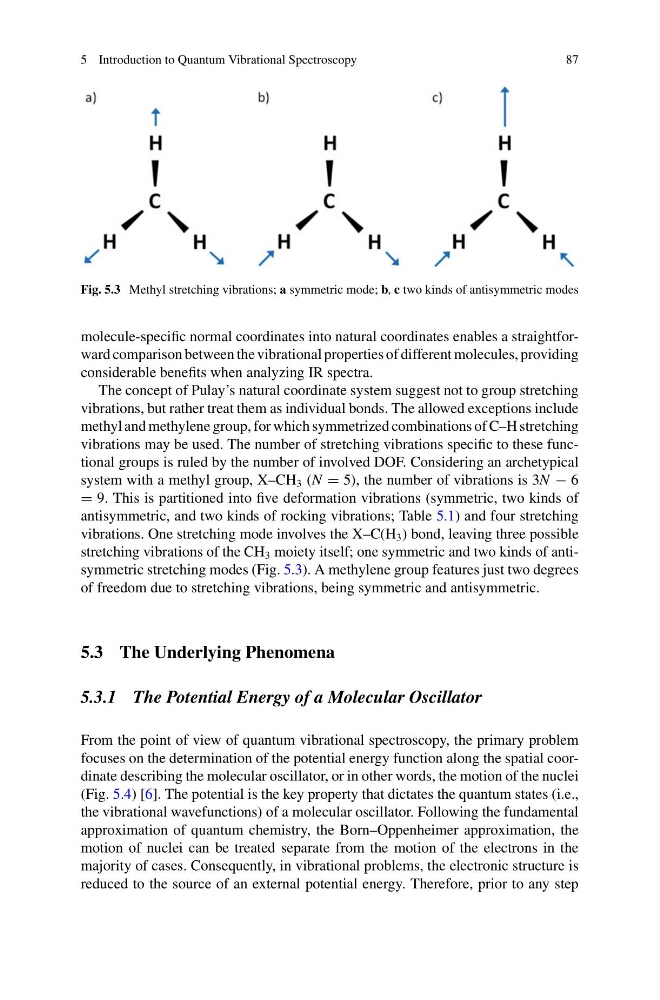
Fig. 5.3 Methyl stretching vibrations; a symmetric mode; b, c two kinds of antisymmetric modes
molecule-specific normal coordinates into natural coordinates enables a straightforward comparison between the vibrational properties of different molecules, providing
considerable benefits when analyzing IR spectra.
The concept of Pulay’s natural coordinate system suggest not to group stretching
vibrations, but rather treat them as individual bonds. The allowed exceptions include
methyl and methylene group, for which symmetrized combinations of C–H stretching
vibrations may be used. The number of stretching vibrations specific to these functional groups is ruled by the number of involved DOF. Considering an archetypical
system with a methyl group, X–CH 3 (N = 5), the number of vibrations is 3N − 6
= 9. This is partitioned into five deformation vibrations (symmetric, two kinds of
antisymmetric, and two kinds of rocking vibrations; Table 5.1) and four stretching
vibrations. One stretching mode involves the X–C(H 3 ) bond, leaving three possible
stretching vibrations of the CH 3 moiety itself; one symmetric and two kinds of antisymmetric stretching modes (Fig. 5.3). A methylene group features just two degrees
of freedom due to stretching vibrations, being symmetric and antisymmetric.
5.3 The Underlying Phenomena
5.3.1 The Potential Energy of a Molecular Oscillator
From the point of view of quantum vibrational spectroscopy, the primary problem
focuses on the determination of the potential energy function along the spatial coordinate describing the molecular oscillator, or in other words, the motion of the nuclei
(Fig. 5.4) [6]. The potential is the key property that dictates the quantum states (i.e.,
the vibrational wavefunctions) of a molecular oscillator. Following the fundamental
approximation of quantum chemistry, the Born–Oppenheimer approximation, the
motion of nuclei can be treated separate from the motion of the electrons in the
majority of cases. Consequently, in vibrational problems, the electronic structure is
reduced to the source of an external potential energy. Therefore, prior to any step
87
Fig. 5.3 Methyl stretching vibrations; a symmetric mode; b, c two kinds of antisymmetric modes
molecule-specific normal coordinates into natural coordinates enables a straightforward comparison between the vibrational properties of different molecules, providing
considerable benefits when analyzing IR spectra.
The concept of Pulay’s natural coordinate system suggest not to group stretching
vibrations, but rather treat them as individual bonds. The allowed exceptions include
methyl and methylene group, for which symmetrized combinations of C–H stretching
vibrations may be used. The number of stretching vibrations specific to these functional groups is ruled by the number of involved DOF. Considering an archetypical
system with a methyl group, X–CH 3 (N = 5), the number of vibrations is 3N − 6
= 9. This is partitioned into five deformation vibrations (symmetric, two kinds of
antisymmetric, and two kinds of rocking vibrations; Table 5.1) and four stretching
vibrations. One stretching mode involves the X–C(H 3 ) bond, leaving three possible
stretching vibrations of the CH 3 moiety itself; one symmetric and two kinds of antisymmetric stretching modes (Fig. 5.3). A methylene group features just two degrees
of freedom due to stretching vibrations, being symmetric and antisymmetric.
5.3 The Underlying Phenomena
5.3.1 The Potential Energy of a Molecular Oscillator
From the point of view of quantum vibrational spectroscopy, the primary problem
focuses on the determination of the potential energy function along the spatial coordinate describing the molecular oscillator, or in other words, the motion of the nuclei
(Fig. 5.4) [6]. The potential is the key property that dictates the quantum states (i.e.,
the vibrational wavefunctions) of a molecular oscillator. Following the fundamental
approximation of quantum chemistry, the Born–Oppenheimer approximation, the
motion of nuclei can be treated separate from the motion of the electrons in the
majority of cases. Consequently, in vibrational problems, the electronic structure is
reduced to the source of an external potential energy. Therefore, prior to any step