

86
K. B. Be´ c et al.
atom displacements defined in normal coordinate system are difficult to interpret in
larger systems; normal coordinates are also specific to a given molecular symmetry
and not transferrable to other ones. Nevertheless, similarities exist between vibrations of molecules constituting similar functional groups and having comparable
structures. A more useful description of vibrational motion is achieved by defining
an alternative coordinate system based on the structural parameters of the systems
such as bond lengths, valence, and dihedral angles. The commonly accepted standard is the internal coordinate system proposed by Pulay et al. [5]; often referred to
as natural coordinate system. The deformation vibrations of functional groups most
commonly found in organic molecules (methyl, −CH 3 ; and methylene sp
3 ; >CH 2 )
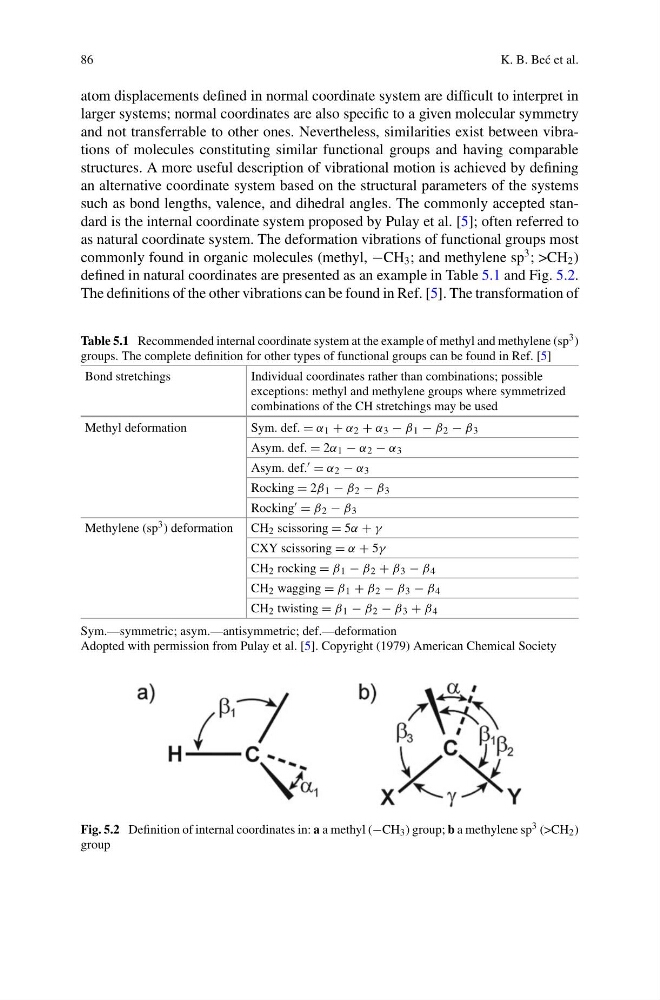
defined in natural coordinates are presented as an example in Table 5.1 and Fig. 5.2.
The definitions of the other vibrations can be found in Ref. [5]. The transformation of
Table 5.1 Recommended internal coordinate system at the example of methyl and methylene (sp 3 )
groups. The complete definition for other types of functional groups can be found in Ref. [5]
Bond stretchings
Individual coordinates rather than combinations; possible
exceptions: methyl and methylene groups where symmetrized
combinations of the CH stretchings may be used
Methyl deformation
Sym. def. = α 1 + α 2 + α 3 − β 1 − β 2 − β 3
Asym. def. = 2α 1 − α 2 − α 3
Asym. def. = α 2 − α 3
Rocking = 2β 1 − β 2 − β 3
Rocking = β 2 − β 3
Methylene (sp 3 ) deformation CH 2 scissoring = 5α + γ
CXY scissoring = α + 5γ
CH 2 rocking = β 1 − β 2 + β 3 − β 4
CH 2 wagging = β 1 + β 2 − β 3 − β 4
CH 2 twisting = β 1 − β 2 − β 3 + β 4
Sym.—symmetric; asym.—antisymmetric; def.—deformation
Adopted with permission from Pulay et al. [5]. Copyright (1979) American Chemical Society
Fig. 5.2 Definition of internal coordinates in: a a methyl (−CH 3 ) group; b a methylene sp 3 (>CH 2 )
group
K. B. Be´ c et al.
atom displacements defined in normal coordinate system are difficult to interpret in
larger systems; normal coordinates are also specific to a given molecular symmetry
and not transferrable to other ones. Nevertheless, similarities exist between vibrations of molecules constituting similar functional groups and having comparable
structures. A more useful description of vibrational motion is achieved by defining
an alternative coordinate system based on the structural parameters of the systems
such as bond lengths, valence, and dihedral angles. The commonly accepted standard is the internal coordinate system proposed by Pulay et al. [5]; often referred to
as natural coordinate system. The deformation vibrations of functional groups most
commonly found in organic molecules (methyl, −CH 3 ; and methylene sp
3 ; >CH 2 )
defined in natural coordinates are presented as an example in Table 5.1 and Fig. 5.2.
The definitions of the other vibrations can be found in Ref. [5]. The transformation of
Table 5.1 Recommended internal coordinate system at the example of methyl and methylene (sp 3 )
groups. The complete definition for other types of functional groups can be found in Ref. [5]
Bond stretchings
Individual coordinates rather than combinations; possible
exceptions: methyl and methylene groups where symmetrized
combinations of the CH stretchings may be used
Methyl deformation
Sym. def. = α 1 + α 2 + α 3 − β 1 − β 2 − β 3
Asym. def. = 2α 1 − α 2 − α 3
Asym. def. = α 2 − α 3
Rocking = 2β 1 − β 2 − β 3
Rocking = β 2 − β 3
Methylene (sp 3 ) deformation CH 2 scissoring = 5α + γ
CXY scissoring = α + 5γ
CH 2 rocking = β 1 − β 2 + β 3 − β 4
CH 2 wagging = β 1 + β 2 − β 3 − β 4
CH 2 twisting = β 1 − β 2 − β 3 + β 4
Sym.—symmetric; asym.—antisymmetric; def.—deformation
Adopted with permission from Pulay et al. [5]. Copyright (1979) American Chemical Society
Fig. 5.2 Definition of internal coordinates in: a a methyl (−CH 3 ) group; b a methylene sp 3 (>CH 2 )
group