

4 Spectral Analysis in the NIR Spectroscopy
79
outlined in Chap. 6. Mean centering will be discussed in centering and normalization
section.
Derivative methods
We already explained the usefulness of derivative method in resolution enhancement
as shown in Fig. 4.10a, b. Here, a problem in the derivative methods which we often
encounter is pointed out. Figure 4.4e shows the second derivative of the spectra as
shown in Fig. 4.4a. It can be seen from Fig. 4.4e that the 7250 cm
−1 peak is much
weaker than the 7300 cm
−1 peak. In the second-derivative spectra, a broad band is
often underestimated, and thus, care must be taken for the second derivative of a
broad band.
4.3.4 Centering and Normalization Methods
Centering and normalization are often effective in chemometrics analysis of NIR data
[1–3]. (Chap. 7) Mean centering is simply an adjustment to a data set to reposition
the centroid of the data to the origin of the coordinate system [2, 3]. Normalization
is an adjustment to a data set that equalizes the magnitude of each spectrum. [2, 3]
Centering methods
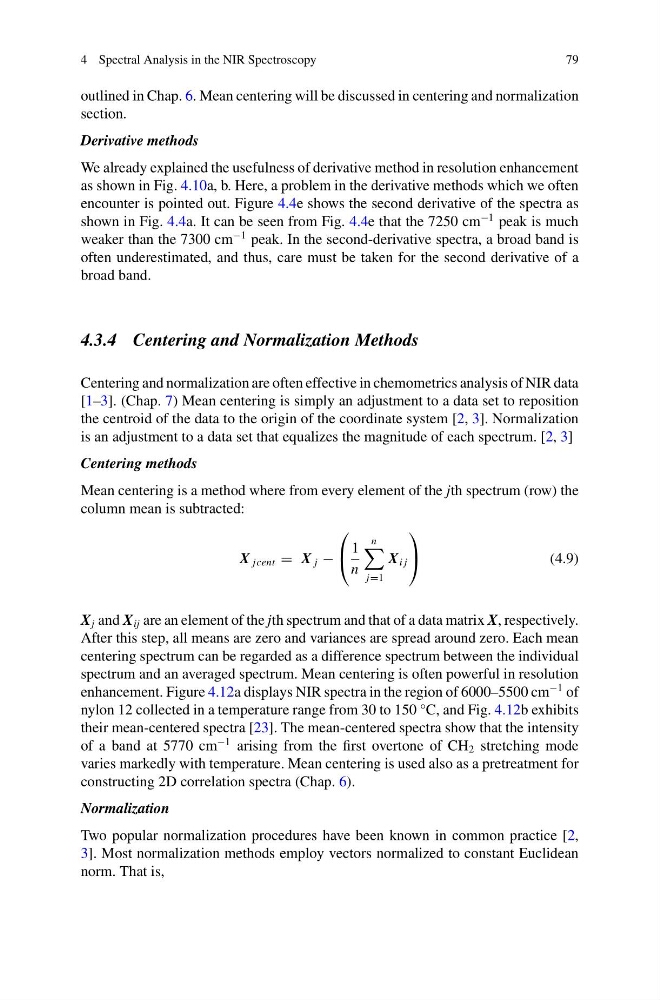
Mean centering is a method where from every element of the jth spectrum (row) the
column mean is subtracted:
X jcent = X j −
⎛
⎝ 1
n
n
j=1
X i j
⎞
⎠
(4.9)
X j and X ij are an element of the jth spectrum and that of a data matrix X, respectively.
After this step, all means are zero and variances are spread around zero. Each mean
centering spectrum can be regarded as a difference spectrum between the individual
spectrum and an averaged spectrum. Mean centering is often powerful in resolution
enhancement. Figure 4.12a displays NIR spectra in the region of 6000–5500 cm
−1 of
nylon 12 collected in a temperature range from 30 to 150 °C, and Fig. 4.12b exhibits
their mean-centered spectra [23]. The mean-centered spectra show that the intensity
of a band at 5770 cm
−1 arising from the first overtone of CH 2 stretching mode
varies markedly with temperature. Mean centering is used also as a pretreatment for
constructing 2D correlation spectra (Chap. 6).
Normalization
Two popular normalization procedures have been known in common practice [2,
3]. Most normalization methods employ vectors normalized to constant Euclidean
norm. That is,
79
outlined in Chap. 6. Mean centering will be discussed in centering and normalization
section.
Derivative methods
We already explained the usefulness of derivative method in resolution enhancement
as shown in Fig. 4.10a, b. Here, a problem in the derivative methods which we often
encounter is pointed out. Figure 4.4e shows the second derivative of the spectra as
shown in Fig. 4.4a. It can be seen from Fig. 4.4e that the 7250 cm
−1 peak is much
weaker than the 7300 cm
−1 peak. In the second-derivative spectra, a broad band is
often underestimated, and thus, care must be taken for the second derivative of a
broad band.
4.3.4 Centering and Normalization Methods
Centering and normalization are often effective in chemometrics analysis of NIR data
[1–3]. (Chap. 7) Mean centering is simply an adjustment to a data set to reposition
the centroid of the data to the origin of the coordinate system [2, 3]. Normalization
is an adjustment to a data set that equalizes the magnitude of each spectrum. [2, 3]
Centering methods
Mean centering is a method where from every element of the jth spectrum (row) the
column mean is subtracted:
X jcent = X j −
⎛
⎝ 1
n
n
j=1
X i j
⎞
⎠
(4.9)
X j and X ij are an element of the jth spectrum and that of a data matrix X, respectively.
After this step, all means are zero and variances are spread around zero. Each mean
centering spectrum can be regarded as a difference spectrum between the individual
spectrum and an averaged spectrum. Mean centering is often powerful in resolution
enhancement. Figure 4.12a displays NIR spectra in the region of 6000–5500 cm
−1 of
nylon 12 collected in a temperature range from 30 to 150 °C, and Fig. 4.12b exhibits
their mean-centered spectra [23]. The mean-centered spectra show that the intensity
of a band at 5770 cm
−1 arising from the first overtone of CH 2 stretching mode
varies markedly with temperature. Mean centering is used also as a pretreatment for
constructing 2D correlation spectra (Chap. 6).
Normalization
Two popular normalization procedures have been known in common practice [2,
3]. Most normalization methods employ vectors normalized to constant Euclidean
norm. That is,