

3 Theoretical Models of Light Scattering and Absorption
53
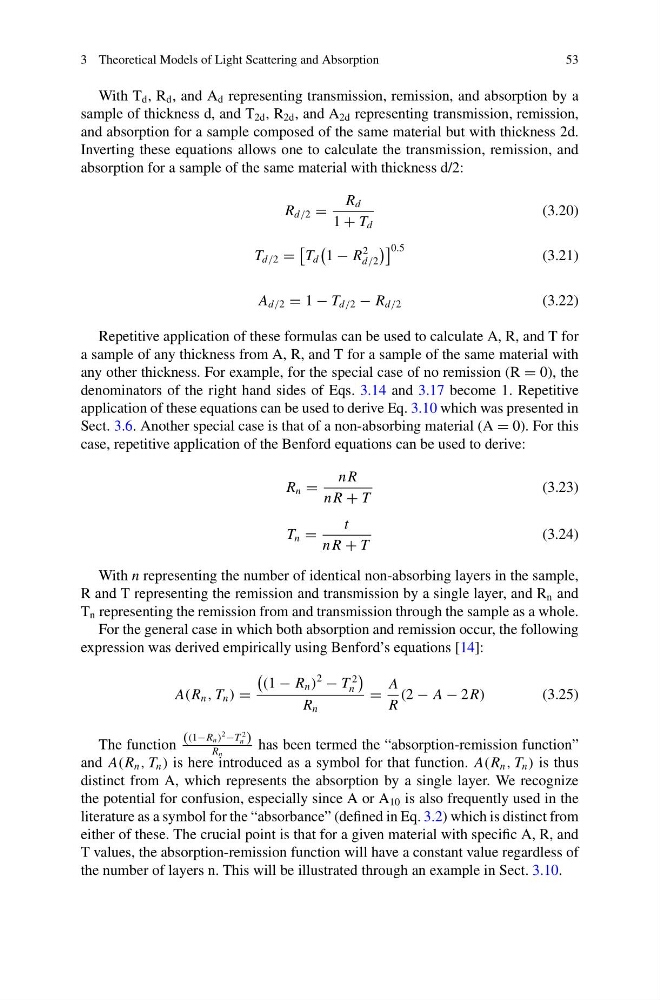
With T d , R d , and A d representing transmission, remission, and absorption by a
sample of thickness d, and T 2d , R 2d , and A 2d representing transmission, remission,
and absorption for a sample composed of the same material but with thickness 2d.
Inverting these equations allows one to calculate the transmission, remission, and
absorption for a sample of the same material with thickness d/2:
R d/2 =
R d
1 + T d
(3.20)
T d/2 =
T d
1 − R
2
d/2
0.5
(3.21)
A d/2 = 1 − T d/2 − R d/2
(3.22)
Repetitive application of these formulas can be used to calculate A, R, and T for
a sample of any thickness from A, R, and T for a sample of the same material with
any other thickness. For example, for the special case of no remission (R = 0), the
denominators of the right hand sides of Eqs. 3.14 and 3.17 become 1. Repetitive
application of these equations can be used to derive Eq. 3.10 which was presented in
Sect. 3.6. Another special case is that of a non-absorbing material (A = 0). For this
case, repetitive application of the Benford equations can be used to derive:
R n =
n R
n R + T
(3.23)
T n =
t
n R + T
(3.24)
With n representing the number of identical non-absorbing layers in the sample,
R and T representing the remission and transmission by a single layer, and R n and
T n representing the remission from and transmission through the sample as a whole.
For the general case in which both absorption and remission occur, the following
expression was derived empirically using Benford’s equations [14]:
A(R n , T n ) =
(1 − R n )
2
− T
2
n
R n
=
A
R
(2 − A − 2R)
(3.25)
The function ((1−Rn)
2 −T
2
n )
R n
has been termed the “absorption-remission function”
and A(R n , T n ) is here introduced as a symbol for that function. A(R n , T n ) is thus
distinct from A, which represents the absorption by a single layer. We recognize
the potential for confusion, especially since A or A 10 is also frequently used in the
literature as a symbol for the “absorbance” (defined in Eq. 3.2) which is distinct from
either of these. The crucial point is that for a given material with specific A, R, and
T values, the absorption-remission function will have a constant value regardless of
the number of layers n. This will be illustrated through an example in Sect. 3.10.
53
With T d , R d , and A d representing transmission, remission, and absorption by a
sample of thickness d, and T 2d , R 2d , and A 2d representing transmission, remission,
and absorption for a sample composed of the same material but with thickness 2d.
Inverting these equations allows one to calculate the transmission, remission, and
absorption for a sample of the same material with thickness d/2:
R d/2 =
R d
1 + T d
(3.20)
T d/2 =
T d
1 − R
2
d/2
0.5
(3.21)
A d/2 = 1 − T d/2 − R d/2
(3.22)
Repetitive application of these formulas can be used to calculate A, R, and T for
a sample of any thickness from A, R, and T for a sample of the same material with
any other thickness. For example, for the special case of no remission (R = 0), the
denominators of the right hand sides of Eqs. 3.14 and 3.17 become 1. Repetitive
application of these equations can be used to derive Eq. 3.10 which was presented in
Sect. 3.6. Another special case is that of a non-absorbing material (A = 0). For this
case, repetitive application of the Benford equations can be used to derive:
R n =
n R
n R + T
(3.23)
T n =
t
n R + T
(3.24)
With n representing the number of identical non-absorbing layers in the sample,
R and T representing the remission and transmission by a single layer, and R n and
T n representing the remission from and transmission through the sample as a whole.
For the general case in which both absorption and remission occur, the following
expression was derived empirically using Benford’s equations [14]:
A(R n , T n ) =
(1 − R n )
2
− T
2
n
R n
=
A
R
(2 − A − 2R)
(3.25)
The function ((1−Rn)
2 −T
2
n )
R n
has been termed the “absorption-remission function”
and A(R n , T n ) is here introduced as a symbol for that function. A(R n , T n ) is thus
distinct from A, which represents the absorption by a single layer. We recognize
the potential for confusion, especially since A or A 10 is also frequently used in the
literature as a symbol for the “absorbance” (defined in Eq. 3.2) which is distinct from
either of these. The crucial point is that for a given material with specific A, R, and
T values, the absorption-remission function will have a constant value regardless of
the number of layers n. This will be illustrated through an example in Sect. 3.10.