

52
K. D. Dahm and D. J. Dahm
the fraction of light that is transmitted through a layer, and R as the fraction of light
remitted by a layer. In this approach, we do not assign particular physical phenomena
to these three outcomes. Thus, R represents all light that “reversed direction,” whether
due to reflection or scatter. Similarly, T represents all light that penetrates the layer,
whether it did so directly or along a more complex path that included one or more
scattering interactions.
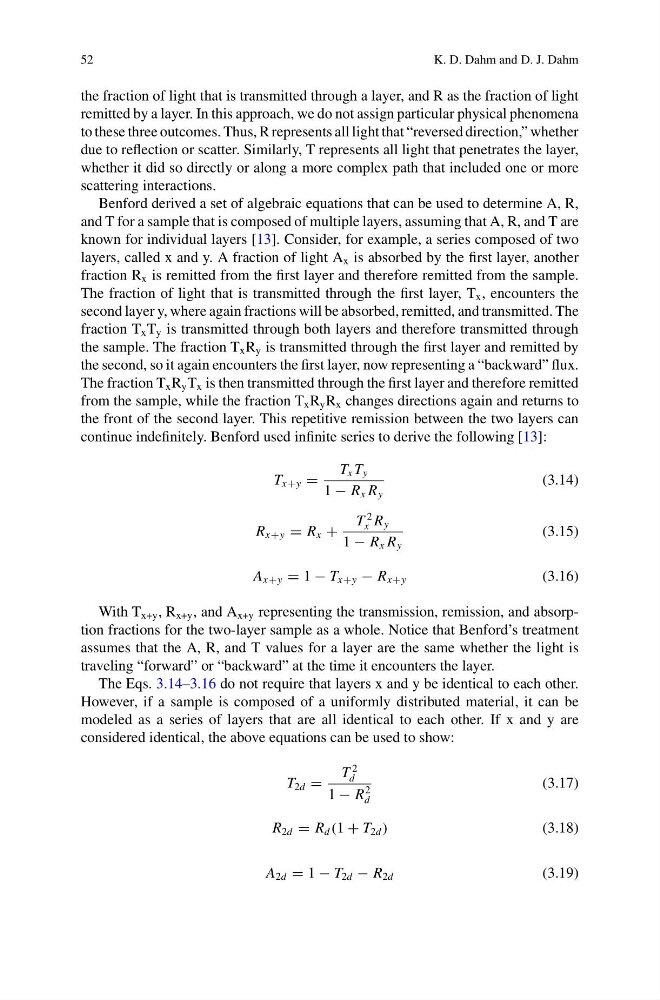
Benford derived a set of algebraic equations that can be used to determine A, R,
and T for a sample that is composed of multiple layers, assuming that A, R, and T are
known for individual layers [13]. Consider, for example, a series composed of two
layers, called x and y. A fraction of light A x is absorbed by the first layer, another
fraction R x is remitted from the first layer and therefore remitted from the sample.
The fraction of light that is transmitted through the first layer, T x , encounters the
second layer y, where again fractions will be absorbed, remitted, and transmitted. The
fraction T x T y is transmitted through both layers and therefore transmitted through
the sample. The fraction T x R y is transmitted through the first layer and remitted by
the second, so it again encounters the first layer, now representing a “backward” flux.
The fraction T x R y T x is then transmitted through the first layer and therefore remitted
from the sample, while the fraction T x R y R x changes directions again and returns to
the front of the second layer. This repetitive remission between the two layers can
continue indefinitely. Benford used infinite series to derive the following [13]:
T x+y =
T x T y
1 − R x R y
(3.14)
R x+y = R x +
T
2
x R y
1 − R x R y
(3.15)
A x+y = 1 − T x+y − R x+y
(3.16)
With T x+y , R x+y , and A x+y representing the transmission, remission, and absorption fractions for the two-layer sample as a whole. Notice that Benford’s treatment
assumes that the A, R, and T values for a layer are the same whether the light is
traveling “forward” or “backward” at the time it encounters the layer.
The Eqs. 3.14–3.16 do not require that layers x and y be identical to each other.
However, if a sample is composed of a uniformly distributed material, it can be
modeled as a series of layers that are all identical to each other. If x and y are
considered identical, the above equations can be used to show:
T 2d =
T
2
d
1 − R
2
d
(3.17)
R 2d = R d (1 + T 2d )
(3.18)
A 2d = 1 − T 2d − R 2d
(3.19)
K. D. Dahm and D. J. Dahm
the fraction of light that is transmitted through a layer, and R as the fraction of light
remitted by a layer. In this approach, we do not assign particular physical phenomena
to these three outcomes. Thus, R represents all light that “reversed direction,” whether
due to reflection or scatter. Similarly, T represents all light that penetrates the layer,
whether it did so directly or along a more complex path that included one or more
scattering interactions.
Benford derived a set of algebraic equations that can be used to determine A, R,
and T for a sample that is composed of multiple layers, assuming that A, R, and T are
known for individual layers [13]. Consider, for example, a series composed of two
layers, called x and y. A fraction of light A x is absorbed by the first layer, another
fraction R x is remitted from the first layer and therefore remitted from the sample.
The fraction of light that is transmitted through the first layer, T x , encounters the
second layer y, where again fractions will be absorbed, remitted, and transmitted. The
fraction T x T y is transmitted through both layers and therefore transmitted through
the sample. The fraction T x R y is transmitted through the first layer and remitted by
the second, so it again encounters the first layer, now representing a “backward” flux.
The fraction T x R y T x is then transmitted through the first layer and therefore remitted
from the sample, while the fraction T x R y R x changes directions again and returns to
the front of the second layer. This repetitive remission between the two layers can
continue indefinitely. Benford used infinite series to derive the following [13]:
T x+y =
T x T y
1 − R x R y
(3.14)
R x+y = R x +
T
2
x R y
1 − R x R y
(3.15)
A x+y = 1 − T x+y − R x+y
(3.16)
With T x+y , R x+y , and A x+y representing the transmission, remission, and absorption fractions for the two-layer sample as a whole. Notice that Benford’s treatment
assumes that the A, R, and T values for a layer are the same whether the light is
traveling “forward” or “backward” at the time it encounters the layer.
The Eqs. 3.14–3.16 do not require that layers x and y be identical to each other.
However, if a sample is composed of a uniformly distributed material, it can be
modeled as a series of layers that are all identical to each other. If x and y are
considered identical, the above equations can be used to show:
T 2d =
T
2
d
1 − R
2
d
(3.17)
R 2d = R d (1 + T 2d )
(3.18)
A 2d = 1 − T 2d − R 2d
(3.19)