

23 Inline and Online Process Analytical Technology with an Outlook …
587
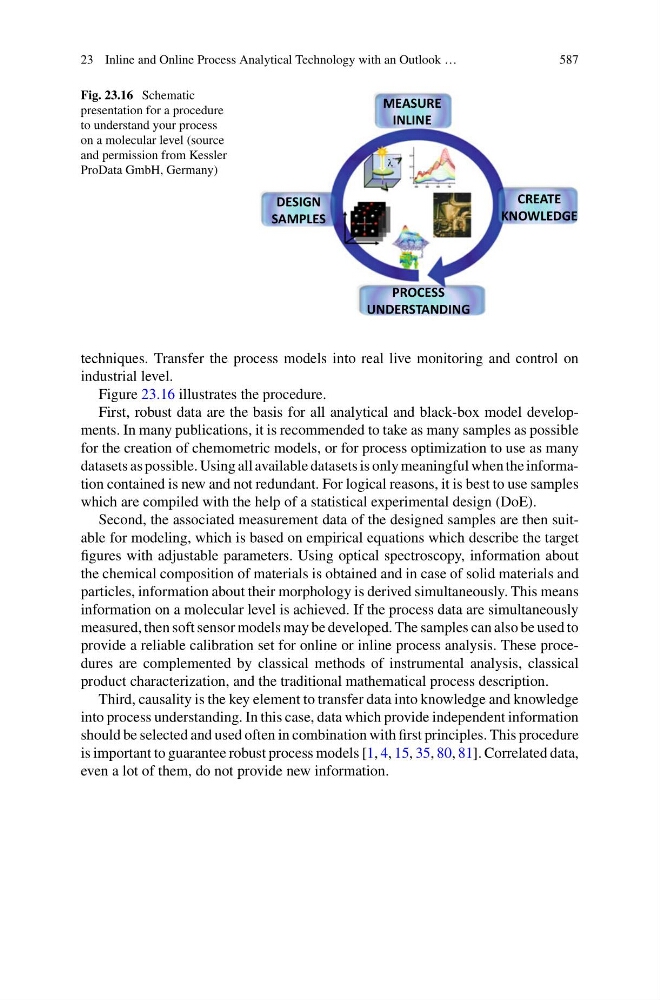
Fig. 23.16 Schematic
presentation for a procedure
to understand your process
on a molecular level (source
and permission from Kessler
ProData GmbH, Germany)
CREATE
KNOWLEDGE
PROCESS
UNDERSTANDING
DESIGN
SAMPLES
MEASURE
INLINE
O
techniques. Transfer the process models into real live monitoring and control on
industrial level.
Figure 23.16 illustrates the procedure.
First, robust data are the basis for all analytical and black-box model developments. In many publications, it is recommended to take as many samples as possible
for the creation of chemometric models, or for process optimization to use as many
datasets as possible. Using all available datasets is only meaningful when the information contained is new and not redundant. For logical reasons, it is best to use samples
which are compiled with the help of a statistical experimental design (DoE).
Second, the associated measurement data of the designed samples are then suitable for modeling, which is based on empirical equations which describe the target
figures with adjustable parameters. Using optical spectroscopy, information about
the chemical composition of materials is obtained and in case of solid materials and
particles, information about their morphology is derived simultaneously. This means
information on a molecular level is achieved. If the process data are simultaneously
measured, then soft sensor models may be developed. The samples can also be used to
provide a reliable calibration set for online or inline process analysis. These procedures are complemented by classical methods of instrumental analysis, classical
product characterization, and the traditional mathematical process description.
Third, causality is the key element to transfer data into knowledge and knowledge
into process understanding. In this case, data which provide independent information
should be selected and used often in combination with first principles. This procedure
is important to guarantee robust process models [1, 4, 15, 35, 80, 81]. Correlated data,
even a lot of them, do not provide new information.
587
Fig. 23.16 Schematic
presentation for a procedure
to understand your process
on a molecular level (source
and permission from Kessler
ProData GmbH, Germany)
CREATE
KNOWLEDGE
PROCESS
UNDERSTANDING
DESIGN
SAMPLES
MEASURE
INLINE
O
techniques. Transfer the process models into real live monitoring and control on
industrial level.
Figure 23.16 illustrates the procedure.
First, robust data are the basis for all analytical and black-box model developments. In many publications, it is recommended to take as many samples as possible
for the creation of chemometric models, or for process optimization to use as many
datasets as possible. Using all available datasets is only meaningful when the information contained is new and not redundant. For logical reasons, it is best to use samples
which are compiled with the help of a statistical experimental design (DoE).
Second, the associated measurement data of the designed samples are then suitable for modeling, which is based on empirical equations which describe the target
figures with adjustable parameters. Using optical spectroscopy, information about
the chemical composition of materials is obtained and in case of solid materials and
particles, information about their morphology is derived simultaneously. This means
information on a molecular level is achieved. If the process data are simultaneously
measured, then soft sensor models may be developed. The samples can also be used to
provide a reliable calibration set for online or inline process analysis. These procedures are complemented by classical methods of instrumental analysis, classical
product characterization, and the traditional mathematical process description.
Third, causality is the key element to transfer data into knowledge and knowledge
into process understanding. In this case, data which provide independent information
should be selected and used often in combination with first principles. This procedure
is important to guarantee robust process models [1, 4, 15, 35, 80, 81]. Correlated data,
even a lot of them, do not provide new information.