

572
R. W. Kessler and W. Kessler
23.5.1.2 Measurement of the Film Thickness and Defect Sites
by the Combination of Spectral Interference Spectroscopy
and Depolarization of Light
The thickness of thin films on a surface can be measurement using, e.g., the specular
reflectance arrangement where wavelength-dependent interference according to the
Fresnel equations will appear. Due to refraction and reflection of the top and lower
level of a film, a phase shift occurs and this phase shift can be measured by means
of the interference pattern of the spectrum of the specular reflected light. Popular
arrangements for inline control are, e.g., illumination at an angle of 45 degrees and
detection at also 45°, which is labeled as 45R45, whereas diffuse reflected light might
be measured at 0 degree, labeled then 45R0. However, if the macroscopic shapes of
the sample, e.g., a shiny skin of a fruit or microscopic mirrors evenly distributed
within a surface layer of a tablet, the use of polarization filters is recommended (see
outline below).
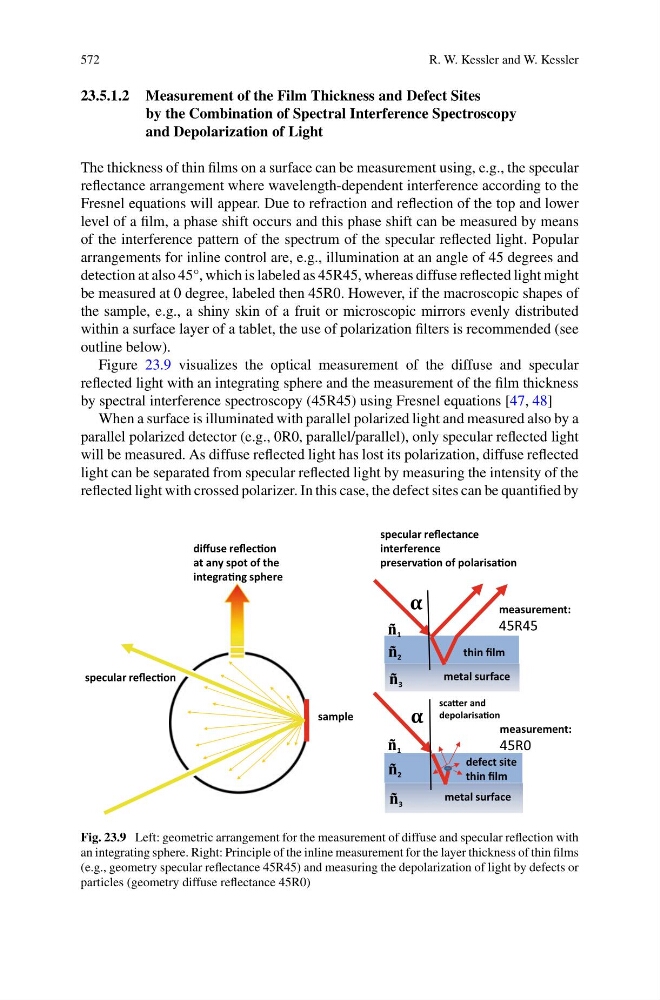
Figure 23.9 visualizes the optical measurement of the diffuse and specular
reflected light with an integrating sphere and the measurement of the film thickness
by spectral interference spectroscopy (45R45) using Fresnel equations [47, 48]
When a surface is illuminated with parallel polarized light and measured also by a
parallel polarized detector (e.g., 0R0, parallel/parallel), only specular reflected light
will be measured. As diffuse reflected light has lost its polarization, diffuse reflected
light can be separated from specular reflected light by measuring the intensity of the
reflected light with crossed polarizer. In this case, the defect sites can be quantified by
sample
specular reflecƟon
diffuse reflecƟon
at any spot of the
integraƟng sphere
specular reflectance
interference
preservaƟon of polarisaƟon
thin film
metal surface
ñ 1
ñ 2
ñ 3
measurement:
45R45
scaƩer and
depolarisaƟon
metal surface
ñ 1
ñ 2
ñ 3
defect site
thin film
measurement:
45R0
Fig. 23.9 Left: geometric arrangement for the measurement of diffuse and specular reflection with
an integrating sphere. Right: Principle of the inline measurement for the layer thickness of thin films
(e.g., geometry specular reflectance 45R45) and measuring the depolarization of light by defects or
particles (geometry diffuse reflectance 45R0)
R. W. Kessler and W. Kessler
23.5.1.2 Measurement of the Film Thickness and Defect Sites
by the Combination of Spectral Interference Spectroscopy
and Depolarization of Light
The thickness of thin films on a surface can be measurement using, e.g., the specular
reflectance arrangement where wavelength-dependent interference according to the
Fresnel equations will appear. Due to refraction and reflection of the top and lower
level of a film, a phase shift occurs and this phase shift can be measured by means
of the interference pattern of the spectrum of the specular reflected light. Popular
arrangements for inline control are, e.g., illumination at an angle of 45 degrees and
detection at also 45°, which is labeled as 45R45, whereas diffuse reflected light might
be measured at 0 degree, labeled then 45R0. However, if the macroscopic shapes of
the sample, e.g., a shiny skin of a fruit or microscopic mirrors evenly distributed
within a surface layer of a tablet, the use of polarization filters is recommended (see
outline below).
Figure 23.9 visualizes the optical measurement of the diffuse and specular
reflected light with an integrating sphere and the measurement of the film thickness
by spectral interference spectroscopy (45R45) using Fresnel equations [47, 48]
When a surface is illuminated with parallel polarized light and measured also by a
parallel polarized detector (e.g., 0R0, parallel/parallel), only specular reflected light
will be measured. As diffuse reflected light has lost its polarization, diffuse reflected
light can be separated from specular reflected light by measuring the intensity of the
reflected light with crossed polarizer. In this case, the defect sites can be quantified by
sample
specular reflecƟon
diffuse reflecƟon
at any spot of the
integraƟng sphere
specular reflectance
interference
preservaƟon of polarisaƟon
thin film
metal surface
ñ 1
ñ 2
ñ 3
measurement:
45R45
scaƩer and
depolarisaƟon
metal surface
ñ 1
ñ 2
ñ 3
defect site
thin film
measurement:
45R0
Fig. 23.9 Left: geometric arrangement for the measurement of diffuse and specular reflection with
an integrating sphere. Right: Principle of the inline measurement for the layer thickness of thin films
(e.g., geometry specular reflectance 45R45) and measuring the depolarization of light by defects or
particles (geometry diffuse reflectance 45R0)