

570
R. W. Kessler and W. Kessler
23.4.2 Retractable Probes for Cleaning in Place (CIP)
and Working with Highly Toxic or Aggressive Media
In food industry and especially in biotechnology, due to probe fouling, there is a
demand for cleaning in place (CIP) which avoids contamination of the bioreactor.
Highly viscous or pulpy process media form often strongly adherend deposits on the
surface of an optical probe which then need aggressive cleaning procedures to reestablish a reproducible measurement. Furthermore, when working with hazardous
materials, the processing unit must be reliably isolated from the environment during
production even when the sensor is broken. In this case, the entire drive unit must be
separated from the process stream under full process conditions. It is important, that
the functionality of the optical probe is continuously under control and the probe can
have a full view into the process.
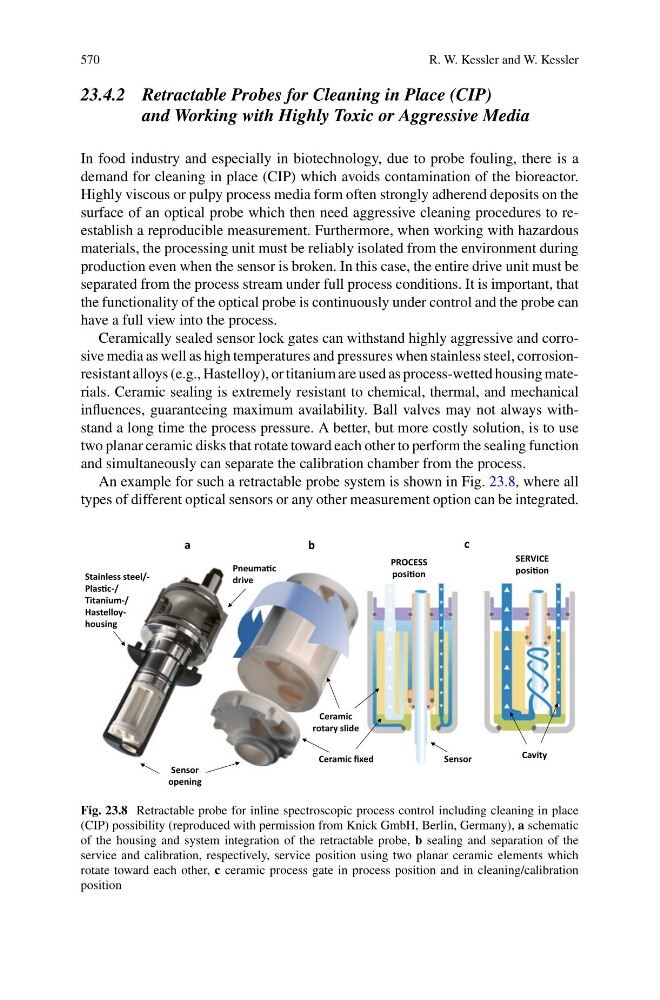
Ceramically sealed sensor lock gates can withstand highly aggressive and corrosive media as well as high temperatures and pressures when stainless steel, corrosionresistant alloys (e.g., Hastelloy), or titanium are used as process-wetted housing materials. Ceramic sealing is extremely resistant to chemical, thermal, and mechanical
influences, guaranteeing maximum availability. Ball valves may not always withstand a long time the process pressure. A better, but more costly solution, is to use
two planar ceramic disks that rotate toward each other to perform the sealing function
and simultaneously can separate the calibration chamber from the process.
An example for such a retractable probe system is shown in Fig. 23.8, where all
types of different optical sensors or any other measurement option can be integrated.
Sensor
Ceramic
rotary slide
PneumaƟc
drive
Stainless steel/PlasƟc-/
Titanium-/
Hastelloyhousing
a
b
c
PROCESS
posiƟon
SERVICE
posiƟon
Sensor
opening
Ceramic fixed
Cavity
Fig. 23.8 Retractable probe for inline spectroscopic process control including cleaning in place
(CIP) possibility (reproduced with permission from Knick GmbH, Berlin, Germany), a schematic
of the housing and system integration of the retractable probe, b sealing and separation of the
service and calibration, respectively, service position using two planar ceramic elements which
rotate toward each other, c ceramic process gate in process position and in cleaning/calibration
position
R. W. Kessler and W. Kessler
23.4.2 Retractable Probes for Cleaning in Place (CIP)
and Working with Highly Toxic or Aggressive Media
In food industry and especially in biotechnology, due to probe fouling, there is a
demand for cleaning in place (CIP) which avoids contamination of the bioreactor.
Highly viscous or pulpy process media form often strongly adherend deposits on the
surface of an optical probe which then need aggressive cleaning procedures to reestablish a reproducible measurement. Furthermore, when working with hazardous
materials, the processing unit must be reliably isolated from the environment during
production even when the sensor is broken. In this case, the entire drive unit must be
separated from the process stream under full process conditions. It is important, that
the functionality of the optical probe is continuously under control and the probe can
have a full view into the process.
Ceramically sealed sensor lock gates can withstand highly aggressive and corrosive media as well as high temperatures and pressures when stainless steel, corrosionresistant alloys (e.g., Hastelloy), or titanium are used as process-wetted housing materials. Ceramic sealing is extremely resistant to chemical, thermal, and mechanical
influences, guaranteeing maximum availability. Ball valves may not always withstand a long time the process pressure. A better, but more costly solution, is to use
two planar ceramic disks that rotate toward each other to perform the sealing function
and simultaneously can separate the calibration chamber from the process.
An example for such a retractable probe system is shown in Fig. 23.8, where all
types of different optical sensors or any other measurement option can be integrated.
Sensor
Ceramic
rotary slide
PneumaƟc
drive
Stainless steel/PlasƟc-/
Titanium-/
Hastelloyhousing
a
b
c
PROCESS
posiƟon
SERVICE
posiƟon
Sensor
opening
Ceramic fixed
Cavity
Fig. 23.8 Retractable probe for inline spectroscopic process control including cleaning in place
(CIP) possibility (reproduced with permission from Knick GmbH, Berlin, Germany), a schematic
of the housing and system integration of the retractable probe, b sealing and separation of the
service and calibration, respectively, service position using two planar ceramic elements which
rotate toward each other, c ceramic process gate in process position and in cleaning/calibration
position