

23 Inline and Online Process Analytical Technology with an Outlook …
569
Transmittance Reflectance Transflectance Attenuated Total
Reflectance (ATR)
to detection
Light source
Light source
Light source
mirror
ATR crystal
Light source
to detection
to detection
to detection
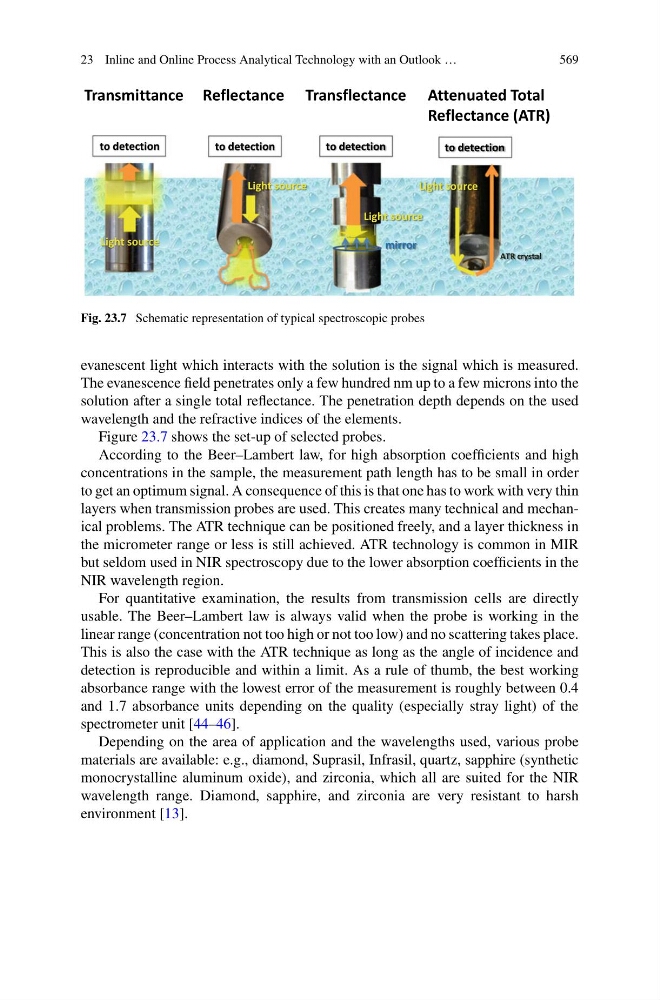
Fig. 23.7 Schematic representation of typical spectroscopic probes
evanescent light which interacts with the solution is the signal which is measured.
The evanescence field penetrates only a few hundred nm up to a few microns into the
solution after a single total reflectance. The penetration depth depends on the used
wavelength and the refractive indices of the elements.
Figure 23.7 shows the set-up of selected probes.
According to the Beer–Lambert law, for high absorption coefficients and high
concentrations in the sample, the measurement path length has to be small in order
to get an optimum signal. A consequence of this is that one has to work with very thin
layers when transmission probes are used. This creates many technical and mechanical problems. The ATR technique can be positioned freely, and a layer thickness in
the micrometer range or less is still achieved. ATR technology is common in MIR
but seldom used in NIR spectroscopy due to the lower absorption coefficients in the
NIR wavelength region.
For quantitative examination, the results from transmission cells are directly
usable. The Beer–Lambert law is always valid when the probe is working in the
linear range (concentration not too high or not too low) and no scattering takes place.
This is also the case with the ATR technique as long as the angle of incidence and
detection is reproducible and within a limit. As a rule of thumb, the best working
absorbance range with the lowest error of the measurement is roughly between 0.4
and 1.7 absorbance units depending on the quality (especially stray light) of the
spectrometer unit [44–46].
Depending on the area of application and the wavelengths used, various probe
materials are available: e.g., diamond, Suprasil, Infrasil, quartz, sapphire (synthetic
monocrystalline aluminum oxide), and zirconia, which all are suited for the NIR
wavelength range. Diamond, sapphire, and zirconia are very resistant to harsh
environment [13].
569
Transmittance Reflectance Transflectance Attenuated Total
Reflectance (ATR)
to detection
Light source
Light source
Light source
mirror
ATR crystal
Light source
to detection
to detection
to detection
Fig. 23.7 Schematic representation of typical spectroscopic probes
evanescent light which interacts with the solution is the signal which is measured.
The evanescence field penetrates only a few hundred nm up to a few microns into the
solution after a single total reflectance. The penetration depth depends on the used
wavelength and the refractive indices of the elements.
Figure 23.7 shows the set-up of selected probes.
According to the Beer–Lambert law, for high absorption coefficients and high
concentrations in the sample, the measurement path length has to be small in order
to get an optimum signal. A consequence of this is that one has to work with very thin
layers when transmission probes are used. This creates many technical and mechanical problems. The ATR technique can be positioned freely, and a layer thickness in
the micrometer range or less is still achieved. ATR technology is common in MIR
but seldom used in NIR spectroscopy due to the lower absorption coefficients in the
NIR wavelength region.
For quantitative examination, the results from transmission cells are directly
usable. The Beer–Lambert law is always valid when the probe is working in the
linear range (concentration not too high or not too low) and no scattering takes place.
This is also the case with the ATR technique as long as the angle of incidence and
detection is reproducible and within a limit. As a rule of thumb, the best working
absorbance range with the lowest error of the measurement is roughly between 0.4
and 1.7 absorbance units depending on the quality (especially stray light) of the
spectrometer unit [44–46].
Depending on the area of application and the wavelengths used, various probe
materials are available: e.g., diamond, Suprasil, Infrasil, quartz, sapphire (synthetic
monocrystalline aluminum oxide), and zirconia, which all are suited for the NIR
wavelength range. Diamond, sapphire, and zirconia are very resistant to harsh
environment [13].