

50
K. D. Dahm and D. J. Dahm
3.7 The Schuster and Kubelka–Munk Equations
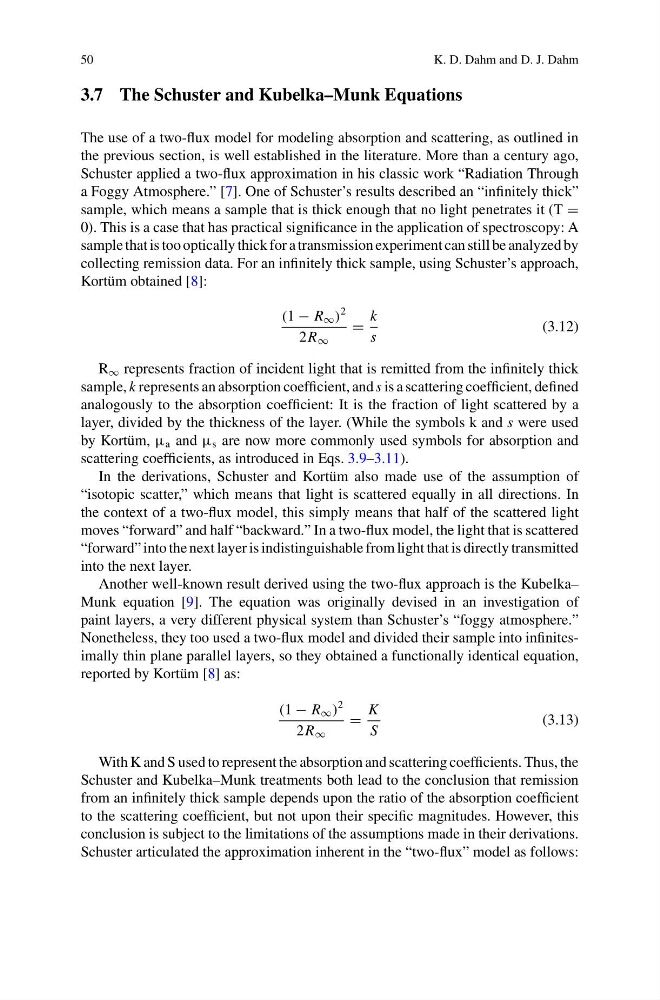
The use of a two-flux model for modeling absorption and scattering, as outlined in
the previous section, is well established in the literature. More than a century ago,
Schuster applied a two-flux approximation in his classic work “Radiation Through
a Foggy Atmosphere.” [7]. One of Schuster’s results described an “infinitely thick”
sample, which means a sample that is thick enough that no light penetrates it (T =
0). This is a case that has practical significance in the application of spectroscopy: A
sample that is too optically thick for a transmission experiment can still be analyzed by
collecting remission data. For an infinitely thick sample, using Schuster’s approach,
Kortüm obtained [8]:
(1 − R ∞ )
2
2R ∞
=
k
s
(3.12)
R ∞ represents fraction of incident light that is remitted from the infinitely thick
sample, k represents an absorption coefficient, and s is a scattering coefficient, defined
analogously to the absorption coefficient: It is the fraction of light scattered by a
layer, divided by the thickness of the layer. (While the symbols k and s were used
by Kortüm, μ a and μ s are now more commonly used symbols for absorption and
scattering coefficients, as introduced in Eqs. 3.9–3.11).
In the derivations, Schuster and Kortüm also made use of the assumption of
“isotopic scatter,” which means that light is scattered equally in all directions. In
the context of a two-flux model, this simply means that half of the scattered light
moves “forward” and half “backward.” In a two-flux model, the light that is scattered
“forward” into the next layer is indistinguishable from light that is directly transmitted
into the next layer.
Another well-known result derived using the two-flux approach is the Kubelka–
Munk equation [9]. The equation was originally devised in an investigation of
paint layers, a very different physical system than Schuster’s “foggy atmosphere.”
Nonetheless, they too used a two-flux model and divided their sample into infinitesimally thin plane parallel layers, so they obtained a functionally identical equation,
reported by Kortüm [8] as:
(1 − R ∞ )
2
2R ∞
=
K
S
(3.13)
With K and S used to represent the absorption and scattering coefficients. Thus, the
Schuster and Kubelka–Munk treatments both lead to the conclusion that remission
from an infinitely thick sample depends upon the ratio of the absorption coefficient
to the scattering coefficient, but not upon their specific magnitudes. However, this
conclusion is subject to the limitations of the assumptions made in their derivations.
Schuster articulated the approximation inherent in the “two-flux” model as follows:
K. D. Dahm and D. J. Dahm
3.7 The Schuster and Kubelka–Munk Equations
The use of a two-flux model for modeling absorption and scattering, as outlined in
the previous section, is well established in the literature. More than a century ago,
Schuster applied a two-flux approximation in his classic work “Radiation Through
a Foggy Atmosphere.” [7]. One of Schuster’s results described an “infinitely thick”
sample, which means a sample that is thick enough that no light penetrates it (T =
0). This is a case that has practical significance in the application of spectroscopy: A
sample that is too optically thick for a transmission experiment can still be analyzed by
collecting remission data. For an infinitely thick sample, using Schuster’s approach,
Kortüm obtained [8]:
(1 − R ∞ )
2
2R ∞
=
k
s
(3.12)
R ∞ represents fraction of incident light that is remitted from the infinitely thick
sample, k represents an absorption coefficient, and s is a scattering coefficient, defined
analogously to the absorption coefficient: It is the fraction of light scattered by a
layer, divided by the thickness of the layer. (While the symbols k and s were used
by Kortüm, μ a and μ s are now more commonly used symbols for absorption and
scattering coefficients, as introduced in Eqs. 3.9–3.11).
In the derivations, Schuster and Kortüm also made use of the assumption of
“isotopic scatter,” which means that light is scattered equally in all directions. In
the context of a two-flux model, this simply means that half of the scattered light
moves “forward” and half “backward.” In a two-flux model, the light that is scattered
“forward” into the next layer is indistinguishable from light that is directly transmitted
into the next layer.
Another well-known result derived using the two-flux approach is the Kubelka–
Munk equation [9]. The equation was originally devised in an investigation of
paint layers, a very different physical system than Schuster’s “foggy atmosphere.”
Nonetheless, they too used a two-flux model and divided their sample into infinitesimally thin plane parallel layers, so they obtained a functionally identical equation,
reported by Kortüm [8] as:
(1 − R ∞ )
2
2R ∞
=
K
S
(3.13)
With K and S used to represent the absorption and scattering coefficients. Thus, the
Schuster and Kubelka–Munk treatments both lead to the conclusion that remission
from an infinitely thick sample depends upon the ratio of the absorption coefficient
to the scattering coefficient, but not upon their specific magnitudes. However, this
conclusion is subject to the limitations of the assumptions made in their derivations.
Schuster articulated the approximation inherent in the “two-flux” model as follows: