

23 Inline and Online Process Analytical Technology with an Outlook …
565
23.3.2.2 NIR Spectroscopic Sensitivity
Near-infrared spectroscopy (NIR) is less sensitive than MIR spectroscopy due to
smaller absorption cross sections of the oscillation transitions of the higher orders.
Therefore, NIR spectroscopy is not a very sensitive method and the detection limit
is much lower than with MIR spectroscopy and also UV–Vis spectroscopy. It must
also be emphasized that scattering of particles can significantly alter the spectral
fingerprints due to the high sensitivity of the scattering cross section (see Table 23.1).
Changes in morphology, e.g., during sample preparation, are often misinterpreted as
changes in chemical composition. An example is the measurement of groundwood
chips used for calibration for the inline measurement of macroscopic wood chips
[1, 4, 13, 33].
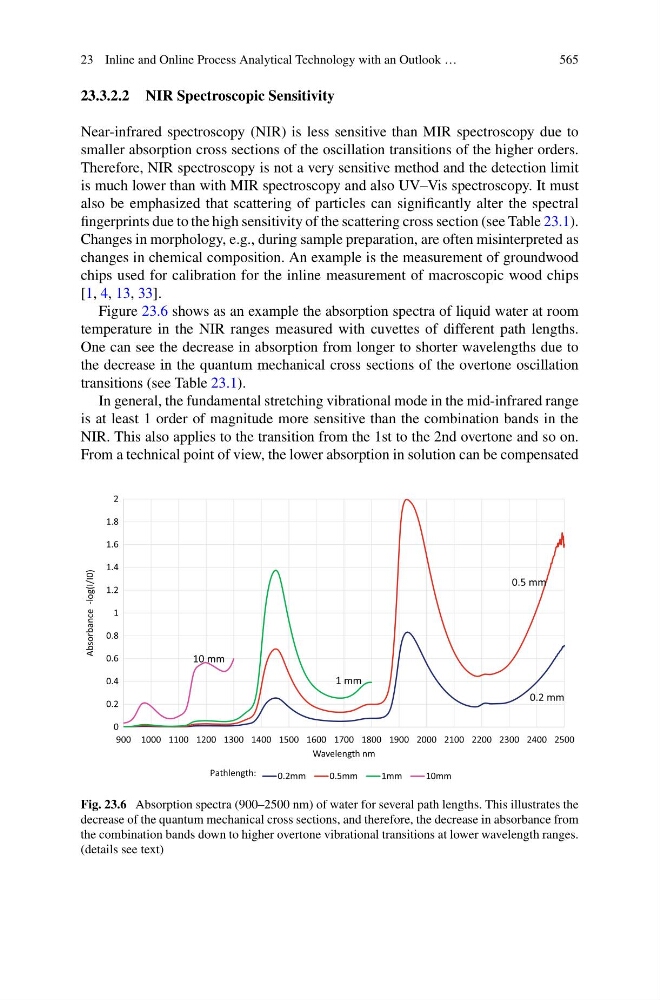
Figure 23.6 shows as an example the absorption spectra of liquid water at room
temperature in the NIR ranges measured with cuvettes of different path lengths.
One can see the decrease in absorption from longer to shorter wavelengths due to
the decrease in the quantum mechanical cross sections of the overtone oscillation
transitions (see Table 23.1).
In general, the fundamental stretching vibrational mode in the mid-infrared range
is at least 1 order of magnitude more sensitive than the combination bands in the
NIR. This also applies to the transition from the 1st to the 2nd overtone and so on.
From a technical point of view, the lower absorption in solution can be compensated
0
0.2
0.4
0.6
0.8
1
1.2
1.4
1.6
1.8
2
900 1000 1100 1200 1300 1400 1500 1600 1700 1800 1900 2000 2100 2200 2300 2400 2500
Absorbance -log(I/I0)
Wavelength nm
0.2mm
0.5mm
1mm
10mm
10 mm
1 mm
0.5 mm
0.2 mm
Pathlength:
Fig. 23.6 Absorption spectra (900–2500 nm) of water for several path lengths. This illustrates the
decrease of the quantum mechanical cross sections, and therefore, the decrease in absorbance from
the combination bands down to higher overtone vibrational transitions at lower wavelength ranges.
(details see text)
565
23.3.2.2 NIR Spectroscopic Sensitivity
Near-infrared spectroscopy (NIR) is less sensitive than MIR spectroscopy due to
smaller absorption cross sections of the oscillation transitions of the higher orders.
Therefore, NIR spectroscopy is not a very sensitive method and the detection limit
is much lower than with MIR spectroscopy and also UV–Vis spectroscopy. It must
also be emphasized that scattering of particles can significantly alter the spectral
fingerprints due to the high sensitivity of the scattering cross section (see Table 23.1).
Changes in morphology, e.g., during sample preparation, are often misinterpreted as
changes in chemical composition. An example is the measurement of groundwood
chips used for calibration for the inline measurement of macroscopic wood chips
[1, 4, 13, 33].
Figure 23.6 shows as an example the absorption spectra of liquid water at room
temperature in the NIR ranges measured with cuvettes of different path lengths.
One can see the decrease in absorption from longer to shorter wavelengths due to
the decrease in the quantum mechanical cross sections of the overtone oscillation
transitions (see Table 23.1).
In general, the fundamental stretching vibrational mode in the mid-infrared range
is at least 1 order of magnitude more sensitive than the combination bands in the
NIR. This also applies to the transition from the 1st to the 2nd overtone and so on.
From a technical point of view, the lower absorption in solution can be compensated
0
0.2
0.4
0.6
0.8
1
1.2
1.4
1.6
1.8
2
900 1000 1100 1200 1300 1400 1500 1600 1700 1800 1900 2000 2100 2200 2300 2400 2500
Absorbance -log(I/I0)
Wavelength nm
0.2mm
0.5mm
1mm
10mm
10 mm
1 mm
0.5 mm
0.2 mm
Pathlength:
Fig. 23.6 Absorption spectra (900–2500 nm) of water for several path lengths. This illustrates the
decrease of the quantum mechanical cross sections, and therefore, the decrease in absorbance from
the combination bands down to higher overtone vibrational transitions at lower wavelength ranges.
(details see text)