

564
R. W. Kessler and W. Kessler
at which the determined mean measurement signal is just above the noise limits of
the zero signal. Among other things, it is defined by the absorption cross section of
the molecule [1, 2, 10, 33].
The sensitivity of a molecule can be described by the quantum mechanical cross
sections [1, 33, 34]. These are the effective areas that determine the probability of
an event with a molecule, such as elastic scattering or absorption or emission of
a photon at a certain wavelength. From a quantum mechanical point of view, the
absorption cross section σ a is usually given in cm
2 /molecule and depends on the
individual molecular structure of the compound and quantum mechanical selection
rules. The term cross section is used in physics to quantify the probability of a certain
interaction, e.g., scattering or electromagnetic absorption. For example, in the NIR
range the cross section probabilities change over several orders of magnitude for the
combination bands between the first and second or third overtone.
It is also important to note that in turbid media or solids the scattering cross section
can be several orders of magnitude more sensitive than the absorption cross section.
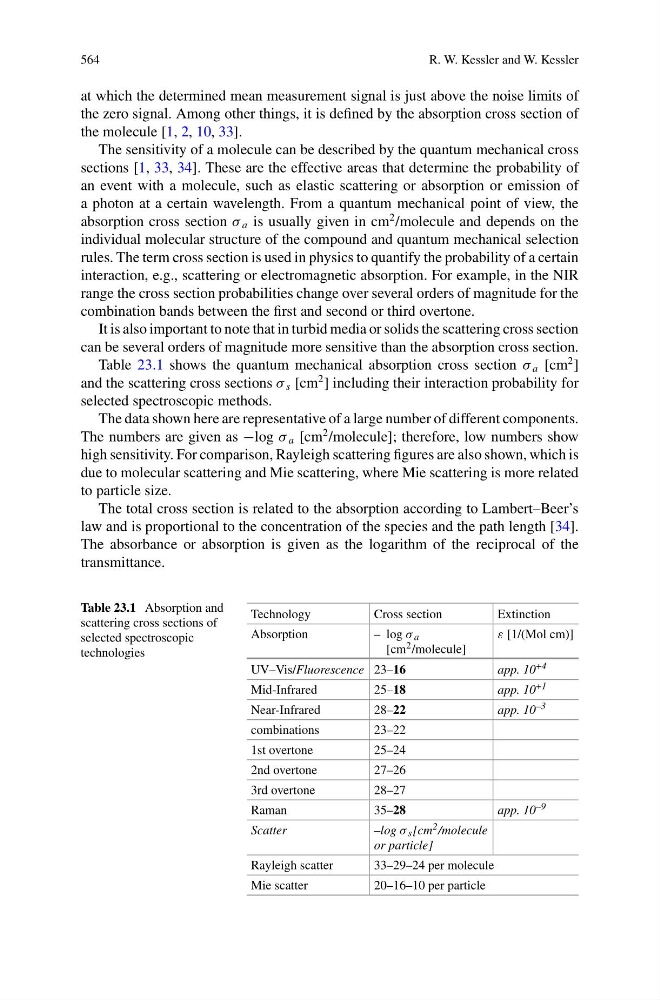
Table 23.1 shows the quantum mechanical absorption cross section σ a [cm
2 ]
and the scattering cross sections σ s [cm
2 ] including their interaction probability for
selected spectroscopic methods.
The data shown here are representative of a large number of different components.
The numbers are given as −log σ a [cm
2 /molecule]; therefore, low numbers show
high sensitivity. For comparison, Rayleigh scattering figures are also shown, which is
due to molecular scattering and Mie scattering, where Mie scattering is more related
to particle size.
The total cross section is related to the absorption according to Lambert–Beer’s
law and is proportional to the concentration of the species and the path length [34].
The absorbance or absorption is given as the logarithm of the reciprocal of the
transmittance.
Table 23.1 Absorption and
scattering cross sections of
selected spectroscopic
technologies
Technology
Cross section
Extinction
Absorption
– log σ a
[cm 2 /molecule]
ε [1/(Mol cm)]
UV–Vis/Fluorescence 23–16
app. 10 +4
Mid-Infrared
25–18
app. 10 +1
Near-Infrared
28–22
app. 10 –3
combinations
23–22
1st overtone
25–24
2nd overtone
27–26
3rd overtone
28–27
Raman
35–28
app. 10 –9
Scatter
–log σ s [cm 2 /molecule
or particle]
Rayleigh scatter
33–29–24 per molecule
Mie scatter
20–16–10 per particle
R. W. Kessler and W. Kessler
at which the determined mean measurement signal is just above the noise limits of
the zero signal. Among other things, it is defined by the absorption cross section of
the molecule [1, 2, 10, 33].
The sensitivity of a molecule can be described by the quantum mechanical cross
sections [1, 33, 34]. These are the effective areas that determine the probability of
an event with a molecule, such as elastic scattering or absorption or emission of
a photon at a certain wavelength. From a quantum mechanical point of view, the
absorption cross section σ a is usually given in cm
2 /molecule and depends on the
individual molecular structure of the compound and quantum mechanical selection
rules. The term cross section is used in physics to quantify the probability of a certain
interaction, e.g., scattering or electromagnetic absorption. For example, in the NIR
range the cross section probabilities change over several orders of magnitude for the
combination bands between the first and second or third overtone.
It is also important to note that in turbid media or solids the scattering cross section
can be several orders of magnitude more sensitive than the absorption cross section.
Table 23.1 shows the quantum mechanical absorption cross section σ a [cm
2 ]
and the scattering cross sections σ s [cm
2 ] including their interaction probability for
selected spectroscopic methods.
The data shown here are representative of a large number of different components.
The numbers are given as −log σ a [cm
2 /molecule]; therefore, low numbers show
high sensitivity. For comparison, Rayleigh scattering figures are also shown, which is
due to molecular scattering and Mie scattering, where Mie scattering is more related
to particle size.
The total cross section is related to the absorption according to Lambert–Beer’s
law and is proportional to the concentration of the species and the path length [34].
The absorbance or absorption is given as the logarithm of the reciprocal of the
transmittance.
Table 23.1 Absorption and
scattering cross sections of
selected spectroscopic
technologies
Technology
Cross section
Extinction
Absorption
– log σ a
[cm 2 /molecule]
ε [1/(Mol cm)]
UV–Vis/Fluorescence 23–16
app. 10 +4
Mid-Infrared
25–18
app. 10 +1
Near-Infrared
28–22
app. 10 –3
combinations
23–22
1st overtone
25–24
2nd overtone
27–26
3rd overtone
28–27
Raman
35–28
app. 10 –9
Scatter
–log σ s [cm 2 /molecule
or particle]
Rayleigh scatter
33–29–24 per molecule
Mie scatter
20–16–10 per particle