

526
D. Ishikawa et al.
many deteriorative biochemical processes such as microbial growth and nonenzymatic browning rely on the availability of free water in foods. NIR spectral imaging
has also been applied to quality assessment of semi-solid foods, as reviewed in [10].
For instance, the transmittance modality has been used to nondestructively assess the
interior quality of eggs [18, 19], while diffuse reflectance modality has been used to
study the microstructure of yoghurt [20] and milk products [21].
22.4 Pharmaceutical-Related Applications
22.4.1 Blend Process Monitoring [22]
Pharmaceutical processes consist of several steps such as milling of materials,
blending, drying, coating and tableting. The samples under processing should be
monitored by the appropriate method, with measurement speed, wavelength resolution, probe type and signal-to-noise ratio being adjusted according to the application. Various studies have been performed to control pharmaceutical processes by
NIR spectroscopy, such as blending. To determine a more accurate end point of the
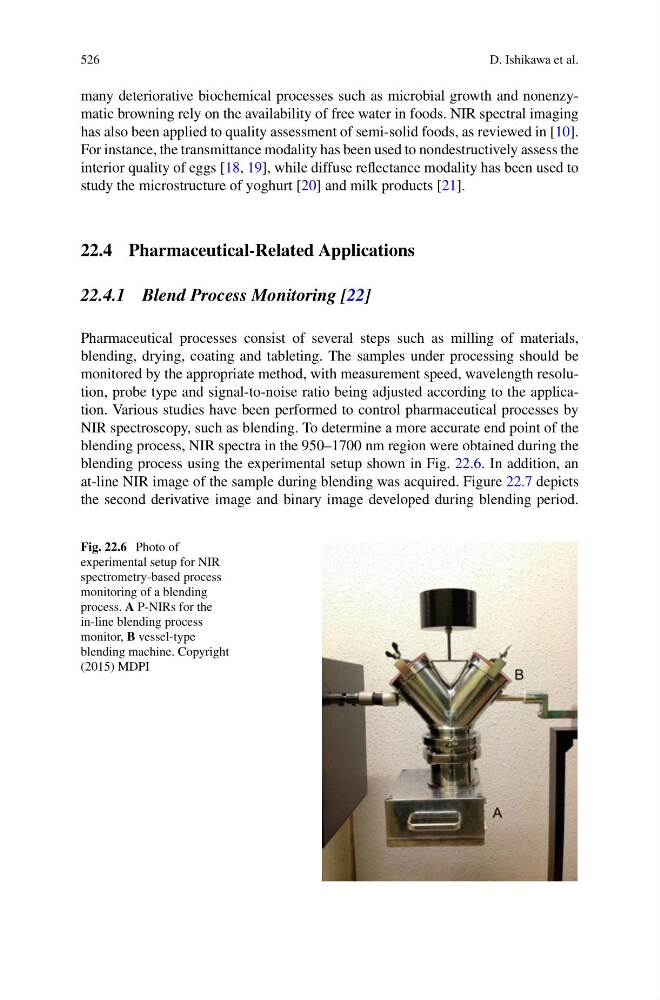
blending process, NIR spectra in the 950–1700 nm region were obtained during the
blending process using the experimental setup shown in Fig. 22.6. In addition, an
at-line NIR image of the sample during blending was acquired. Figure 22.7 depicts
the second derivative image and binary image developed during blending period.
Fig. 22.6 Photo of
experimental setup for NIR
spectrometry-based process
monitoring of a blending
process. A P-NIRs for the
in-line blending process
monitor, B vessel-type
blending machine. Copyright
(2015) MDPI
D. Ishikawa et al.
many deteriorative biochemical processes such as microbial growth and nonenzymatic browning rely on the availability of free water in foods. NIR spectral imaging
has also been applied to quality assessment of semi-solid foods, as reviewed in [10].
For instance, the transmittance modality has been used to nondestructively assess the
interior quality of eggs [18, 19], while diffuse reflectance modality has been used to
study the microstructure of yoghurt [20] and milk products [21].
22.4 Pharmaceutical-Related Applications
22.4.1 Blend Process Monitoring [22]
Pharmaceutical processes consist of several steps such as milling of materials,
blending, drying, coating and tableting. The samples under processing should be
monitored by the appropriate method, with measurement speed, wavelength resolution, probe type and signal-to-noise ratio being adjusted according to the application. Various studies have been performed to control pharmaceutical processes by
NIR spectroscopy, such as blending. To determine a more accurate end point of the
blending process, NIR spectra in the 950–1700 nm region were obtained during the
blending process using the experimental setup shown in Fig. 22.6. In addition, an
at-line NIR image of the sample during blending was acquired. Figure 22.7 depicts
the second derivative image and binary image developed during blending period.
Fig. 22.6 Photo of
experimental setup for NIR
spectrometry-based process
monitoring of a blending
process. A P-NIRs for the
in-line blending process
monitor, B vessel-type
blending machine. Copyright
(2015) MDPI