

524
D. Ishikawa et al.
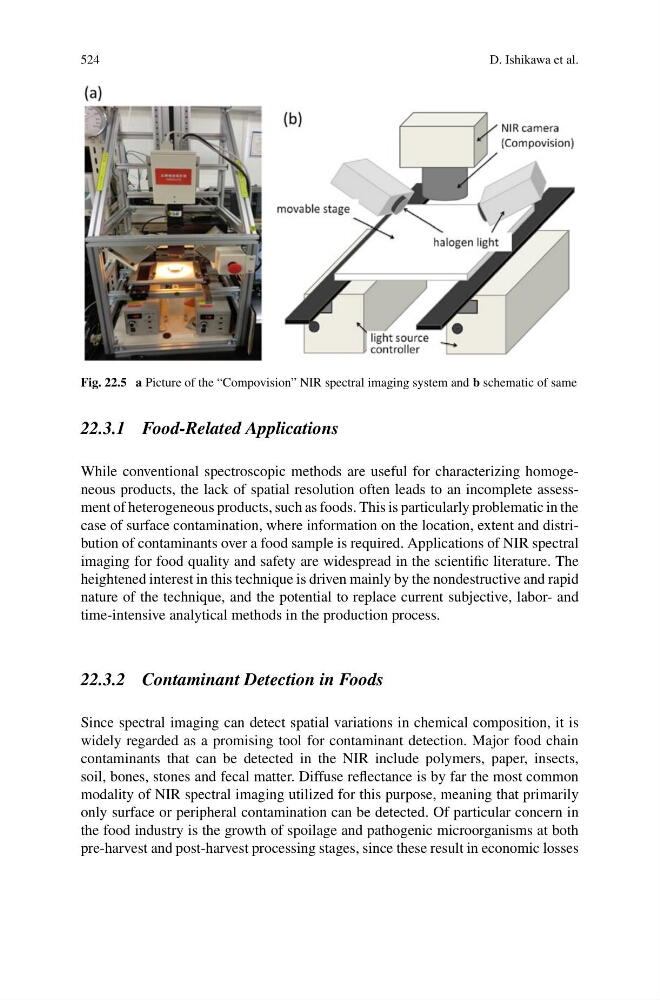
Fig. 22.5 a Picture of the “Compovision” NIR spectral imaging system and b schematic of same
22.3.1 Food-Related Applications
While conventional spectroscopic methods are useful for characterizing homogeneous products, the lack of spatial resolution often leads to an incomplete assessment of heterogeneous products, such as foods. This is particularly problematic in the
case of surface contamination, where information on the location, extent and distribution of contaminants over a food sample is required. Applications of NIR spectral
imaging for food quality and safety are widespread in the scientific literature. The
heightened interest in this technique is driven mainly by the nondestructive and rapid
nature of the technique, and the potential to replace current subjective, labor- and
time-intensive analytical methods in the production process.
22.3.2 Contaminant Detection in Foods
Since spectral imaging can detect spatial variations in chemical composition, it is
widely regarded as a promising tool for contaminant detection. Major food chain
contaminants that can be detected in the NIR include polymers, paper, insects,
soil, bones, stones and fecal matter. Diffuse reflectance is by far the most common
modality of NIR spectral imaging utilized for this purpose, meaning that primarily
only surface or peripheral contamination can be detected. Of particular concern in
the food industry is the growth of spoilage and pathogenic microorganisms at both
pre-harvest and post-harvest processing stages, since these result in economic losses
D. Ishikawa et al.
Fig. 22.5 a Picture of the “Compovision” NIR spectral imaging system and b schematic of same
22.3.1 Food-Related Applications
While conventional spectroscopic methods are useful for characterizing homogeneous products, the lack of spatial resolution often leads to an incomplete assessment of heterogeneous products, such as foods. This is particularly problematic in the
case of surface contamination, where information on the location, extent and distribution of contaminants over a food sample is required. Applications of NIR spectral
imaging for food quality and safety are widespread in the scientific literature. The
heightened interest in this technique is driven mainly by the nondestructive and rapid
nature of the technique, and the potential to replace current subjective, labor- and
time-intensive analytical methods in the production process.
22.3.2 Contaminant Detection in Foods
Since spectral imaging can detect spatial variations in chemical composition, it is
widely regarded as a promising tool for contaminant detection. Major food chain
contaminants that can be detected in the NIR include polymers, paper, insects,
soil, bones, stones and fecal matter. Diffuse reflectance is by far the most common
modality of NIR spectral imaging utilized for this purpose, meaning that primarily
only surface or peripheral contamination can be detected. Of particular concern in
the food industry is the growth of spoilage and pathogenic microorganisms at both
pre-harvest and post-harvest processing stages, since these result in economic losses