

22 NIR Imaging
521
22.2.2 Spectral Image Acquisition
Currently, there are four main ways in which spectral images can be obtained: point,
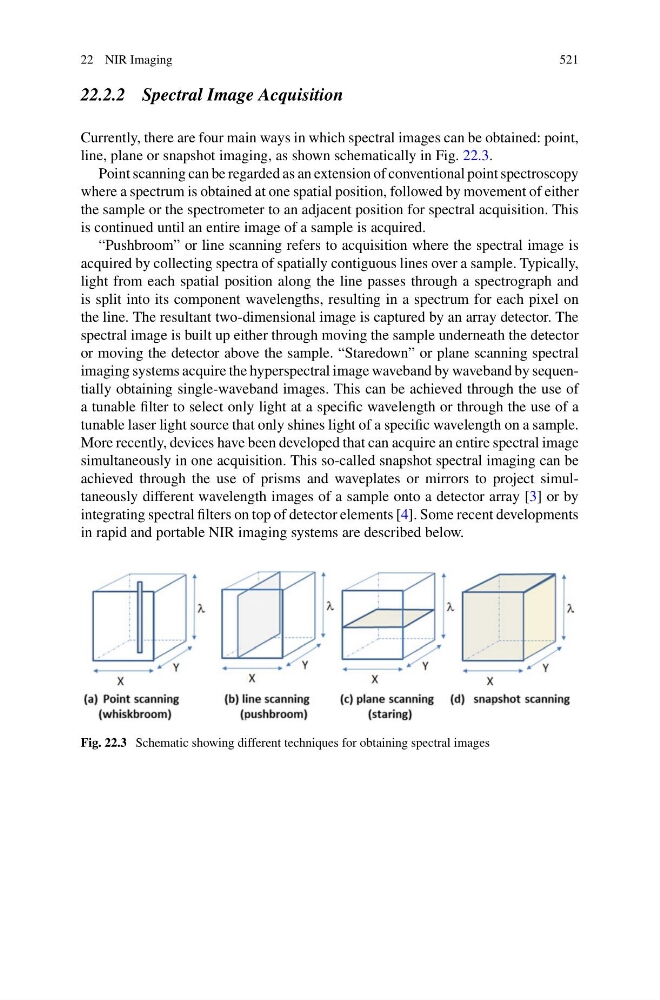
line, plane or snapshot imaging, as shown schematically in Fig. 22.3.
Point scanning can be regarded as an extension of conventional point spectroscopy
where a spectrum is obtained at one spatial position, followed by movement of either
the sample or the spectrometer to an adjacent position for spectral acquisition. This
is continued until an entire image of a sample is acquired.
“Pushbroom” or line scanning refers to acquisition where the spectral image is
acquired by collecting spectra of spatially contiguous lines over a sample. Typically,
light from each spatial position along the line passes through a spectrograph and
is split into its component wavelengths, resulting in a spectrum for each pixel on
the line. The resultant two-dimensional image is captured by an array detector. The
spectral image is built up either through moving the sample underneath the detector
or moving the detector above the sample. “Staredown” or plane scanning spectral
imaging systems acquire the hyperspectral image waveband by waveband by sequentially obtaining single-waveband images. This can be achieved through the use of
a tunable filter to select only light at a specific wavelength or through the use of a
tunable laser light source that only shines light of a specific wavelength on a sample.
More recently, devices have been developed that can acquire an entire spectral image
simultaneously in one acquisition. This so-called snapshot spectral imaging can be
achieved through the use of prisms and waveplates or mirrors to project simultaneously different wavelength images of a sample onto a detector array [3] or by
integrating spectral filters on top of detector elements [4]. Some recent developments
in rapid and portable NIR imaging systems are described below.
Fig. 22.3 Schematic showing different techniques for obtaining spectral images
521
22.2.2 Spectral Image Acquisition
Currently, there are four main ways in which spectral images can be obtained: point,
line, plane or snapshot imaging, as shown schematically in Fig. 22.3.
Point scanning can be regarded as an extension of conventional point spectroscopy
where a spectrum is obtained at one spatial position, followed by movement of either
the sample or the spectrometer to an adjacent position for spectral acquisition. This
is continued until an entire image of a sample is acquired.
“Pushbroom” or line scanning refers to acquisition where the spectral image is
acquired by collecting spectra of spatially contiguous lines over a sample. Typically,
light from each spatial position along the line passes through a spectrograph and
is split into its component wavelengths, resulting in a spectrum for each pixel on
the line. The resultant two-dimensional image is captured by an array detector. The
spectral image is built up either through moving the sample underneath the detector
or moving the detector above the sample. “Staredown” or plane scanning spectral
imaging systems acquire the hyperspectral image waveband by waveband by sequentially obtaining single-waveband images. This can be achieved through the use of
a tunable filter to select only light at a specific wavelength or through the use of a
tunable laser light source that only shines light of a specific wavelength on a sample.
More recently, devices have been developed that can acquire an entire spectral image
simultaneously in one acquisition. This so-called snapshot spectral imaging can be
achieved through the use of prisms and waveplates or mirrors to project simultaneously different wavelength images of a sample onto a detector array [3] or by
integrating spectral filters on top of detector elements [4]. Some recent developments
in rapid and portable NIR imaging systems are described below.
Fig. 22.3 Schematic showing different techniques for obtaining spectral images