

21 Applications of NIR Techniques in Polymer Coatings …
513
63 g m
-2
0 g m
-2
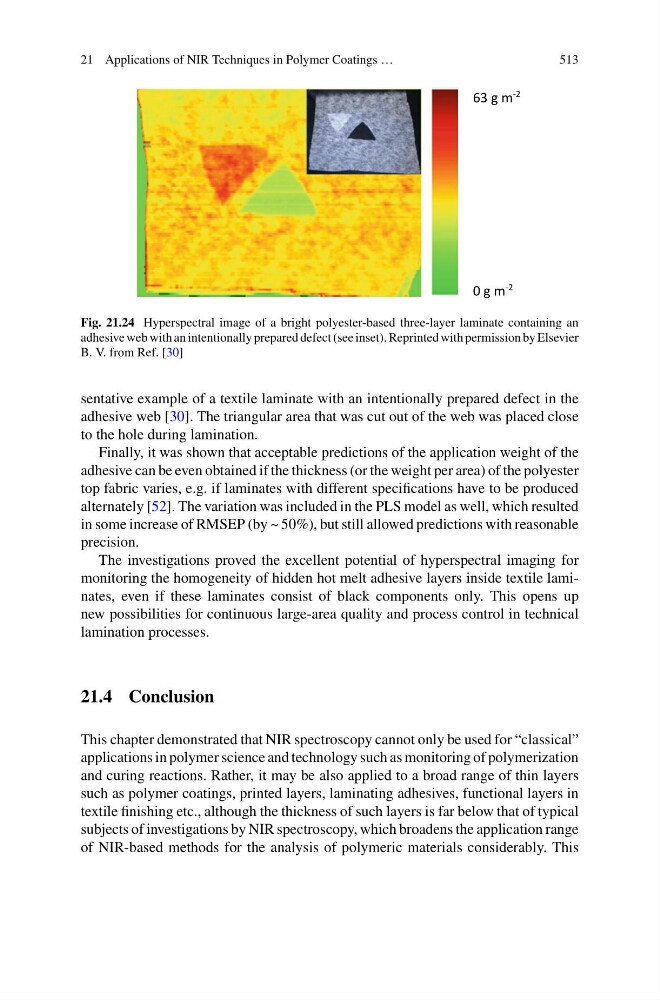
Fig. 21.24 Hyperspectral image of a bright polyester-based three-layer laminate containing an
adhesive web with an intentionally prepared defect (see inset). Reprinted with permission by Elsevier
B. V. from Ref. [30]
sentative example of a textile laminate with an intentionally prepared defect in the
adhesive web [30]. The triangular area that was cut out of the web was placed close
to the hole during lamination.
Finally, it was shown that acceptable predictions of the application weight of the
adhesive can be even obtained if the thickness (or the weight per area) of the polyester
top fabric varies, e.g. if laminates with different specifications have to be produced
alternately [52]. The variation was included in the PLS model as well, which resulted
in some increase of RMSEP (by ~ 50%), but still allowed predictions with reasonable
precision.
The investigations proved the excellent potential of hyperspectral imaging for
monitoring the homogeneity of hidden hot melt adhesive layers inside textile laminates, even if these laminates consist of black components only. This opens up
new possibilities for continuous large-area quality and process control in technical
lamination processes.
21.4 Conclusion
This chapter demonstrated that NIR spectroscopy cannot only be used for “classical”
applications in polymer science and technology such as monitoring of polymerization
and curing reactions. Rather, it may be also applied to a broad range of thin layers
such as polymer coatings, printed layers, laminating adhesives, functional layers in
textile finishing etc., although the thickness of such layers is far below that of typical
subjects of investigations by NIR spectroscopy, which broadens the application range
of NIR-based methods for the analysis of polymeric materials considerably. This
513
63 g m
-2
0 g m
-2
Fig. 21.24 Hyperspectral image of a bright polyester-based three-layer laminate containing an
adhesive web with an intentionally prepared defect (see inset). Reprinted with permission by Elsevier
B. V. from Ref. [30]
sentative example of a textile laminate with an intentionally prepared defect in the
adhesive web [30]. The triangular area that was cut out of the web was placed close
to the hole during lamination.
Finally, it was shown that acceptable predictions of the application weight of the
adhesive can be even obtained if the thickness (or the weight per area) of the polyester
top fabric varies, e.g. if laminates with different specifications have to be produced
alternately [52]. The variation was included in the PLS model as well, which resulted
in some increase of RMSEP (by ~ 50%), but still allowed predictions with reasonable
precision.
The investigations proved the excellent potential of hyperspectral imaging for
monitoring the homogeneity of hidden hot melt adhesive layers inside textile laminates, even if these laminates consist of black components only. This opens up
new possibilities for continuous large-area quality and process control in technical
lamination processes.
21.4 Conclusion
This chapter demonstrated that NIR spectroscopy cannot only be used for “classical”
applications in polymer science and technology such as monitoring of polymerization
and curing reactions. Rather, it may be also applied to a broad range of thin layers
such as polymer coatings, printed layers, laminating adhesives, functional layers in
textile finishing etc., although the thickness of such layers is far below that of typical
subjects of investigations by NIR spectroscopy, which broadens the application range
of NIR-based methods for the analysis of polymeric materials considerably. This